Ever since I began to think about getting a new puppy, I’ve had ideas for topics I wanted to write about: selecting the litter, selecting the individual puppy, first days together, first six months, and more. I’ve also made extensive notes in draft form. And I’ve structured, and re-structured, and re-re-structured the online facility I would use to record all this info.
But for health reasons — a brutal attack of sciatica a few days ago — combined with the usual overwhelming complexities of life, I haven’t felt ready to publish anything, while my notes continue to pile up.
So ready or not, here’s my first post. I’ll try to back-fill with info that’s logically earlier when I have time, and plan a more structured presentation of lessons learned on a separate website as soon as I can get to it. But today’s post is about the topic of most immediate interest to me personally: getting Lightning started on retrieving.
Some background
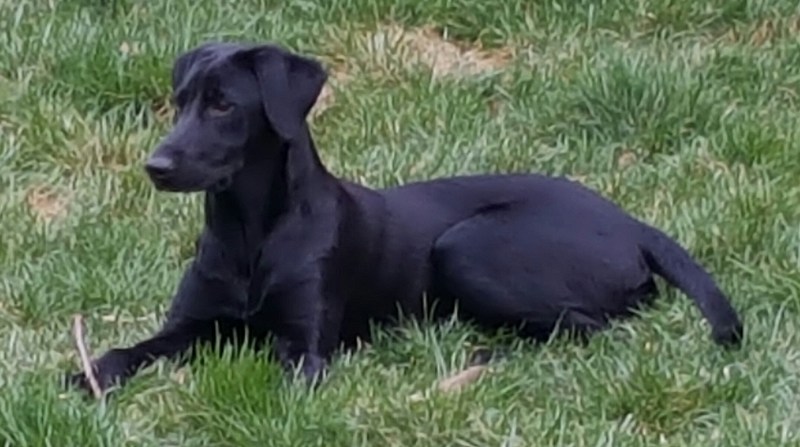
Oh, so a couple of notes: Lightning is the call name I’ve associated with my new boy’s registered name, Shoreline’s Blue Lightning. He’s an event-bred black male Labrador Retriever from the Shoreline kennel in New York. Over the years, my wife Renée has had two show-bred Goldens and I’ve had two field-bred Goldens, but this is our family’s first Lab. Born September 6, 2015, he’ll be training with Laddie, my 8yo Golden.
Positive training
Lumi, my first Golden who passed away this spring at 11yo, and Laddie, mentioned above, were both trained for field competition using my personal definition of “positive training”, and that is how Lightning will also be trained. Different trainers use different definitions of that term. For me, positive training means that my dogs have been trained, and will be trained, entirely without the use of any physical aversives. That means I use none of the aversive equipment used to various degrees by today’s traditional-style trainers — no electronic collar (“ecollar”), no force fetch, no heeling stick (crop), no ear or toe pinch, no choke collar, no pinch (prong) collar, no cattle prod — and of course no shotgun blasts or stick beatings as were used for retriever training in the old days.
Results so far
Lumi was trained for agility and musical freestyle till she was 3yo. Then for health reasons, we switched to field. She took a First place Blue ribbon in her first field competition ever, and ended her career at age 7yo with a WCX from the GFCA and an SH from the AKC. As far as I know, no other dog trained entirely without physical aversives ever achieved either of those titles, and I lost count long ago of the number of times I read or was told that it couldn’t be done.
Laddie also achieved WCX and SH (and also took First place in both of his first two competitions), but since he started field work younger than Lumi and was not prevented from continuing by arthritis the way Lumi was, Laddie then went on to accomplish his MH and to complete many Qualifying stakes in AKC field trials, with six JAMs, an additional two Reserve JAMs, and Third place in a 33-dog trial in the fall of 2015. I plan to continue running him in field trials as long as we’re both physically able.
As with Lumi, I believe Laddie’s accomplishments as a positive-trained retriever are unprecedented. As far as I know, no other retriever trained entirely without physical aversives has ever even run in a field trial, much less earned JAMs or placements.
I often hear of positive-trained dogs who did have some of the same accomplishments as Lumi and Laddie, but when I talk to the trainers, it always turns out they had a different approach to training than mine. For example, their dogs were trained recall or whistle sit with an ecollar, or they were Force Fetched with ear-pinches, or they were taught obedience, line manners, or steadiness with a heeling stick or choke collar. But of course it’s also possible other positive-trained dogs by my definition might have gone as far or further than Lumi and Laddie. I just don’t know about them.
My motivation
[This section is highly personal. Please feel free to skip it.]
It may not be of interest, but I’ll just mention that I have negative feelings as well as positive ones towards field sports. Among the negative ones, first of all, I feel terrible for the birds. To paraphrase a friend, let’s hope St. Peter isn’t a duck. Secondly, I find the sport personally painful. Competition creates a high level of anxiety coming into the event, which I understand is a rather common experience, but I guess most people don’t mind it as much as I seem to. On top of that, I feel a crushing level of emotional distress when my dog and I are not successful, which as with most field trial dogs and many hunt test dogs, especially beginners, is most of the time. My despair at the end of an unsuccessful event can last for hours and even days, and compounded with the loneliness I also experience, those emotions are, from what I understand from conversations with friends, much harder on me than is typical. Another negative about the the sport for me is that it is an enormous drain on resources: time, money, and as I mentioned, emotions. This means that I’m diverting resources from my family’s future, and that naturally induces some guilt.
But obviously all of those negatives must be overbalanced by positives or I wouldn’t keep competing. The biggest such positive is the dogs. Dogs bred for retrieving just love this game, and the level of joy a good dog exhibits in training and competition is enough to burst your heart. I cannot describe it in words, but if you’ve watched retrievers training or competing, you may know what I mean.
The second reason is the people. Gosh, this sport has some wonderful people! It’s funny because in many cases we are from different tribes socially. But our love for our dogs. and having our dogs participate in this sport which means so much to them, brings us humans together in magical ways as well.
My last reason is the most personal, and here it is: I just want to know how far you can take a positive-trained dog in AKC field trials. Maybe I’ve already learned the answer to that with Laddie. Or maybe Laddie will go further in the next few years, or Lightning will eventually surpass him. But whatever the answer is, it is an answer that will outlive me and outlive all of us. Never again will anyone be able to say, “It can’t be done.” That’s important to me.
Dumb reason, eh? Well, now you know a little about what makes me tick, and maybe even more than you ever wanted to know. Sorry. :0)
Before today
I picked Lightning up a week ago, and have hardly been able to sit up or stand up since then because of the sciatica attack I mentioned. But of course Lightning and I have had plenty of interaction. In fact we have been together practically 24/7. He sleeps in a crate sitting on a coffee table next to the couch I sleep on, so we’re at eye level to each other, and I usually keep the crate door open. I guess between that and his breeder’s preparation, he hasn’t really needed any crate training in the house. I set up two side-by-side crates in the back of my Honda Odyssey, one for Laddie and one for Lightning, and Lightning has so far never been in his when Laddie wasn’t in his, so when I’ve left them alone for short times, for example for my doctor visits, I guess he was fine. I didn’t hear any noise leaving the vehicle or coming back.
Lightning’s house training hasn’t been quite as successful so far, since he seems to have no inhibition from peeing or pooping on carpet or hard floor, with the exception of when he is in his little crate next to me or when he is crawling around on top of me on the couch. Renée has been wonderful about taking him out frequently, where he eliminates as needed. In the middle of the night, I am able to limp to the front door and let him outside to pee if he wants to. At 8-9 weeks he is no flight risk and comes back to the door within seconds to be let back in.
We’ve done a little other training. I tried having him retrieve a variety of toys indoors but have seen little motivation. I suspect he’d chase certain articles in the yard but I’m not physically up to it. Besides, I don’t want him to develop any history for retrieves that breakdown without returning at least part of the way back to the handler, which would mean having him run on a check cord, and the check cord I purchased for him has a bronze snap that our holistic vet says is too heavy for him right now. I guess I need to order him a new one for now, but everything’s so complicated when you can’t even sit up!
Anyway, I also charged the clicker yesterday with about twenty treats. “Charging the clicker” is a term used by clicker trainers that means creating a classical, or Pavlovian, conditioning between the clicker as secondary stimulus and treats as primary stimulus. The dog learns at an unconscious level that clicks predict treats. In our short session, Lightning began alerting to the click and looking for a treat in fewer than ten clicks, so the clicker has been charged for Lightning. That means I can use a click to provide instantaneous feedback to Lightning when he has done something I wish to reinforce, making the behavior more probable under similar context in the future, with the click acting as a bridge, or secondary reinforcement, that will invariably be tied to some primary reinforcer, generally a treat in the early training. You can notify the puppy of a desired behavior with much better timing using a clicker than trying to feed the treat at the split-second of the desired behavior. Alternately, you could use a verbal signal instead of a clicker, but at the possible cost of diluting its reinforcing value since most such stimuli are likely to not be tied to treats or other primary rewards in most occurrences.
Anyway, in addition to beginning clicker training, we’ve also played a ton of tug. I like tug for retrievers for several reasons, one being that it’s used for building drive in Schutzhund dogs, and I consider drive to be highly desirable in a retriever. I know that Susan Garrett and other agility trainers also use tug in training high-end performance dogs in their sports.
Lightning and I sometimes play tug with toys, but unfortunately for me, quite a few of our tug games occur with my fingers, hands, and toes as well. Luckily I am a very brave and fearless dog daddy, and I know in my heart that this too shall pass.
I’m sure I’ve left some aspects of our first week’s training out. For example, if the crate is closed, I won’t open it unless Lightning is quiet and sitting, so we’ve made a start on self-control. Not a big deal in this case, since Lightning’s never especially worried about getting out, but it happens occasionally so it’s a start. In addition, we do have an xpen, but he’s only been in it a few times, given my laid up condition.
Anyway, that’s enough about non-retrieve training for now, I guess.
An invitation for comments
Which reminds me of something I wanted to mention before I go further. You as a reader may have some thoughts, and dare I say it, maybe even some suggestions or criticisms. Regrettably I am somewhat thin-skinned, but in the interest of science, I do invite your thoughts.
However, keeping them all together will be a challenge. Some of you may reply on this website. Others on DogTrek or PositiveGunDogs, the two Yahoo! groups I currently follow. Others still on Facebook. And others, if you wish, via email: LDRidgeway at gmail. It would be nice to keep the comments all together, but I know if I ask you to use one particular method some of you won’t, so never mind. In a hundred years they’ll get this all worked out. Maybe we’ll all use machine-enhanced telepathy by then.
If you’d really like to keep your comments where everyone reading this blog can see them, I’d suggest you use the comments feature of this blog, rather than commenting on Facebook or one of the Yahoo! groups. If you have something you’d like to say to me without making it public (at least initially, given my sensitivities), please feel free to use email or a messaging system such as texting or Facebook messenger. We can transcribe to the comments on this website if we both agree to later.
Today’s session
Thanks to some new meds I got last night, I was able to sit up for a few minutes at a time today, and was thrilled to try out my latest thoughts on some intro to retrieving (yes, 2000 words later, we finally arrive at the topic of this post). By now I’d decided that I don’t know how to get Lightning to chase and retrieve indoors, but I feel that I do know, from more than a decade of training Lumi and Laddie, how to shape a behavior. This would not be a full “Trained Retrieve”, as well-known field trainer Alice Woodyard uses the term. That is, I’m not trying to back-chain the three commands that comprise deliver-to-hand, namely “Out-Hold-Fetch”. I plan to train that back-chain some months from now, after Lightning completes teething, using a positive version of the Trained Retrieve. I don’t feel too concerned about waiting that long; renowned field trial guru Mike Lardy also trains the Trained Retrieve (Force Fetch) after many other intro skills, and I believe he also waits until after teething.
No, at this stage, I’m not worried about deliver-to-hand, which in any case I believe is somewhat aversive to a young dog and would only discourage that most critical and yet most difficult of all skills, the field recall. I just want to see Lightning race out after a thrown article, pick it up, and race back. I’ll worry about delivery later.
And I know there are a zillion ways to train such a basic retrieve. In fact, I seem to recall that Laddie just did it naturally, but that was a long time ago and a lot of things might have been different in the way I was training it with Laddie. Lightning also showed that behavior when I put him in a enclosed area with live birds during the puppy testing I did a week ago.
But since that approach wasn’t working with inanimate objects indoors with Lightning, and training outdoors wasn’t an option today, here’s what I did instead. First, I cleared an indoor area for us to work. No other humans, no other dogs, no toys on the floor, no lawnmowers outside or other loud noises in the environment, no wind or scents. In a word, no distractions.
Secondly, I requested some treats from Renée’s stash that she’s been using with Ryley, her Golden, so I’d have some treats to use for Lightning with my clicker. The treats she gave me turned out to be good from a high-value reward stand-point, but they were too crumbly for my work with Lightning. After a few reps, the crumbs on the floor became a distraction. For our second and last session, I switched to little dabs of PB on my finger from a jar. Next time I think I’ll try to pick up some hot dog slices or deli meats. My shopping cart would never tell you we’re vegetarians!
Thirdly, Lightning wore no check cord for these indoor retrieves. The check cord will be for later, when we’re outside. For clicker training inside, any clicker training, I better be the most interesting thing in the dog’s environment or I’m doing something wrong.
The next question was, what to use as an article? In theory, I guess, you might reserve one toy just for this game. But here’s another theory: Keep experimenting until you find a toy the dog actually wants to interact with. That’s the route I took, and once I found such a toy, we were able to use it for two sessions. It may never work again, we’ll see. As I said, I’m not a purist. I’ll again let Lightning decide.
Next question, how many retrieves? I’ve heard from friends I totally trust that I should limit a small pup to 1 or 2 retrieves per session. That might be OK outside, but the fact is, you can’t shape a behavior with a clicker that way. I’d say I used about 15 reps for the first session, then a ten minute break, then another 10 reps. I’ll probably do another session tonight. As I mentioned above, I don’t love competition, but I love training!
Oh, also, as our first session began, Lightning had not eaten in a couple of hours, and had had a nice nap afterwards, so he was feisty and could hardly wait to start playing. Also, Renée was kind enough to take him outside for me before disappearing herself. You always want an empty dog to train, not one who’s looking for somewhere to eliminate.
So now for the training. First I charged the clicker three times. That’s a trick I learned from well-known clicker trainer Helix Fairweather. I didn’t want to do it too much because I wanted Lightning to be hungry while we’re working, but I think Helix is right that it facilitates clicker training to charge the clicker each session, or frequently in any case.
Then I tossed the article. As I mentioned, that didn’t work with the first few articles I tried. But soon I discovered an article that Lightning found exciting, and he pounced on it. Click, treat!
When I repeated it with the same article, he didn’t pounce immediately, so I made it come to life, tossed it again, and so forth till I got another pounce. Click, treat!
By the way, as I mentioned earlier, I’m not a purist. If you don’t want to call this “shaping” because I was interacting with the dog by making the toy come to life, that’s up to you. This is how I shape.
In any case, we repeated several more times. If Lightning were being self-reinforced by the retrieve itself, he would not have needed the treats. And I feel sure that time will come, given Lightning’s breeding. But for this session, the treats were playing the role of primary reinforcer. By the end of the first session and my first batch of treats, Lightning didn’t hesitate. I would put down the article, and Bam! my boy would pounce on it. At the instant of each pounce: Click, treat.
I then took a short break to search for a more suitable treat, finally settling on a jar of PB as I mentioned before. And good news, Lightning’s work exhibited no backsliding for the second session. As soon as we started, Lightning immediately began pouncing on the article again.
Is it obvious how I’ll extend this kind of work into the kind of basic retrieves we’ll need for a club training day a few weeks from now? Well, I can’t be sure myself. But let’s see what I come up with for my next post.
Until then, thanks for hanging in there for 3500+ words. You’re the best!
Update
Although my leg has just about had it for tonight, I just had to try Lightning out on one more session, in this case, ten more reps. Good news: even after several hours delay, Lightning instantly pounced when I tossed the article for him. He continued to do so throughout the session, even as I lengthened the throws to 8-10 feet, as much room as I have available in my rehab area.
It was obvious in this third session, by the way, that Lightning wasn’t just pouncing in hopes of getting the extrinsic reinforcement of the bridge (that is, the click) and the taste of PB. He was owning that toy! That is, he was already discovering in himself the intrinsic reinforcement of retrieving. For me, that’s the ultimate training system, what I call “discovery training”.
Seeing how the third session went, I think Lightning’s ready for us to begin to shape a pick-up. I’d love to do it tonight, and I think Lightning would go for it. But my body is screaming No Más, so we’ll have to leave it where it is. Meanwhile, maybe Lightning will have some nice dreams tonight about growing up to be a real working retriever some day. :0)
Update 2
I had to fix some typos introduced by my spell “checker”, and while I was at it, also performed some fairly extensive editing.
 Lightning's Journal