[This post was started when I first got Lightning, but I didn’t finish it and publish it till January 1, 2016. I thought it would be placed in Lightning’s journal based on when I published it, and that guided my wording to some extent. But it turns out that WordPress positioned it based on the date of the original draft, making it the first post in the journal. That’s actually a better placement based on the subject matter, but may have resulted in some confusion in the text, for which I apologize.]
On November 2, a friend and I went for a drive with Laddie, my adult competition Golden. We brought along a small carton of live birds my friend had obtained for us. The day had come for me to pick up my new puppy. We drove several hours to the breeder where I’d be selecting the puppy and bringing him home.
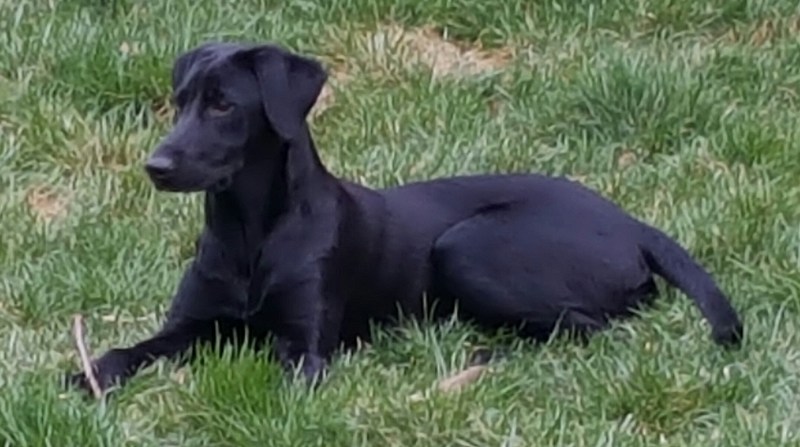
I already knew that his registered name would be Shoreline’s Blue Lightning, that I would call him Lightning, and I knew he’d be one of four male puppies I had the opportunity to choose from.
I’m no expert, but I thought I’d share the approach I used to selecting my new puppy.
- Over a period of months, I selected a litter based on the pedigrees of the parents. I think it would be more logical first to select a breed, such as Golden, Chessie, or Lab, and most people probably do. But I actually had a compelling desire for either a Golden or a Lab, so for me, it was a matter of waiting until a litter of either of those breeds with the kind of pedigree I was looking for came along. It so happened that it turned out to be Lightning’s breeding, and he’s a Lab.
- I did not rely on advertising. Finding the right litter for me turned out to be a matter of networking with friends, for both Laddie eight years ago and for Lightning this time.
- I also had friends, including a few pros, look at the pedigrees for litters I was considering and give me their thoughts before I made my decision.
- I was looking for an event-bred retriever, one whose pedigree showed a consistently high degree of competitive success in field trials. That is hardly the only basis for selecting a puppy. It was just what I was looking for.
- Equally high on my list of considerations was a concern for genetic health factors such as OFA hip and Optigen DNA clearances of the parents. I also wanted a pup who was EIC clear.
- Once I had decided, I reached out to the breeder. Luckily, making contact with Lightning’s breeder was easy. In fact, we had trained together in the past and she remembered Laddie and me, as well as my unusual approach to training and the success Laddie, and Lumi before him, had had. So I was fortunate that she was amenable to me purchasing one of her puppies from the litter I had selected. My travels enabled me to visit the puppies twice over a period of weeks, and then I made arrangements to come and make a selection when they were eight weeks old.
- Opinions vary on the correct age for a puppy to go home with his or her new owner. It’s generally at the breeder’s discretion. From my reading, eight weeks seemed like a good time and I was glad that’s what the breeder had decided on.
- The last step was selecting a particular puppy from the litter. In Laddie’s case eight years ago, I was not given a choice; the breeder matched puppies to new owners, a practice some breeders prefer. But with Lightning, I had the opportunity to spend some time with the puppies and express my preference.
- That’s where the live birds that my friend and I had brought along came in. We had quail and a chukar. We put the puppies and some of the birds in a small room, both as a group and individually, to see how the puppies interacted with the birds. The puppy I selected was the one who showed unhesitating boldness and a natural instinct to drag the bird back toward a person standing nearby rather than trying to chew it. That bird test was the primary basis I used for selecting Lightning.
- That’s hardly the only approach. Several standard puppy testing systems exist, and also the advice of the breeder or another expert can guide the selection. In fact, I had all of those, and by a happy coincidence, they all led me to the same puppy.
Over a period of years, I had developed detailed plans for training a retriever puppy starting from the first day we got home, the plan I call Positive Retriever Training (PRT). But unfortunately, I was struck with a spinal injury the night of our drive home. I was barely able to sit up, much less stand or walk, and I ended up having to delay Lightning’s training by several weeks.
But beginning in mid-December, we embarked on the training, and I have been recording our progress in this journal. And with this post, I’ve gone back and described how the journey began.
 Lightning's Journal