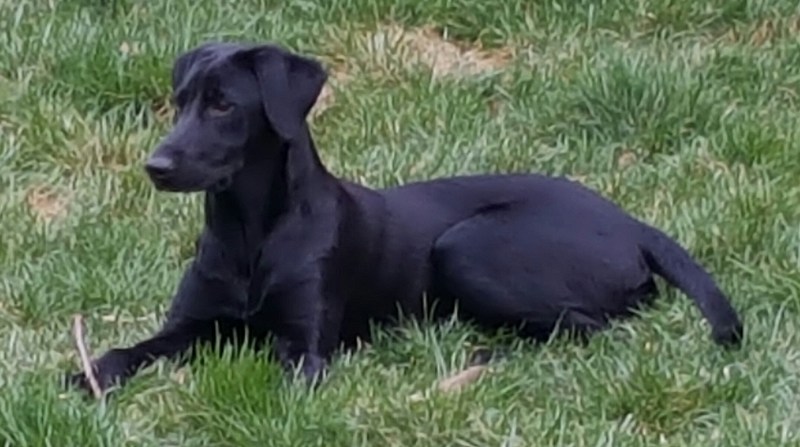
Gunner-thrown marks

Since Lightning has only been learning to retrieve for about a week and a half, of course he doesn’t completely understand the retrieve pattern. When I tried to run him on setups with gunner-thrown marks too often in a couple of earlier sessions, he became confused about his returns and began bringing the bumper to the thrower instead of back to the handler at the start line.

Realizing that I had not broken the return concept down enough, today we used a plan where Lightning was able to practice retrieving gunner-thrown marks without that confusion. I had brought two assistants, Liza and Peter, so I actually stayed in the van to avoid straining my back and legs, still recovering from my spinal injury, while they did all the training. Here’s the plan I provided:

  • Lightning, as usual when we work on outdoor retrieves, wore a 15′ check cord.
  • Peter stood at the start line, using the check cord to restrain Lightning till the bumper was thrown. For simplicity, and to maximize motivation, we’re not working on any sort of steadiness yet, just relying on the check cord for restraint. Lightning is released as soon as the bumper is in flight.
  • The target spot for all throws, from both Peter and Liza, was planned to be 20y from the start line. Let’s call the direction of that target 12 o’clock from the start line.
  • Liza was 30y from the start line, in the direction of 10 o’clock. That means she was throwing LTR to the target. Peter, Liza, and the target spot formed a triangle, approximately equilateral.
  • The key to this stage of the training was that Liza was almost invisible to Laddie. I had planned to use a location with a shrub or tree for her to hide behind, which this location turned out not to have without Liza having to step into swampy terrain. But she happened to be wearing a long coat the same color as the trees, and when she turned her back so that her face was not visible, she was entirely camouflaged.
  • Another key was that I did not assume, once Lightning had picked up one of Liza’s throws and then returned to Peter at the start line, that all confusion was gone and from then on all the marks could be thrown by Liza.
  • Instead, I requested that Peter make the first couple of throws, which I believed Lightning would retrieve correctly, and he did. Then Liza and Peter would alternate, so that Lightning would get to practice a gunner-thrown mark, but then immediately receive a refresher on his earlier experience with a handler-thrown mark. Occasionally Liza might throw two marks in a row, but no more than that without a throw from Peter.
  • Altogether, they threw about a dozen marks. Lightning’s performance was just what we hoped for, never once even considering a return toward Liza but instead every time grabbing the bumper and heading straight back toward Peter.
  • Peter would then use the check cord to capture Lightning near the start line, wait for him to drop the bumper, and then, as quickly as possible, the next thrower would call hey-hey-hey and throw.

By the way, it turned out that because Peter was actually throwing about 30y, the target spot was beyond the flat area where we had planned the bumper to land, and instead in a shallow ditch, making the bumper invisible once it had landed. Liza saw where Peter was throwing to and made her throws to the same spot. The first time Peter made that throw, Lightning ran in the correct direction but hunted a couple of yards short, unable to find it. After a few seconds, Peter went out to pick up Lightning’s check cord, then took another couple of steps to pick up the bumper as Lightning watched. Ah, so that’s where it was! Lightning never had a problem with the disappearing marks again. He ran the correct line but no longer hunted short. Instead he continued full speed into the depression, grabbed the bumper, and immediately turned back toward Peter, no matter who had thrown the mark.

Though not part of the original plan, I think this was a good step in strengthening Lightning’s confidence in running marks, discovering repeatedly that if he ran in the direction of where he had seen the mark fall, it would be there waiting for him when he got there. Naturally I prefer Lightning taking a straight line to the mark to a strategy of running to the general area of the fall and hunting, or running toward the gunner and then veering over to the mark.

I might mention that in these sessions, Laddie is also getting some work, for example a double plus a keyhole blind, or a double momma-poppa, that is, both gunners throwing two marks, one to the left and one to the right. The work is interesting and hopefully helpful to Laddie’s continued development, but I won’t always take the time to describe it in these posts to Lightning’s journal.

We plan to train again tomorrow, New Year’s Eve. Lightning’s work, at least in the first set of marks, will be the same as today’s, but with Liza throwing RTL this time so that Lightning doesn’t become out of balance in the direction the throws are coming from.

If he is again successful, we may do a second set where Liza begins to make herself visible during part of the work, until eventually, Lightning will always return to the handler at the start line even when gunners, and eventually other distractions, are visible.

For this training, the key will be not to rush into adding complexity to the work, avoiding a situation where Lightning again becomes confused about where to return to. Today was a good step in that direction.

Proofing Sit and Here together

Behaviors the dog learns in the training room will require extensive proofing before they can be used in competition. A typical series of proofing locations might be:

  • Other rooms of the house
  • The yard immediately outside the house
  • An enclosed area away from the house, such as a tennis court
  • An open field
  • A field in the vicinity of a training day, but away from the other dogs and people
  • A training day with other dogs and people, simulating competition as much as possible
  • Competition

Here is a way to work on proofing both Sit and Here for such a progression of locations:

  • Cue Sit (see earlier post on how to train this cue). The dog may need to be retrained this cue in new locations, so patience is essential.
  • Back away one step, then quickly return to the dog.
  • If the dog moved toward you, speak gently to give assurance that it’s OK, but don’t reinforce with a treat. Then try again. You can maneuver the dog with hand gestures back to the original position but it’s not necessary. Instead, you can just start again from the dog’s new position.
  • When the dog stays in the sit as you step backwards, quickly step forward again and reinforce with treat and encouragement.
  • Continue in this way until you can step backwards several steps.
  • Also, without stepping backwards, turn around in place, so that for an instant your back is to the dog.
  • As the next step in your training, after you have backed away, instead of coming back to the dog, cue Here. I like to do this with enthusiasm, so that the cue itself shows your pleasure in the dog’s good Sit and acts as an immediate reinforcer. Then, of course, when the dog arrives in front of you, reinforce with a treat and perhaps more words of encouragement.
  • As you extend the distance for this game, you can also introduce a bit of hide-and-seek by gradually creating the situation where you move out of the dog’s sight, and the dog hears you call Here from out of sight. I’ve found dogs seem to love this version of the game.
  • Splashing thru puddles, and swimming across channels once the dog has learned to swim (to be discussed in a later post), are further important location-proofing facets.

So this provides a game you can play in a series of increasingly challenging locations to proof both the Sit and the Here cues.

Besides location proofing, another kind of proofing is also essential: distraction proofing. So as you proceed with location proofing, you also need to introduce distractions of increasing difficulty, such as food bowls, rolling or flying tennis balls or bumpers, duck crates, and other people and well-behaved dogs, both still and moving.

The skills of Sit and Here are so difficult in the context of a competition retrieve that it’s possible no amount of proofing will complete the training needed for that work, and you even occasionally see well-trained and experienced field retrievers fail either of those cues in competition or a training day. But a thorough proofing with this game will lay a foundation for both cues that you can build on as they are merged into retrieve training.

[Note: This post is not specifically about Lightning and will eventually be moved, perhaps with edits, to the PRT website still under construction. But I might mention that this is one bit of dog training that seems to work fine if I let Laddie train alongside Lightning. It’s way too easy for Laddie, it uses twice as many treats, and it’s conceivable I’ll find that Lightning is not learning the skills as well as if he were training alone. But it tugs at my heart to lock Laddie away, especially while he can hear me training Lightning, so at least in the early training I’ve let him join us in the game.]

Tug

The game of tug, short for tug of war, is widely taught and used by positive trainers for dogs who participate in many activities. You can work with the dog to the point where tug becomes a powerful primary reinforcer, so after a successful trial in a wide variety of trained skills, you can offer a game of tug to reinforce the performance and make that version more probable in the future.

But before I continue, a disclaimer: I have found that some traditional trainers do not think you should teach a dog to play tug, much less actually play the game with them. I’m not sure why. An obvious possibility is that they believe it increases the risk that the dog will develop a habit of sticking (reluctant release) or even freezing (refusal to release) on delivery to hand. Sticking and especially freezing are serious flaws, and I’ve heard that they can be so difficult to repair that they can end a dog’s career.

If that’s the concern, then it may be true for some dogs, so please stay alert if you decide to train the game anyway. But my experience with the small number of dogs I’ve trained is the opposite. Over time, the dog and I achieve a long history of playing tug, with an evolving understanding that when I stop playing, that round is over and they release, with a high probability that I will then immediately initiate another game of tug, or provide some other high value reward, to reinforce the release.

On the question of whether you should always, or never, let the dog win, my experience is that it doesn’t much matter. I believe that tug simulates two dogs working cooperatively to tear apart a large piece of meat, so I believe it is the game itself that acts as a reinforcer, not how it ends. That said, it may be useful to let the dog win in the early training to help her engage in the game until she discovers within herself the pleasure of tugging itself.

Training tug:

  • Select an article the dog has a natural, previously displayed inclination to hold onto when you reach for it in her mouth. It is an uphill and possibly losing battle to try to train tug with an article you think would be good for the game but which the dog has little inclination to play tug with.
  • For each trial, entice the dog with the article, for example by swinging it a few inches over the floor or snaking it in front of the dog.
  • When the dog grabs it, lightly resist giving it up, then let go. Over time, you’ll be able to increase how hard you pull against the dog to virtually full strength and engage for several seconds per trial.
  • An advanced version of the game is to swing the dog around on a circle fast enough that the dog’s rear legs lift off the ground. I never got that far with either of my Goldens, perhaps because Goldens have much softer bites than the Schutzhundt dogs that trick is sometimes taught to. I’ll have to see whether Lightning will be able to do it when he’s older.
  • Another advanced version of the game consists of holding the article behind your back and then putting it in one hand and suddenly pivoting your body to left ot right to reveal the article. The dog must now grab it in the blink of an eye or you pivot back and she loses the opportunity. This trains her to seize the opportunity without delay, which I suppose is vital for police dogs, with whom this game is played. I’m not sure I see such a reflexive response as important for a field retriever as a skill per se, but it does seem to increase motivation, which is always a good thing.
  • In Lightning’s first session, I experimented with a number of articles that didn’t work. At last I found that he would engage with the rope of a 2″ bumper. We played for about 20 trials. His motivation gradually increased as he figured out the game, but he never became highly motivated. Perhaps he needed more practice, or other conditions, such as play room distractions or being a bit tired from earlier play, were in effect. By the second session, he was just as happy to grab the bumper itself, rather than the rope, and his motivation was significantly higher.
  • Eventually you will want to train a release. That’s actually part of the Trained Retrieve, and that component is cued by various trainers as “out” or “give”. I’ve even heard the cue “leave it” for this purpose. In any case, it doesn’t need to be trained at this time. You can just let the dog win.
  • Alternately, if you stop tugging but just refuse to let go, the dog eventually becomes bored and lets go. It could take minutes the first few times. But if you instantly reinforce the release with a high value reward, possibly another game of tug, the dog will release sooner and sooner without the need for a verbal cue, until the dog simply reads your body language and releases almost as though reading your mind. That skill can extend to field work. Both of my Goldens generally released the bird on delivery to hand without a verbal cue, though I did train “Out” when we worked on the Trained Retrieve. We’ll discuss that in a later post, since it will be after teething.

Sit on cue, plus remote sit

My grandson Gavin is visiting for Christmas. The combination of a 5yo (his birthday was yesterday) and two puppies is explosive, but they’d had a day to get used to each other. So when Gavin asked if we could train Lightning, I thought this might be an opportunity to get help with some indoor clicker training.

Next up on my training queue was Sit, so we’d train it first with a visual cue, then with a verbal cue. I didn’t know it, but we’d also end up training something special I hadn’t planned for the first session.

I experimented with letting Gavin do the clicking, his preferred task, but he couldn’t get the timing right. After a number of late clicks, I gave him the new job of feeding treats. Eventually I also had him try giving the verbal cue, with some success.

I you perform an online search, you’ll probably see a number of approaches for clicker training a sit. We used this one:

  • Gavin tore up some sliced ham into small pieces, about inch-square, which we would use as our high value treats.
  • I recharged the clicker: click-treat three times to kick off the session.
  • With my empty hand in a cupped shape, I moved around until Lightning was on his feet, then moved my hand over his head, palm up. He followed it with his eyes, which caused him to sit down. Click treat.
  • I repeated that a couple of times, and then tried the gesture without actually moving my hand over his head. He sat down. Click treat. Now we had a visual cue for Sit.
  • I said “Sit” and waited a second, then used the visual cue. He sat. Click treat. I repeated that a few times, and soon he began to sit as soon as I said Sit without waiting for the visual cue. Now we had a verbal cue.
  • Dog minds are different from ours in many ways, and one of those is that when they learn something, they learn the entire context, not just what we consider salient. As a result, Sit, like any other cue, would need to be proofed for both location and distractions. It might even need to be retaught in several locations before the dog generalized it.
  • So Gavin and I refreshed our supply of treats, providing a valuable break in the session.Then we moved around the play room, practicing verbal Sit in one location after another. I usually gave the cue and clicked at the moment Lightning sat down. Gavin dispensed the treats.
  • I soon noticed that having Gavin giving the treats meant that Lightning did not need to be responding to the Sit cue while physically close to me, nor in a “front” position. He could be in any part of the room, facing in any direction, when I cued Sit and clicked, and would not be motivated to come to me for his treat because Gavin would be right there. So now, though I had not planned it, we had a remote Sit. That may or may not have much value for a pet dog or in some dog sports, but it’s hugely valuable for a field retriever because it’s a key component of handling skills. In time, Lightning will be cued to sit hundreds of yards away from where I’m standing. We had now laid the groundwork for that skill. In fact, no reteaching had even been needed. Lightning had come to understand Sit as a remote cue in his first session.

Of course we’re not done with proofing Sit by a long shot. Lightning will be practicing that cue for the rest of his life, and if he’s like other dogs I’ve known, he’ll even forget what it means occasionally, despite my best efforts to reinforce it consistently and my attempts to make it reflexive. After all, dogs are always basically guessing at what we mean by our attempts to communicate. Sometimes they draw a blank or guess wrong, and of course sometimes the context they are in produces a different outcome than we intend.

Nonetheless, Gavin and I had given Lightning a good foundation for Sit in our training session on Christmas eve. I think it was fun for all of us.


Longer marks (with video)

For today’s training session, we had limited time and only one assistant, Peter. I decided to use those resources as follows:

  • We would drive to a nearby ball field, large, isolated enough that we could use the blank pistol, and likely to be deserted or nearly so. A woman was playing with her daughter on a swing set far from where we’d be working, but no one else was there, so we had a good location.
  • I asked Peter to throw a double for Laddie, moving from one gun station to the other, while I handled Laddie from a chair. The terrain was flat, but the marks had good distance and some trees to negotiate, and of course the memory bird was retired since Peter stayed over at the go-bird station. Laddie took a slightly outside arc on the go-bird, a straight line on the memory bird, but ran directly to both marks. Hopefully this is helping him restore his endurance and have a little fun.
  • Peter then put Laddie in his crate and brought out Lightning. For Lightning, I had three goals:
    1. Start training with white bumpers rather than the various other articles we’ve been using. We’re sticking with 2″ bumpers for now.
    2. Stop depending on the check cord to guide Lightning’s return. The cord is there to help catch him if necessary, but at some point he needs to return without being guided.
    3. Begin to stretch the length of his retrieves.
  • The training plan was simply to address those goals one by one, each building on the one before. Peter did all of the work and did a fine job. For example, even on his long throws, he kept them low so that Laddie wouldn’t lose sight of them in flight.
  • In all, Lightning ran about 20 retrieves. He looked like he’d gladly run a thousand more, but we’ve been having success with short sessions and stayed with that approach today.
  • I managed to get a video of a couple of Lightning retrieves once we reached the point where Peter was throwing the bumper good distance. Unfortunately, my voice sounds terrible, but I think it’s fun to watch Lightning’s work. So here’s Lightning retrieving at 3mo:

Hand touch

Some time ago I worked with Lightning to charge the clicker, a series of click-treat pairs until Lightning realized, visible in his reaction to the click, that a click predicts a treat.

Today I used that work as the basis for a simple, fundamental skill: training Lightning to touch his nose to my hand when I present an open palm. No verbal cue is used, just the visual cue.

Training this skill is simple. I started by tearing up some pieces of sliced ham, since I wanted to use a high-value reinforcer. [I think training with anything less than a high-value reinforcer is a waste of time.]

Next, I sat on the couch in our TV room, where Lightning spends most of his days. Both of our family’s Goldens were nearby. Ryley was in his crate in an adjoining room, and Laddie was lying on the floor a couple of feet from Lightning and me. Both are clicker-trained and both like sliced ham, so I wasn’t sure we’d be able to work in that location, but they ignored us so it was fine.

The room is also littered with dog toys, but again, all of Lightning’s attention was on me. If he had been distracted, we would have moved so that we could work without distractions.

As soon as I sat down, Lightning came to a sit in front of me. He often gets treats in that location. He couldn’t see the ham, which was in a bowl on a table next to the couch, though he could probably smell it. In any case, he was fully engaged.

I started with a quick recharge of the clicker, three click-treats. He alerted to all the clicks, so we were ready to go.

Then I put my open hand a few inches from his face. It’s natural for a dog to touch your palm with his nose when you do that, and when Lightning did so, click-treat. I repeated that about twenty times, till I ran out of ham.

Of course I didn’t leave my hand in the same place each time. I gradually increased the distance, until he eventually had to stand up and walk over to me to touch my hand. I also used my other hand a few times.

I may not write more about this in the future, so I’ll mention a few points before I finish:

  • We’ll practice this skill for the rest of Lightning’s life in various forms, greater distances being one goal, and also proofing for distractions of all sorts and for many different locations, inside and out.
  • A time will soon come when I’ll reinforce Lightning for moving to my hand without actually touching his nose to it. At that point, my hand can be used to lead him into any desired position, such as bringing him around from front to heel, without physical contact.
  • Similarly, he’ll soon learn to follow the direction of an open hand gesture with momentum right past my open hand. In that way, I’ll be able to use a sweeping gesture to cue him into his crate or thru a door in front of me, again without physical contact.
  • With respect to field work, the visual cue, even for an advanced field dog, when you are calling the dog in either straight or on an angle, is one or both palms open toward the dog as your arm or arms reach down toward the ground. So Lightning is already learning a retriever’s handling cue, too!  :0)

The hand touch is a nice starting skill for a new clicker-trained dog. I’ll discuss others in future posts.

Duck wing retrieves and gunner thrown marks

Although Lightning’s third training session, described in “First Duck Interaction”, showed progress and promise, I later realized that in one respect, I had attempted a much larger increment from previous training than I had intended. A Mallard weighs as much as 3-1/2 pounds, several times more than any object Lightning had ever carried before. That, combined with unfamiliar scent, taste, and texture was, apparently, a bit too much for a pup who, after all, himself only weighs 21 pounds.

Yet I wanted to take the next step from retrieving bumpers, though of course we’ll work plenty with bumpers, too, in the future. The solution to taking that next step: let Lightning retrieve a duck wing rather than a whole duck.

So that was the third goal of today’s session: to see whether Lightning could retrieve a duck wing as well as he had a slipper, and then an orange bumper, in previous sessions.

The training plan was the same, and Lightning turned out to be crazy about his duck wing. The only difference was that he took much longer to drop it than previous articles, but I urged Peter to be patient and not take it away. As I’ve mentioned previously, I don’t want Lightning learning that returning to the handler means something undesirable will happen, in this case, having his prize taken away from him. We’ll get to deliver-to-hand after teething, in a few months.

By the way, from 20y away, I was ecstatic with Lightning’s work, but Peter later told me that Lightning was chewing the wing. That will need to get fixed when we train Hold, but that won’t be for months. I don’t want to be digging a training hole in the meantime, so for now I don’t plan to train with duck wings or ducks at all again for some time. We’ll use bumpers to continue introducing Lightning to the PRT pre-teething skill set.

Yet I’m not quite finished telling you about today’s session. Yes, we had met all three of our training goals, but as we began packing up, I noticed two unusual facts: for once we were not rushed for time, and for once we had a second assistant, Evan. Lightning was certainly not used up, not as long as that duck wing was in the picture.

So this was a fine opportunity to try Lightning out on gunner-thrown marks, something he had not seen before. Evan acted as the thrower, and Peter continued his sterling work as handler. Since Peter had Lightning’s check cord to guide Lightning’s returns, it went smoothly. Peter would call for the throw, Evan would attract Lightning’s attention and toss the duck wing to the same location Peter had been tossing it, Lightning would be on the wing in the blink of an eye, and Peter would gently guide Lightning back to the start line. Then, Peter and Evan would patiently wait till Lightning dropped the wing for an instant, giving them an opportunity to grab it off the ground and set up the next trial.

I almost think Lightning could have played this game all afternoon, but I called it off after three trials, while Lightning’s motivation was still assuredly at its peak. This time we really did pack up, and the session was finally complete.

Gunfire conditioning

I had three goals for today’s training session, two of which were to occur together, and the third afterwards. I’ll describe them in two posts. This is the first one, where we worked on the first two goals.

One of the goals was for Laddie, my Golden, and that was just to give him a chance to do some retrieving. My injury has made that difficult, and he’s gotten little work the last two months. So today we brought along Peter, who has become my primary assistant, and one of his friends, Evan, who has worked with us before and did a nice job today as well. That enabled Laddie to run some singles, with Peter handling and Evan throwing. We worked in a field with uneven terrain and varied cover, hardly the most challenging Laddie has run but at least of some interest. Besides, it would probably be best to phase him back into more demanding work after the long layoff anyway.

In theory we could have run doubles. I can’t throw, or at least I don’t think it would be safe for my spine, but I could probably handle from a chair. However, I had another job to do, which was for our order goal: conditioning Lightning to gunfire.

So I sat in my chair with Lightning accompanying me on a short lead, no particular activity available. Peter handled Laddie form a start line 30y away, and Evan threw bumpers from various positions further away from Lightning and me. For the first throw, Evan was 120y away from us. All three of us had radios to coordinate our work.

My “equipment” was a warm hot dog from a convenience store, broken into a dozen or so large chunks.

Each trial went as follows:

  • Peter would call Laddie to heel, lock him in on Evan, and call for the throw.
  • Evan would fire the pistol, loaded with 209 primers, and throw a white bumper.
  • In the next instant, as Lightning looked around to find the source of the sound, I offered first one, and then a second, chunk of hot dog, which he ate in his puppy nibbling way, a new flavor for him and one much to his liking.
  • Meanwhile, Laddie completed the retrieve and Peter threw a few happy bumpers for him to add even more fun and exercise to his experience.
  • I then used the radio to reposition Evan for the next throw, closer to us each time, while Peter continued to use the same start line, repeating until Evan was only 50y from us. I then moved Peter and his start line to a new location 10y from us, and Evan to throw another 20y from there. He did his best to provide Laddie with a relatively interesting retrieve, considering the short distance.
  • Finally, I had Peter and Evan reverse positions. Now Laddie would be running toward us rather than away on his send out, and the gunfire was only 10y away. I used my last two chunks of hot dog. By now, gunfire was old hat to Lightning. He heard the gunshot and enjoyed his hot dog chunks.

Lightning now knew, or rather had been conditioned to the fact, that gunfire predicts good things, and Laddie had gotten some work in. Both our first two goals had been accomplished.

In my next post, I’ll describe our work on the third goal we had set for the session.

First duck interaction

Despite subfreezing temps, a stiff wind, and a wind chill of 25 degrees, Peter and I had a thawed duck to work with this afternoon and were determined to give Lightning a chance to try retrieving it. This would be Lightning’s first interaction with a duck. Here’s how it went:

  • We tried a new location but something in the environment kept drawing Lightning’s attention. We only stayed for three trials, then headed back to the location where we had last had good results.
  • We tried the red bumper from out previous session and Laddie ran a nice retrieve and return. I was satisfied he was ready to see the duck.
  • Peter then executed our planned trial about six times. It went exactly the same every time: Peter would show Lightning the duck, he would throw it a few feet, Lightning would swoop down onto it, he would jump back a foot and begin to circle it with an occasional sniff, and after about three circles he would get distracted. I’d then say to Peter, Throw it again. After six trials, I saw no progress and the trial ended with me asking Peter to give me the duck.
  • From my chair, I then held the duck up at Lightning’s eye level. He immediately ran over, grabbed it with his teeth, and pulled it out of my hand, then dropped it. So he was willing to attempt to carry the bird. That was progress. Was it repeatable?
  • Yes, it was. I held the duck up again, and Lightning did exactly the same thing.
  • We could have stopped there on a high note, but I just wanted to see if Lightning’s attitude about the duck had now evolved a bit. So instead of holding it up, I picked it up but then set it down on the ground. Lightning ran to it, grabbed it, and dragged it a few inches.

Yay! We can build on that. Meanwhile, the duck is back in the freezer till next time.

Bumper retrieves

Today, on a short, damp, gloomy, and chilly day, my assistant Peter joined Lightning and me for our second training session together.

Since my working window is limited by gathering pain when I’m not lying down, Peter did virtually everything today, following my instructions cheerfully and suggesting his own valuable innovations as we worked. I stayed inside lying down as he prepared our work site, then bundled up and watched as he carried out the training. Afterwards, I retired to the couch indoors to recover while he put everything up. Kudos to Peter for a job well done!

Here’s how the session went:

  • Although our yard is a bit slick from the rain, I still wanted to use it if possible rather than the driveway. Peter’s first job was to select a suitable area and clear as many leaves, branches, and other possible distractions as possible. In the end, we used that area for a few retrieves but something in the distance kept distracting Lightning, so mid-session Peter selected a different location that worked better, where we finished the session.
  • Both areas were on a hillside, but we eliminated the risk that Lightning would tend to swerve off-track because of gravity by working on the hill’s axis, with the trainers at the bottom and the article tosses straight up the hill. Diagonal hill retrieves will come later.
  • We brought about six kinds of bumpers and also one of my slippers to try as articles.
  • As before, Peter’s instructions were to draw Lightning to us if he picked up the article and then went in some other direction than carrying it back to us. That never happened a single time.
  • Also, Peter again followed the principle of tossing the article again immediately as soon as Lightning dropped it. We ran about a dozen trials and that was again effective, Lightning each time seeming increasingly engaged and comprehending of the retrieval pattern.
  • Peter did get one use of the check cord. A couple of times, Lightning dropped the bumper early. I suggested to Peter that he gently draw Lightning toward us without the bumper. As I hoped, that engaged Lightning’s anxiety that he would lose the bumper and he grabbed it before he has been pulled too far.
  • For the first trial of two, Peter made his re-throws in random directions within our area. I asked him to stop doing that. Instead, return to our start line and re-throw up the hill from there. That eliminated the variable of multiple views, helping Lightning grasp the pattern more readily.
  • We only used the slipper once. We also had a little luck with a white bumper. But Peter noticed that Lightning seemed interested in an orange bumper we’d brought, and he was right. We used that the rest of the session with great results.
  • And so we had a session of bumper retrieves: Peter would toss the bumper; Lightning would chase it, pounce on it, pick it up, and bring it back in his dancing, puppyish way; finally he’d drop it and Peter would pick it up and run the next trial.
  • After about a dozen trials, while Lightning’s enthusiasm was still at maximum, we wrapped it up. Lightning never had a chance to begin to lose interest.

What’s next?

We could simply repeat today’s session several times over the next few days, strengthening Lightning’s understanding of the retrieve pattern.

But I think we’ll try adding one more element. I asked Peter to take one of my ducks out of the freezer to thaw overnight. If it thaws enough, perhaps tomorrow Lightning will retrieve his first duck.