Unless you’ve trained a puppy recently, you may not remember much about how you taught her to eliminate outdoors. Some puppies come house-trained or nearly so when you get them. And the training period is rarely very long.
But if you do happen to have a puppy or older dog who is still making mistakes indoors, this article, together with others available online, may help.
I think you need to apply two principles, both of which can be applied in a myriad of ways:
- The dog needs to be taken outside often enough.
- When the dog is inside, she must spend every second in locations where she has a natural instinct to maintain control till next trip outdoors.
You could follow a cookie-cutter approach or invent your own, as long as it meets those two criteria.
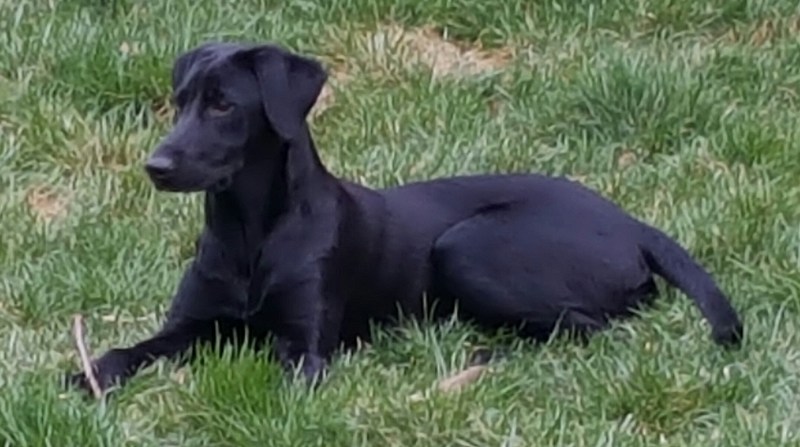
Though I had had him for several weeks, my puppy Lightning was a challenge at 12 weeks because he did not seem to have come with much understanding of where was OK to go in the first place, and because for our first month together I was almost immobile from a spine injury. At nearly 3 months of age, he was still peeing almost indiscriminately in the house.
So my wife and I worked out a schedule specific to Lightning’s needs, and we’ve now pretty much resolved the issue, with no mistakes in several days. Your situation is no doubt different, but perhaps our example will help you apply the principles to your own solution.
- Lightning is walked three times per meal: once immediately before, once immediately afterwards, and once about 20 minutes afterwards. The operative word here is “immediately”. For Lightning, he eats in his crate and then he finds a treat-filled Kong or other treats in his crate after the second and third walks. Thus going out is a satisfying adventure (he gets to relieve himself), and coming back in is also fun and reinforcing. I should mention that this is a big daily job, since Lightning is on a raw diet where he eats four times per day. That’s twelve walks per day right there.
- In addition to those walls, he gets a walk first thing in the morning and last thing at night, plus every couple of hours during waking hours, if those aren’t covered by the mealtime walks.
- Lightning, like any puppy, needs thorough hydration, but in the early days of house-training, he gets all his water added to his meals. He will have free access to fresh water when he has better control.
- He loves to play with my wife’s Golden, who is two months older. For those play sessions indoors, I have to interrupt him every few minutes to take him outside for a break. I’m not sure why, but that’s one time when Lightning has especially poor control. I guess it’s the excitement.
- So much for frequency. It’s a lot, but it could be worse, and I’m sure some dogs would need even more frequency in the early stages.
- As for safe indoor locations, Lightning has two: his crate, provided he really, definitely has empty tanks when he is in there; and tethered to me on a short leash attached to his flat collar. By short, I mean 30″ or so. That works for us because as it happens, Lightning has never tried to eliminate when he was that close to me. That, by the way, is how we sleep at night. Lightning actually spends little time confined to his crate, since his company means a lot to me while I’m injured.
Obviously all the constraints I’ve described will gradually be broadened, and equally obviously, they are unlikely to apply perfectly to your requirements. But hopefully they provide a sense of the stringent discipline you need to apply to your own behavior as a trainer if you have a particularly difficult case.
 Lightning's Journal