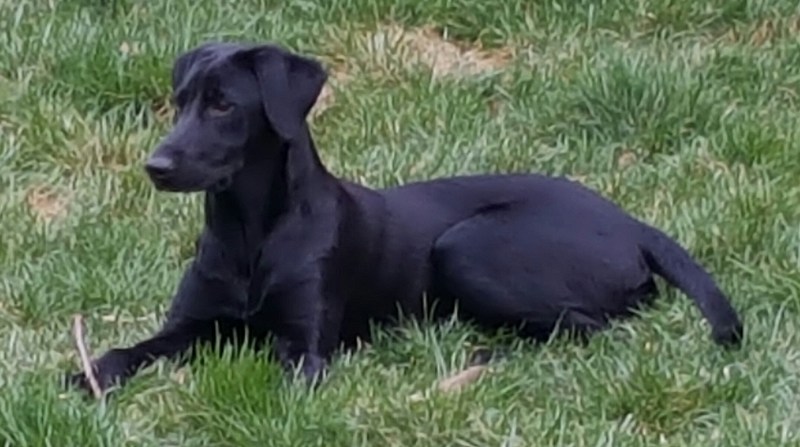
The game of tug, short for tug of war, is widely taught and used by positive trainers for dogs who participate in many activities. You can work with the dog to the point where tug becomes a powerful primary reinforcer, so after a successful trial in a wide variety of trained skills, you can offer a game of tug to reinforce the performance and make that version more probable in the future.
But before I continue, a disclaimer: I have found that some traditional trainers do not think you should teach a dog to play tug, much less actually play the game with them. I’m not sure why. An obvious possibility is that they believe it increases the risk that the dog will develop a habit of sticking (reluctant release) or even freezing (refusal to release) on delivery to hand. Sticking and especially freezing are serious flaws, and I’ve heard that they can be so difficult to repair that they can end a dog’s career.
If that’s the concern, then it may be true for some dogs, so please stay alert if you decide to train the game anyway. But my experience with the small number of dogs I’ve trained is the opposite. Over time, the dog and I achieve a long history of playing tug, with an evolving understanding that when I stop playing, that round is over and they release, with a high probability that I will then immediately initiate another game of tug, or provide some other high value reward, to reinforce the release.
On the question of whether you should always, or never, let the dog win, my experience is that it doesn’t much matter. I believe that tug simulates two dogs working cooperatively to tear apart a large piece of meat, so I believe it is the game itself that acts as a reinforcer, not how it ends. That said, it may be useful to let the dog win in the early training to help her engage in the game until she discovers within herself the pleasure of tugging itself.
Training tug:
- Select an article the dog has a natural, previously displayed inclination to hold onto when you reach for it in her mouth. It is an uphill and possibly losing battle to try to train tug with an article you think would be good for the game but which the dog has little inclination to play tug with.
- For each trial, entice the dog with the article, for example by swinging it a few inches over the floor or snaking it in front of the dog.
- When the dog grabs it, lightly resist giving it up, then let go. Over time, you’ll be able to increase how hard you pull against the dog to virtually full strength and engage for several seconds per trial.
- An advanced version of the game is to swing the dog around on a circle fast enough that the dog’s rear legs lift off the ground. I never got that far with either of my Goldens, perhaps because Goldens have much softer bites than the Schutzhundt dogs that trick is sometimes taught to. I’ll have to see whether Lightning will be able to do it when he’s older.
- Another advanced version of the game consists of holding the article behind your back and then putting it in one hand and suddenly pivoting your body to left ot right to reveal the article. The dog must now grab it in the blink of an eye or you pivot back and she loses the opportunity. This trains her to seize the opportunity without delay, which I suppose is vital for police dogs, with whom this game is played. I’m not sure I see such a reflexive response as important for a field retriever as a skill per se, but it does seem to increase motivation, which is always a good thing.
- In Lightning’s first session, I experimented with a number of articles that didn’t work. At last I found that he would engage with the rope of a 2″ bumper. We played for about 20 trials. His motivation gradually increased as he figured out the game, but he never became highly motivated. Perhaps he needed more practice, or other conditions, such as play room distractions or being a bit tired from earlier play, were in effect. By the second session, he was just as happy to grab the bumper itself, rather than the rope, and his motivation was significantly higher.
- Eventually you will want to train a release. That’s actually part of the Trained Retrieve, and that component is cued by various trainers as “out” or “give”. I’ve even heard the cue “leave it” for this purpose. In any case, it doesn’t need to be trained at this time. You can just let the dog win.
- Alternately, if you stop tugging but just refuse to let go, the dog eventually becomes bored and lets go. It could take minutes the first few times. But if you instantly reinforce the release with a high value reward, possibly another game of tug, the dog will release sooner and sooner without the need for a verbal cue, until the dog simply reads your body language and releases almost as though reading your mind. That skill can extend to field work. Both of my Goldens generally released the bird on delivery to hand without a verbal cue, though I did train “Out” when we worked on the Trained Retrieve. We’ll discuss that in a later post, since it will be after teething.
 Lightning's Journal