[This post contains ideas previously discussed elsewhere as well as other editing annoyances. My apologies; I’ll fix it when I can. But meanwhile,what a day! I would love to tell you about it.]
Circumstances
The PRT program I am developing includes about a score of pre-teething goals, with sequence sometimes crucial and sometimes irrelevant. One of those goals is “Intro to retrieving”. I can’t remember whether it has prerequisites in TRT, but I think any trainer might want to see at least enough to gauge what he’s starting with.
In my case with Lightning, unfortunate events prevented me from trying a single outdoor retrieve with him for more than a month after I picked him up, by which time he was a few days past three months old.
Then, out of the blue, Peter, one of my long-time training assistants, now a full-time college student, contacted me and mentioned that, with winter break, he was available if I were interested. With a few more text exchanges, we had made arrangements and he was here first thing this morning. First he helped me with some business duties, and then he stayed for another few minutes so we could try Lightning out on a small experiment.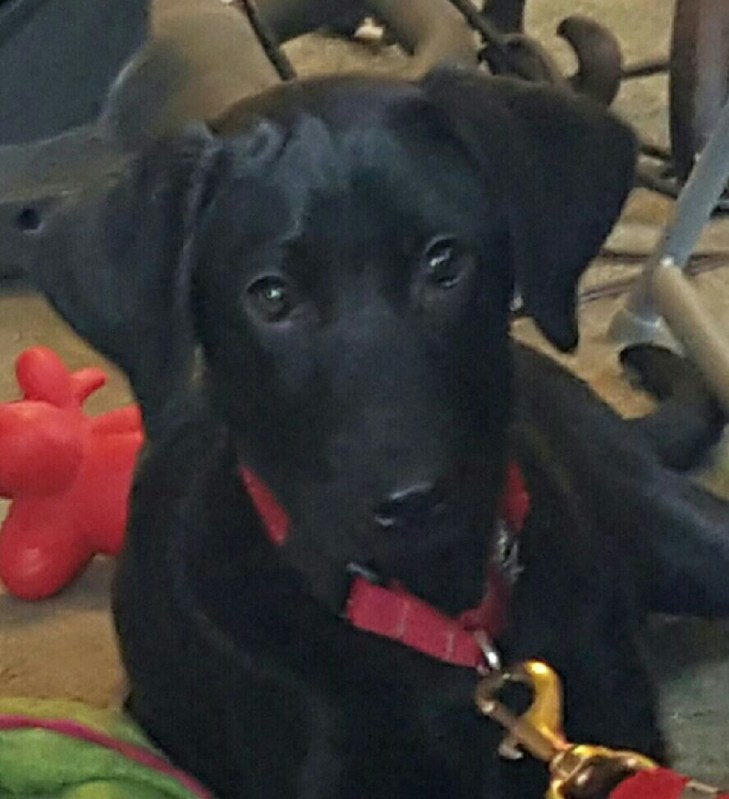
Lightning outfitted for training the next day
Discovery training
I call the method we would be using “discovery training”. It shares some principles with a well-known training method called “shaping”, which you can study via an online search if you wish.
As for discovery training, the trainer accomplishes it by creating opportunities for the dog to discover within herself self-reinforcing behaviors which happen to coincide with the trainer’s objectives. Thus the reinforcement comes not from extrinsic rewards, such as food (+R) or electric shocks (-R), nor from the dog’s relationship with the “pack” or “pack leader”, but rather from the dog’s own primary feelings about the actual activities being performed.
By example, a dog who was naturally more comfortable with a symmetrical sit than with an asymmetrical one could learn an improved obedience “front” by being given enough opportunities to practice that she eventually began sitting straighter because it felt better to her. No treats, no relationships.
The method obviously has limited applications, though perhaps is more useful than might first seen apparent. As an example, discovery training is a fine approach to house-training, since the act of eliminating actually provides all the reinforcement the dog really needs, and is just as effective as treats and cheer-leading if used in combination with giving the dog well-timed opportunities to experience elimination in the trainer’s desired target areas.
I can’t say whether discovery training would have much application in other dog sports. I suspect that the answer is yes at least for those sports and activities the dog was actually bred for, such as herding and sled-pulling.
It seems to have broad application in training competition retrievers to dogs bred for the sport, in any case, and we’ll see an example of it in today’s work.
Important note: Years after I wrote this post, I decided that discovery training is not such a good idea after all, and may have contributed to Lightning’s addiction to keep-away games, which plagued several years of his early training. I added a post to this journal at that time to discuss the issue: The demise of discovery training
Expectations
Here, then, were the modest goals I set for my session with Lightning and Peter today, and how I thought we might address particular contingencies.
[Now, by the way, may be as good a time as any to mention that I am not always good at predicting dog training contingencies. For me, a valuable skill is coming up with ways to address particular responses on the fly, when they actually occur, even if I had had no idea in advance the session would happen that way. I think hat means that for my experiences to be useful to others, you may find you need to exercise spontaneity, flexibility, and even creativity at times as you conduct your training, sometimes even varying your program from one dog to another that same day.]
My training plan was more or less as follows:
- I was confined to a chair, so I would demo how to run each trial, provide verbal guidance, and Peter would then execute as many times as necessary. Peter did a great job with that approach.
- Working in our front yard, Lightning was too distracted by the leaves that kept blowing by. At Peter’s suggestion, we moved into a wind-sheltered area of the driveway, which helped a lot.
- Laddie needed to be in the house. He was barking and it made me sad, but you can’t train two dogs at once in most cases.
- Each trial would start with a short toss of a retrieval article, Lightning unrestrained. The universe of possible responses from Lightning would dictate our next step. Peter and I discussed the possibilities at some length. At one extreme, Lightning would ignore the throw. At the other, he would execute a perfect retrieve.
- We would not require a delivery. Lightning could do whatever he wanted to with the article once he was near the handler. I believe strongly in this concept for pre-teething dogs.
- Lightning wore a 15′ check cord. I also strongly believe in pre-teething pup’s practicing retrieves while wearing a check cord.
- I won’t attempt to go over all the hypotheticals. Let’s see what actually happened.
Payoff
We ran about six trials. Here’s what happened:
- I tossed a 2″ white bumper. Almost perfect retrieve. OMG!
- Identical toss. Lightning did not even run to it. Hmm, 180 degrees from first trial.
- I thought he might be finding the bumper unsatisfying, so I took off one of my slippers, and we used that remainder of session. I tossed it, Lightning chased it, picked it up, and started to go crazy shaking it and running around with it. Awesome response. Per instructions, Peter picked up Lightning’s check cord and gently drew him towards us. After a few feet Lightning dropped the slipper.
- Per instructions, Peter scooped up the slipper and tossed it again, so that it lay inactive for less than a second. Lightning chased it, picked it up, went crazy again, and just held onto it a bit longer when drawn back towards us via the check cord.
- An almost mathematical progression. This time Lightning carried the slipper almost all the way to us. He was also visibly more directed about that being the natural direction for him to go after his pick-up.
- Once again, Peter tossed the slipper, and once again, Lightning raced to it and picked it up. But this time, he made an arcing return run right to my hand, which was hanging beside the chair, without dropping the slipper at all. Thrilled, I scooped him into my arms and let Peter know that we had completed our session on a triumphant note.
This session really illustrated the discovery mechanism at work. No treats, no praise, no cheer-leading. Lightning was simply given the opportunity to discover for himself what great fun it is, if you happen to be a retriever, to bring the article back so it will be tossed again a split second later.
Yet he was never given a chance to get bored. We quit while he was hungry for more. I think that’s the right way to do it.
So there you have it. I honestly feel we have the natural foundation for a retrieve. Now all Lightning needs is a few years to refine the details.

 Lightning's Journal