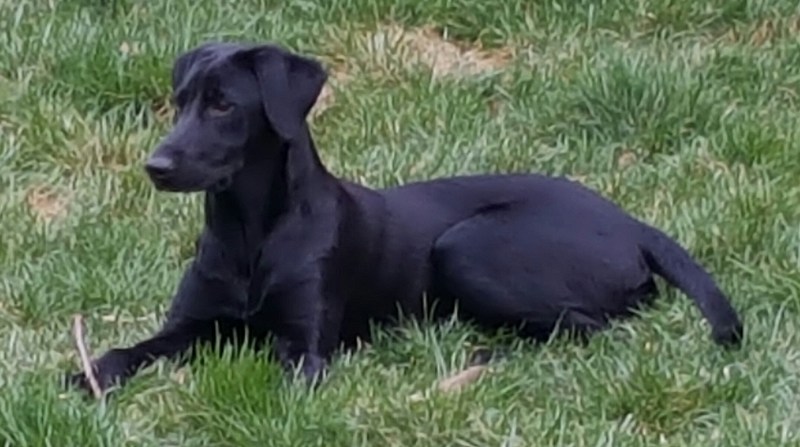
Lightning turned 4mo four days ago. I thought it might be worth while to take stock of where we are in his training program.
As I’ve mentioned, I call the program I’m developing Positive Retriever Training (PRT), modeled on Total Retriever Training (TRT), the program created by renowned trainer Mike Lardy using traditional methods he’s helped to refine. While PRT follows the same steps to accomplish the same training goals in the same sequence, PRT does so without the use of physical aversives such as the ecollar and Force Fetch.
I began my efforts to develop PRT with Lumi and Laddie, and am now continuing with Lightning.
One of my goals in maintaining this journal is to tell others who might be training retrievers about my experience with this experimental approach. Even those using TRT or some other traditional program might find some of the information interesting. But especially if you are planning to train without using physical aversives, you may find this journal to be a unique resource to help you with your goal.
In terms of where we are in the program, Lightning has been training for about four weeks. I actually picked him up from the breeder about ten weeks ago, but because of a back injury that became badly aggravated that day, I was unable even to sit up, much less stand or do any training, for the first six weeks. So in comparison to a puppy with similar breeding in a daily training program, Lightning is presumably about six weeks behind in his training.
That does not mean that another trainer using PRT, or a traditional program for that matter, would be at the same place in his training after four weeks. The dog might have started training at six weeks younger and a different maturity level as I had planned for Lightning, or at an older age, and in that case would have had life experiences that might or might not be helpful to your training goals. In addition, the dog might have different breed or individual characteristics. And of course, the trainer might have different skills, be using different methods, have different grounds or weather conditions for his or her training, and so forth. The important point for me is that skills be taught in a sequence that maximizes the dog’s future performance, however long those steps take.
As an aside, retriever trainers don’t universally agree on performance goals, training sequence, or both. For example, a dog being trained for hunting might have more of a focus on steadiness training in the early stages and less of a focus on the retrieve pattern and building motivation for the retrieve.
However, I’ve made no effort to postulate an alternate training sequence. Rather, I trust that Mike’s performance goals for his dogs are about the same as my goals for my dogs, and I trust his vast knowledge, born of generations of field trial retrievers and their trainers, and unprecedented success in his own career as a trainer and competitor, of what sequence to train skills in to reach toward those goals.
In terms of the TRT and therefore also the PRT programs, Lightning and I are now in the first stage, which Mike calls “Socialization and Introduction to Field,” shown in the box at the top of Mike’s TRT Flow Chart and not covered in his TRT video.
As I’ve been describing in this journal, of the 18 objectives outlined in that box, Lightning’s training has met to varying extents all but three so far:
- He’s had no introduction to water retrieves, because the weather, though unseasonably warm in our region this year, has still been too cold for introducing a puppy to water, at least in my opinion.
- He’s had no introduction to upland hunting because I’m not a hunter.
- And he’s had no multiple marks.
Of those three objectives, I expect to introduce Lightning to multiple marks soon, but introduction to water will have to wait for warmer weather, and its possible he’ll never have an opportunity to go hunting, upland or otherwise.
Yet even if we had begun running some multiples, and even if Lightning had done some water retrieves and some upland hunting, it would not be time in my opinion to go on to the next stage of the TRT and PRT programs, which Mike calls “Basics”. The reason is that I’m under the impression that Basics is suitable for a dog who has finished teething, which I estimate will be in about two months for Lightning.
For an older dog who has accomplished all the introductory goals and is past teething, it’s possible the dog would benefit from proceeding to Basics after only four weeks of training. But even after ten weeks, which Lightning would have had if I had not been injured, something else might still be missing, something not expressly shown on the flow chart. By that, I mean a greater depth of experience with those introductory objectives. In the next two months, Lightning will have an opportunity to get even better with his recall, Sit and remote Sit, heeling, and the retrieve pattern, not only achieving better understanding, but also discovering ever more deeply his love for the activities that make up the career of a competition retriever.
As in any other learning process, such as playing a musical instrument, it’s not always best to push on to the next stage of learning (for example, a more difficult piece of music) once an earlier stage has been covered. Instead, it’s often best to continue to practice the skills already learned, as they become ever more accomplished, ever easier, ever more enjoyable, and ever closer to second nature. The result is to strengthen the foundation that what follows will be built upon. That’s the approach I plan for Lightning over the next two months.
 Lightning's Journal