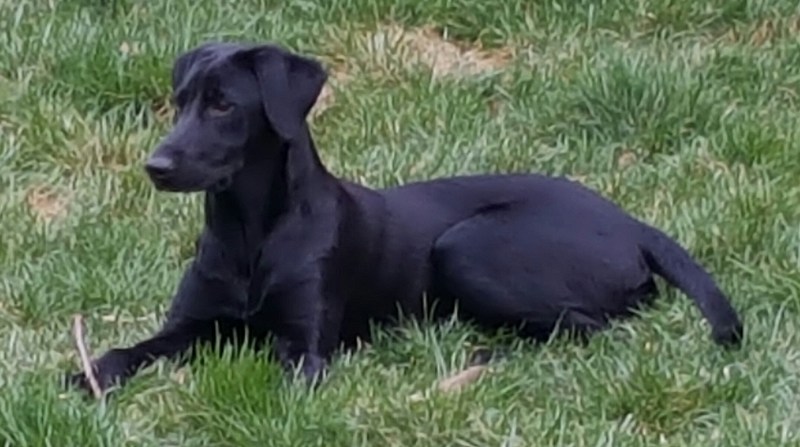
When Lightning first began retrieving ducks, he began to develop a high quality return, as he had been showing earlier in our training when he was retrieving bumpers.
But yesterday, his returns deteriorated again, and he started carrying the duck off to the side. His check cord made it possible for Peter, who was acting as handler, to catch him, preventing the behavior from becoming self-reinforcing, but the trend was still in the wrong direction.
Reflecting on his performance over night, I decided we should try two changes to reverse the trend and get back to good returns.
First, we had begun to slip in our original plan of waiting for Lightning to drop the article, in this case the duck, of his own accord. To save time, we had begun grasping the duck when he returned, then holding on as he tried to pull it away until he finally let go, possibly by accident while trying to improve his grip. We had to stop doing that, not only because it would be disastrous for that behavior to become a feature of his delivery when he gets older, but more immediately, because it created an aversive on his return sequence, making him less likely to want to come to the handler with the bird.
Secondly, because we were training with only one thawed duck, we had lost a key reinforcement feature of our previous training with bumpers, the ability of the handler to instantly call for another throw at the moment Lightning dropped the previous article he had retrieved. Since he is not yet willing to retrieve a bumper when a duck is present, the only solution I could come up with was to bring out more ducks when we train. Two ducks would enable us to call for the next throw instantly every other retrieve. Three ducks, two thirds of the time. Four ducks, three fourths of the time. So the more ducks I brought out, the more reinforcement Lightning would receive for returning to the handler and dropping the bird. But I only have a few more ducks in my freezer to last us till I can get more, which I’m not even sure how I’m going to do. I decided to thaw three ducks for today’s session.
Those two changes resulted in a gradual improvement in today’s returns. The amount of time Lightning took to drop the bird, when we made no effort to take it, gradually lessened, as he learned that dropping the bird often (⅔ of the time) instantly produced another gunshot and thrown duck. And no longer having a disincentive to return to the handler, because he would just be welcomed warmly and no one was going to try to take his duck away, he gradually stopped attempting detours and began running straight back to the handler with his bird.
By the way, I don’t believe I’ve mentioned that a couple of sessions ago, I asked Peter to begin wearing a field trial whistle and tweet three times to call Lightning in with the bird, before then using claps and enthusiastic calls of Here as we have been doing in our handling. My instructions were that over time, when Peter saw that Lightning responded to the whistle, he could begin fading out other cues for come-in. Lightning has begun responding to the whistle, but we are not yet ready to drop clapping and calling from our practicing. That time will come, but I think those sounds add to the excitement for Lightning, and are valuable in this stage of his training.
We’re still starting each session with a single bumper retrieve, but Lightning won’t retrieve it if a bird is too close, so that’s an ongoing challenge. And I’m continuing to rely primarily on my assistants to act as both gunner and handler, while I watch from the vehicle to minimize wear and tear on my back. In this session, for example, I reloaded the pistols for the gunner as she used up each load (I had asked her to fire twice for each throw to build excitement, so the pistol only lasted three throws), and I finally came out and handled Lightning myself on his last retrieve, after about five rounds of three retrieves each, with breaks for the gunner to collect the ducks and get a reloaded pistol.
By the time I ran Lightning, he was running straight back on his returns. The feeling of cooperation between dog and handler had once again strengthened. All of us could sense it in the air. It was exhilarating, a great way to wrap up the session.
 Lightning's Journal