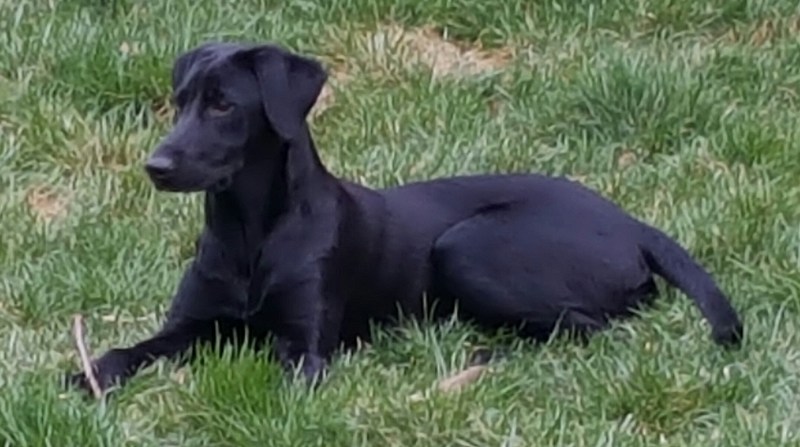
Mike Lardy’s TRT seems to contain a bit of a paradox. One of the final introductory tasks is introducing the dog to multiples, but Force Fetch comes later, under Basics. The dog in theory hasn’t learned Out (or one of the equivalent cues, such as Give) during the introductory stage. So how do you get the go-bird article away from the dog on a multiple such as a double so that he or she can launch for the next article after retrieving the previous one?
A related issue, which may or may not be part of Mike’s thinking, is that I don’t want the dog to be required give up am article after retrieving it, because I don’t want the dog to be reluctant to return to the handler carrying his or her prize. I believe that has been a valuable factor in Lightning learning to return to his handler in practicing single marks early in the process, with Lightning’s check cord to assist when needed. He eventually drops the article, and we often reinforce that by the gunner immediately firing a pistol and throwing another mark. That speeds up Lightning dropping the retrieved article, but it still takes several seconds, too slow for the rhythm of running another mark that was already thrown as part of a double or triple.
Yet another concern for a dog completing his or her introductory training is that, if you started the training with a puppy, the puppy may still be teething at the stage where you want to train the final introductory skills. Lightning at four months is still teething; I sometimes see blood on his buddy Ryley’s white coat after a wrestling match. I don’t want Lightning to associate the pain of teething with retrieving in general or the Force Fetch behavior chain in particular. Therefore, for the indoor work, I’m using soft objects such as balled up socks as the retrieval articles. Outdoor training will be out of the question because of the snow and slippery conditions, which could lead to an injury, for some time anyway. If he’s still teething when outdoor conditions are better, I’ll watch carefully to see if avoidance behaviors suggest that carrying birds or bumpers seems to be causing any pain and call off the session if so.
Meanwhile, I’d still like to train Lightning to run a double or triple, for now with soft articles indoors. So even though I’m going to train a Formal Fetch (the PRT equivalent of Force Fetch) in the next stage of training, and even though I won’t take the last article of a multiple away but will let Lightning keep it as long as he wants, I do need him to give up the earlier article or articles when he brings them back to the handler so he can be sent to the next mark already lying out there.
With those remarks as preface, here was my approach to training Out, the new behavior I’ll need for running multiples.
For reinforcement, I used a small bowl of cream cheese, which I would dip into with my finger. Although this training would have been a good prospect for clicker training, I didn’t use a clicker as my secondary reinforcer, or bridge, but instead used a cheerful Good! or some similar exclamation at the moment Lightning performed the desired behavior, following up quickly with a taste of cream cheese as the primary reinforcer.
You can’t train Out immediately, because first the dog needs to be holding an article. That means that first you need to train Take it. The dog may have no practical use for Take it during a training day or competition, but it provides an efficient starting point for training Out.
If the dog will instantly grab the article in his or her teeth the moment you present it, you may not even need a cue. But that wasn’t the case with Lightning. So the first step was to shape Take it. First I would reinforce Lightning if he merely glanced at the article, then if he made even a slight move with his head toward it, then if he touched it with his nose. Finally I wouldn’t reinforce that and, as usual when shaping a behavior, Lightning exhibited an extinction burst, offering a more vigorous version of the previously reinforced behavior (the nose touch) before giving up. The more vigorous version was to grab the article with his teeth. Of course I immediately said Good! and reinforced with a dab of cream cheese.
After that, I would no longer reinforce a nose touch, and would only reinforce taking the article in his mouth. And once I could sense the moment he was about to do so, I began to say Take it just as he was about to. Soon, he began responding to Take it as a cue without me needing to wait for him to spontaneously offer the behavior. As usual in training a new cue, by saving saying the cue until the behavior was already reliable, I avoided having him associate the cue with incorrect responses.
In order for Lightning to lick the cream cheese off my finger, he needed to drop the article, so we were soon in a quick rhythm of repeated Take it practice, allowing us to maintain a high Rate of Reinforcement (ROR), the key to a quality training session.
In addition, I was soon able to sense the moment Lightning was about to drop the article, so I could put my hand on it and say Out at that moment. It was important not to pull it away. The dog needs to respond to Out by fully committing to giving up the article, eventually learning to pull away while you hold the article in place, rather than the dog just opening his or her mouth.
To keep the training fresh, I switched articles every few trials. Although other articles probably would have worked, I switched between two balled up socks. Since Laddie was in the room with us, I also gave him opportunity to show off his skill with Take it and Out, and earn his own tastes of cream cheese, every other turn. I don’t know whether that accelerated Lightning’s learning — I don’t think so — but hopefully it didn’t hurt, and I think it might have made it more fun for Lightning as well as Laddie, though I can’t be sure. It’s interesting that Laddie instantly remembered the Take it cue. He hasn’t heard it in many years.
I found with Lightning that having to respond to a chain of two cues, Take it and then Out, before receiving his treat resulted in too low an ROR, so I interspersed frequent trials where I only cued Take it and then immediately offered reinforcement when he responded. As he became more fluent, my adding the Out cue no longer seemed to discourage him, since the behavior chain was the same anyway. Soon he was responding to Out as an independent cue.
The work I’ve described was completed in two short sessions, after which I put the articles away and ended our training for awhile. Next time we’ll practice it a bit more, and then see if we can use it to help train an indoor double. With the snow in our yard higher than the dogs’ shoulders, I guess we won’t be training outdoors again for some time.
 Lightning's Journal