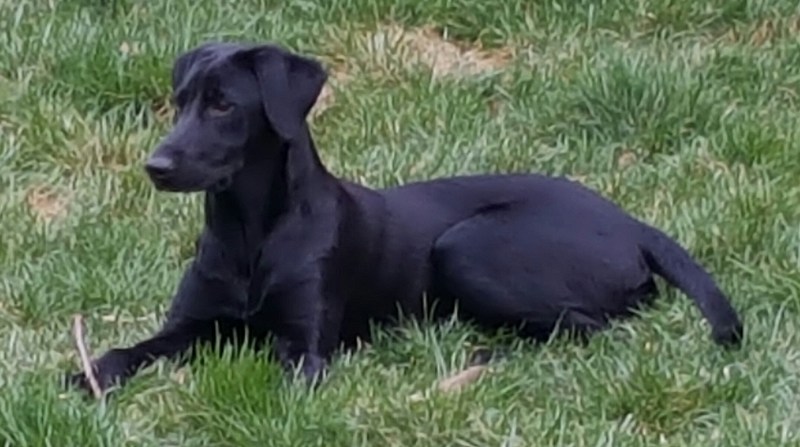
Mike Lardy doesn’t list catching a ball on his 18-item checklist for “Socialization and Introduction to Field” at the top of his TRT Flow Chart, and since TRT is the basis for the PRT program I’m developing, it may not be an essential training objective for competition retrievers.
However, playing catch can provide a lifetime of fun, indoor and out, for any dog. It has always been a favorite game for Lumi and Laddie, and Lightning, not yet 5mo, has also discovered he can catch a tennis ball in the air.
Besides the obvious opportunity to develop and practice the athletic facets of the game — reflexes, focus, coordination — catch is also an opportunity for the dog to continue discovering the intrinsic pleasure of the retrieve pattern, including not only an exciting version of the chase and also the return, but adding a deliver-to-hand component with a tennis ball that in my opinion, as I’ve mentioned before, is too soon to train for a field retrieve of a bumper or bird at this stage.
Whereas Lightning has shown in the field a deterioration in his motivation and performance when a retrieve article, especially a bird, is taken from him rather than the handler waiting for him to drop it, the opposite happens when Lightning and I play catch with a tennis ball. I toss the ball, he rises up to catch it, and then a high percentage of the time he brings the ball straight back to me, releasing it as soon as I grasp it. As quickly as I can, to reinforce the behavior chain, I toss the ball again.
Like other dogs I’ve trained to play catch, Lightning quickly grasped that the only way to get me to throw the ball again is to bring it to me and then release it when I reach for it. He’s also seen that if he drops it on the ground, I pick it up and put it in front of his mouth, cueing Take it and then Out, before I toss it again. Since that’s not as much fun as the quick toss that results from simply delivering to hand in the first place, he quickly learned to make that choice. When the time comes to work on delivery to hand as the finish for a Formal Retrieve, Lightning will already have a positive reinforcement history with the concept.
So far, we’re only playing catch indoors. But when the weather dries out, we’ll move the game outside as well. We’ll mix tosses that he can catch in the air with throws that he has to chase down, and strengthen his reinforcement history with delivery to hand even further.
Let me end with a couple of notes of caution: First, a young dog can sustain skeletal injuries with jumping activities before the dog’s plates have closed, which occurs around the age of 14 months, so I plan to keep my throws low for the next ten months to prevent high jumps, and also to end the game sooner at times than Lightning wants in order to avoid an overuse injury.
And second, a dog at any age can tear a ligament landing the wrong way after a high leap in the air to catch a ball or other article. Too often have I sent Laddie soaring by tossing or bouncing a ball over his head so that it would come down behind him. It was fun to watch his exquisite, gravity-defying acrobatics in mid-flight and his joy in the game. But that was before I realized the risks. I don’t do it with Laddie any more, nor do I plan ever to do it with Lightning.
Update: After some time, Lightning became fairly compulsive about playing catch at times, bringing me the bank over and over again, just as my two Goldens had in years past, and just as Laddie still does.
With Lightning, that gave me the opportunity to introduce a cue we won’t officially train till Stage 2 of the PRT program, the Fetch cue.
It works like this. When I see that Lightning is excited about playing catch, especially with a squeaky ball, I place the ball on the floor and use my hand to block him from getting it until I’m ready. Then I say “Fetch”.
Since I already know he’s going to lunge for the ball and bring it to me as soon as I release him in some way — he’s already shown that behavior to me repeatedly — all I’m doing now is associating the cue “Fetch” with that response.
After a little experience with the cue, I can put the ball some distance away, say Fetch, possibly wave a hand toward the ball, and he’ll pounce on it and bring it to me to toss back to him. Squeaking it a few times before tossing it seems to make it even more delicious for him, based on the intensity of his focus as I rehearse the throw to get our timing in sync and then toss it to him.
Update: For an example of how catching an article played a practical role in Lightning’s later retrieve training, see The heel and catch game.
 Lightning's Journal