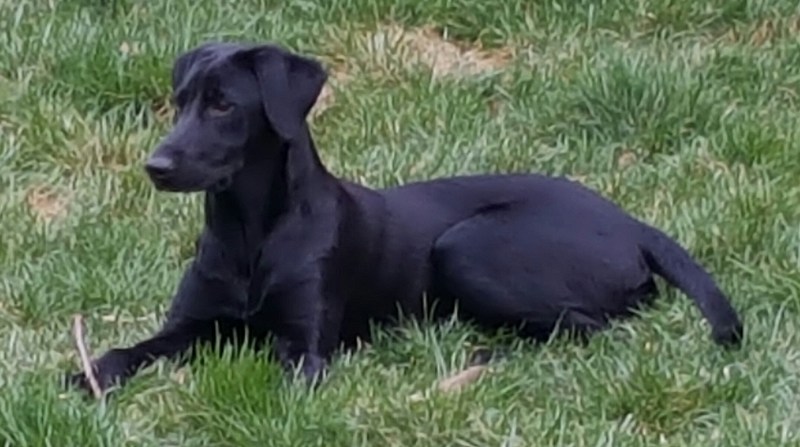
Midway thru Mike Lardy’s list for socialization and introduction to field, which is the basis for the first stage of the PRT program I’m developing, is “walking on leash (two sides)”.
Lightning has had lots of experience with lines in various contexts: in his first few weeks with me, I kept him tethered to me indoors most of the time, for a number of benefits including house training; in the field, he is always on a check cord to promote quality returns during retrieve practice; and when necessary out of the house, such as for vet visits, he’s been on a leash.
However, because of the injury I sustained the same day I picked him up at the breeder’s on November 2 last year, I have been unable to walk more than a short distance at a time, if at all, until the last few days. But now I can walk several hundred yards, so among our various other training activities, I’ve finally begun to work with Lightning on sustained leash walking.
The process I’m using is relaxed. I’m not trying to work on recall, Heel, or other related skills while walking Lightning on lead. Other skills may be merged into leash walking in time, but they would change the experience at this time from a stroll to nearly continuous training, and I feel from experience with previous dogs that it would be difficult to maintain a high rate of reinforcement adding such criteria to this early stage of leash training.
That means no verbal cueing during our leash walks at this time, and it means a relatively long leash, a little over 6′. Lightning only has one rule to learn: attempts to pull against the leash in a forward direction cause Daddy to stop in his tracks, and if sustained, can even cause Daddy to back up.
Although I’m using a fairly long leash, I’m not using a retractable. I think those are the most comfortable way to walk a dog on leash, but I’m not sure the dog learns anything about not pulling. In fact, the dog may actually obtain reinforcement for pulling.
I’ve also switched to a harness instead of a flat collar. My Goldens have always worn collars when leash walking, and Lightning had, too, till I switched to the harness. The reason I switched is that Lightning sometimes pulled so hard that he would make himself gag, and my holistic vet suggested a harness to avoid a throat injury.
As for location, I believe I mentioned before that I’ve never walked Lightning to the end of our driveway nor into our neighborhood. As a result, I can let him out in our yard, even though we have no fence, and he generally makes no effort to go outside the boundaries he’s learned. Of course I keep my eye on him, and if he or Laddie do wander too close to a boundary, I call out, “Don’t go over there.” I know dogs don’t understand English, but they know what I mean in this case. That makes it possible for them to run around, play, and explore safely off lead while I rest inside watching thru a window, or sitting in a lawn chair outside with them.
So, since I don’t want to walk Lightning in our neighborhood, for our new leash-walking practice, I take Lightning and Laddie to various nearby locations such as parking lots or fields that are large, have little or no traffic, and are relativity free from distractions. I keep Laddie on one side at heel but off lead, and Lightning on the other on his lead and harness. When Lightning wanders to the other side, I switch Laddie as well.
This is so much more relaxed than trying to keep Lightning on a tight lead at heel. As he comes to understand what we’re doing and the rule that pulling won’t work, I’ll gradually shorten the lead over a period of months.
By the way, I guess some field dogs are taught fairly early to walk under control on a tight lead. However, from the standpoint of Lightning’s preparation for field competition, I don’t think that’s necessary. In the stakes he’ll be running, he’ll never be on lead when under judgment, and if he isn’t perfect at leash walking and pulls at times, it won’t affect his score. So I think just a moderate proficiency is all he’ll require for this particular skill. That will leave us more time and energy for other training.
 Lightning's Journal