A poorman mark is a mark you go out to throw while leaving your dog in a sit at the start line. After you throw, you return to the line and send the dog.
I learned the term “poorman mark” from my mentor, Alice Woodyard, so I guess it’s in common usage at least in some regions, though I’ve never heard anyone else use the term. In fact, I suspect many trainers never use this skill, or even train it, either because they never run marks alone or because they use launchers.
Though launchers are valuable, I think poorman marks also have their place. They’re a lot faster than setting up launchers, and the dog can learn some steadiness even before you begin to explicitly work on that skill. Poorman marks also give you an opportunity to practice the verbal Sit cue, and a way for the dog to get a solid understanding of his or her name as the release cue on a send out. More generally, poorman marks require the dog to exercise self control, since you are not there to physically restrain the dog while throwing.
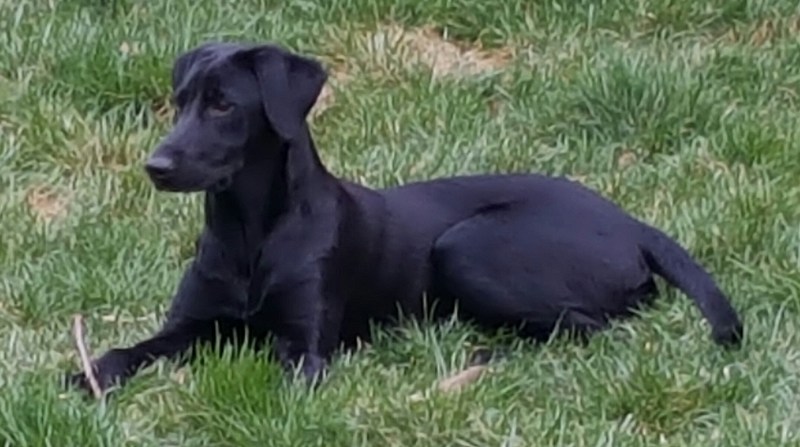
I’m not sure how early you can comfortably train poorman marks to a puppy. It may be a matter of age, it may be a matter of familiarity with the retrieve pattern, or some other factor might be involved. I tried to train the skill to Lightning several weeks ago and decided it was too soon. Perhaps he was to distracted that day, but in any case, I decided to put it off for a while Then this morning I took him out to the driveway in front of our house to try again, and this time it went smoothly.
Here’s the approach I’ve used to train poorman marks to my dogs. Holding a bumper, you first stand in front of the dog and cue Sit. Toss the bumper back behind you. Then slowly step forward and turn so that you are standing next to the dog. Put your hand down like a gun sight and without moving it, cue the release by saying the dog’s name. If the dog is able to stay in the Sit until released, and launches well when cued, you’re in business. If not, it might be too soon for this training.
If the first trial goes well, the next time, set up as before, but take a step backwards before tossing the bumper behind you. Continue to add another step or two of distance. Then, the next time, toss the bumper at 11 o’clock or 1 o’clock rather than 12 o’clock straight back, so that the dog sees a throw a bit.
With more trials over several sessions, you can build additional distance; set up initially at the dog’s side, cue Sit, and walk straight away; throw the bumper as normal rather than behind you; proof at more challenging locales; add a gunshot for excitement; and throw two or more marks while you are in the field, which you can then send the dog to one after another, practicing line mechanics as you select each mark. This gives the dog an introduction to retired guns as well as multiples.
I don’t know whether it’s possible for any dog to learn steadiness on flyers with poorman marks, and you won’t be able to train steadiness to competition level without training with flyers. I’ll discuss a positive approach training steadiness with flyers in a future post, when Lightning is further along in our training program.
Meanwhile, poorman marks provide a good introduction to steadiness with bumpers and thawed birds, and provide a convenient way to work on a number of major training goals on those days when you’re training alone.
 Lightning's Journal