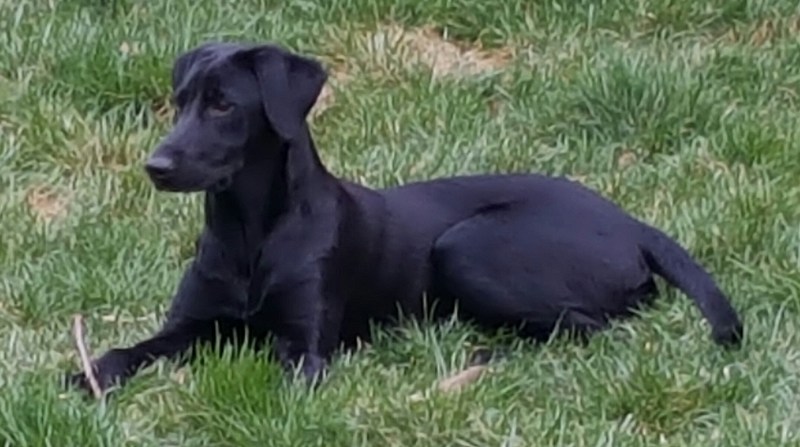
Yesterday I worked with Lightning and Laddie using Peter as my assistant. Laddie’s foreleg seems to be fully healed now, so I ran him on two series, each consisting of a double and a blind, distances 150-300y. For the doubles, Peter would throw one, then move to a different location to throw the other, so that the memory bird was in effect retired.
I had brought a mat out, and ran Laddie from it on all of his retrieves, with different placements for the two series.
Between the two series, I put Laddie back in his crate and ran Lightning. After placing the mat in a suitable location, I asked Peter to handle Lightning while I threw five walking singles. I had meant to throw six but accidentally left one of the bumpers behind. Although I am still in recovery from my back injury and shouldn’t be walking far, especially on uneven ground, it would be even worse if I had to chase and catch Lightning on one of his returns. Peter never had to leave the starting line as it turns out, but I couldn’t be sure that would be the case as we started. Besides, I continue to believe Lightning benefits in his understanding of the retrieve pattern by having multiple handlers. The day before, Liza, one of my other assistants, handled him on some doubles while I again did the throwing.
I thought I’d mention a couple of points about yesterday’s session.
First, the term “walking singles” refers to a particular way of practicing. Instead of the thrower remaining in the same place and throwing several singles, perhaps in different directions, the thrower starts at a relatively short distance, and then moves further away for each throw. For example, yesterday I started at 80y and worked my way out to 180y by the last throw. I didn’t walk in a straight line but headed off in different directions each time I moved, and I also randomly alternated whether to throw to left or right.
The other concept I wanted to mention is called helping. In one case yesterday, Lightning ran to a rock thinking it was the bumper, and then became confused and raced off in the wrong direction trying to find the bumper.
If he had not left the area of the fall, I would have let him hunt. That’s a useful discipline that occurs often in competition, and you don’t want the dog becoming frustrated and giving up or popping (looking back at the handler) when a hunt is needed. But at some point you might conclude that the dog is lost and that the hunt is no longer productive.
Different trainers decide to stop letting the dog hunt at different times, so when you’re throwing, normally you don’t make the decision whether to help or not. The handler will call for help if he or she wants it, and may not appreciate a thrower helping when not asked. In fact, some handlers will let a dog go on lengthy hunts far from the area of the fall believing that helps the dog’s training, assuming it’s safe. And some will invariably blow a sit whistle and handle a lost dog, or at least get the dog going in the right direction, and will never call for help from the gunner.
I agree with handling when the dog has consciously run in an undesired direction, for example to avoid water or high cover. Of course I haven’t yet trained Lightning to handle. Instead, at this stage, I avoid running him on lines where he can obtain reinforcement for taking such a detour, since I want to build a habit of laser straight marks.
However, I usually don’t handle when the dog gets lost during a hunt and leaves the area of the fall. Instead I want the gunner to help. Handling is fun, and in competition, you have no choice but to handle if it becomes necessary. You can’t ask for help from the gunner unless you’re giving up on the competition, so you need to practice occasionally to make sure the dog learns to switch from hunting mode to handling mode when you blow the sit whistle.
But when you blow the whistle in practice, you lose a golden opportunity for the dog to learn an important strategy, which my mentor, Alice Woodyard, calls Plan B. What you want is for the dog to remember where the fall is and run directly to the mark, or at least to the area of the fall and put on a short hunt. But if the dog doesn’t remember where the fall is, getting confused during the retrieve as Lightning did at one point yesterday, you don’t want the dog habitually looking to the handler for help, since that’s a pop and hurts the dog’s score. Instead, Plan B is for the dog to look for the gunner and mentally calculate where the mark is likely to have been thrown.
It might seem obvious for the dog to look for the gunner when he or she can’t remember the fall, but experience shows that apparently it’s not always obvious to dogs, since dogs sometimes hunt hundreds of yards away from the fall, which hurts their score or gets then eliminated entirely in competition. Helping is a way to teach the dog that the gunner is a beacon. You’re teaching the dog, if you can’t remember where the mark is, look for the gunner. The gunner always throws a typical distance, so you as the dog can figure out about where the mark must be. The more often a handler takes the opportunity to call for help, the better the dog learns this Plan B strategy.
By the way, I might also mention how to help. In the first place, the gunner should sit down immediately after throwing, facing more toward the fall than just straight at the start line. Since the dog gets used to the gunners all sitting down, a gunner can simply stand up and face the mark. Often that’s all the help an experienced dog needs, and you want the dog to figure it out with as little dependence as possible on the behavior of the gunner, who won’t move at all in competition.
If standing doesn’t draw the dog in the right direction, next you take a long step, and then possibly another, toward the mark. Again, often that’s enough.
If that’s still not enough, the next thing to try is faking a throw using an exaggerated motion. You might do that, wait a second or two, and repeat it if the dog hasn’t responded yet.
If the dog isn’t looking at you when you’re trying to help, or isn’t responding to your visual cues, you can help further by calling hey-hey-hey, usually accompanied by faking a throw. Even for an inexperienced dog, that’s often enough to get the dog headed for the mark. It was enough for Lightning yesterday, the first time he ever needed help on walking singles
As a last resort, you can go all the way to the mark, pick it up, call hey-hey-hey to attract the dog’s attention, and throw the article a short distance.
What I’ve just described is the way I was taught to help in some of the groups I’ve trained with. But each group has it’s own culture, and I’ve seen some variations. For example, even though in general you’re not supposed to help unless asked to, in some groups you are expected to automatically help, without being asked, if the dog gets behind you. Some trainers want you to follow exact instructions on how to help during each incident, while others just request help (with a holler or, preferably so you don’t attract the dog’s attention, over the radio) and expect you to use your own judgment as you work thru the help options, during down as soon as the dog has figured out where to run to. Another example of a difference in approaches is that some trainers expect you to always have a second article in hand when you throw, and if the trainer calls for help, you’re expected to immediately throw the second article to the same place as the original throw, without taking extra time to reach down and pick another article up. (By article, I mean bird or bumper, whichever your training with.) I have trained with pros who never throw a second bird, and at the other end of the spectrum, others who use that strategy often, especially with young dogs, sometimes even if the dog isn’t lost, I believe to build motivation.
As you can see, you have a number of options to deal with a dog who becomes lost on a mark. You can let him hunt; you can handle; you can call for help by having the gunner stand, or take one out more steps, or fake a throw, or call hey-hey-hey, or go to the article, pick it up, and re-throw it; or you can call for another throw. I’ve explained my preference for calling for help, in order to train the dog to look for the gunner when lost as a Plan B strategy, and I actually welcome opportunities to call for help, even with Laddie, to continuously strengthen the dog’s understanding of that strategy. But dogs are smart and resilient, and can be successful with other approaches as well.
 Lightning's Journal