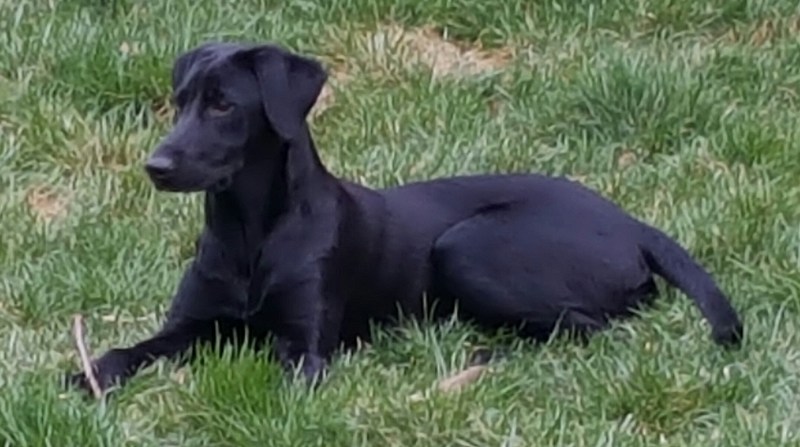
Lightning has now been with me nearly four months. That included an initial six weeks of virtually no training as I dealt with the most acute phase of my back injury, another six weeks of the kind of early retriever training I had planned for Lightning, and then a prolonged winter period when weather conditions, including the historic blizzard known locally as Snowzilla, limited us exclusively at times to indoor training. Even that training was limited further by Lightning going thru teething and showing discomfort carrying even 2″ bumpers, so that he would carry them by their ropes instead.
As a result, I’ve decided to extend our schedule for the initial phase of Lightning’s training, rather than my original plan of moving into the next phase after teething.
As I mentioned previously, that’s not because we’re missing many checkmarks in our planned activities, based on Mike Lardy’s Socialization and Introduction to Field training phase. In fact, the only missing item I’m concerned about is introduction to water retrieves, and for that we’ll have to wait till the weather is warmer in our region regardless of our other training activities.
But just because Lightning has some experience with various skills doesn’t necessarily mean it’s time to go onto the next phase. Instead, I want him to have as deep and rich an experience with foundation skills as if we had been able to train outdoors this entire time. Hence the decision to extend this phase.
I think Lightning has pretty much finished teething, since he’s carrying 2″ bumpers by the bumper again instead of by the rope. And now the weather has been better for a few days, so we’ve had training sessions most days, though it snowed again last night.
Here then are the things we’re continuing to work on:
- Heeling. This involves practicing a number of maneuvers, including walking beside me and then sitting when I stop, coming toward me and then looping around at my side to sit facing the same way I am, and swinging from heel at one side to heel at the other. We practice all of those equally on both sides. I use high-value treats to reinforce every sit. I usually do not have to cue the sit.
- Self-control. For example, although Lightning loves to rough house with Ryley, DW Renee’s 8mo Golden, he has also learned to stop and come to me when I cue Stop and Here, and then sit quietly at my feet or on the couch next to me for long durations while Ryley continues attempting to entice him to resume playing.
- Hippity-hop. My cue for what most trainers call “kennel”, cueing Lightning to jump up into his crate in the back of our van, accompanied if necessary by a sweeping hand gesture. I always reinforce with treats. Lightning is still quite small, but he’s big enough to jump into the back of our van.
- Leave it. We haven’t proofed this outdoors yet, but we often practice it in the house, typically with a treat in my hand or on the floor. This also gives Lightning an opportunity to learn “OK” as a release cue.
- Leash walking. This remains a challenge for me because of my back injury as well as because of the weather, but we practice it regularly. I’ve made no effort to merge it with Lightning’s heeling skills, which I regard as for shorter distances. For leash walking, I’m just looking for Lightning not to pull forward. It took years to get there with Lumi and Laddie, and Laddie still often pulls on lead, so I’m not expecting Lightning to become good at walking on a loose lead overnight. But it’s coming.
- Catch. Lightning often brings me a tennis ball to throw to him so he can rise up on his hind legs and catch the ball in the air, over and over again. I haven’t worked on it outdoors yet. I’m a little worried that he could injure himself jumping, either landing the wrong way, or from the impact of repeated landings. So we just play catch in the house for now. After he’s 14mo and his plates have closed, jumping will be safer, though I’ll still need to be cautious to avoid a ligament tear.
- Retrieving. This, of course, is both our favorite activity. Whenever possible I get one or more assistants. I always ask for one bumper retrieve first, and then we train either with bumpers or ducks. We go a variety of different places to train, and I vary the terrain on the lines Lightning runs as much as possible: up, down, and across hillsides, running thru cover, changes of surface, and always avoiding running in mow lines, ditches, or other channels but always running across them on diagonals. Lightning still wears a 15′ check cord attached to his harness when we run retrieves, but he’s extremely reliable on his returns with bumpers and almost as reliable with ducks. We mostly run singles, but occasionally we throw in a double. I don’t require steadiness from Lightning and allow him to race out in the field as soon as the gun fires, and I have my assistants do the same when they’re handling him. I sometimes let him hunt if he misses the mark on his send-out, but I also often call for help from the gunner in those situations to instill in Lightning that looking for the gunner is a good Plan B.
- Poorman retrieves. This is how Lightning and I, or Laddie and I, practice without an assistant. Lightning has become reliable at waiting in place at least till I throw, and most of the time also waits till I return to his side to send him. This self-control is related to steadiness, but has not and probably will not automatically transfer to steadiness during ordinary marking. I think that for most high energy, high prey-drive dogs, training for steadiness will be a separate and distinct activity in a later stage of training. I feel that too much emphasis on steadiness training in the early stages risks permanently impairing motivation, and that’s not a risk I want to take.
Despite the fact that Lightning seems to be past teething and has worked on nearly all of the items planned for this stage of training, he’s had no experience with flyers or water, and as I mentioned, he’s had far fewer training days than if we had been able to train as I would have wished by now. Since I don’t plan to run him in Derby, the only stake restricted to younger dogs, we have is no urgency to move on to the next stage of training. Instead, we’ll continue in the current stage, taking the time to lay a solid foundation for Lightning’s future career in field trial competition.
 Lightning's Journal