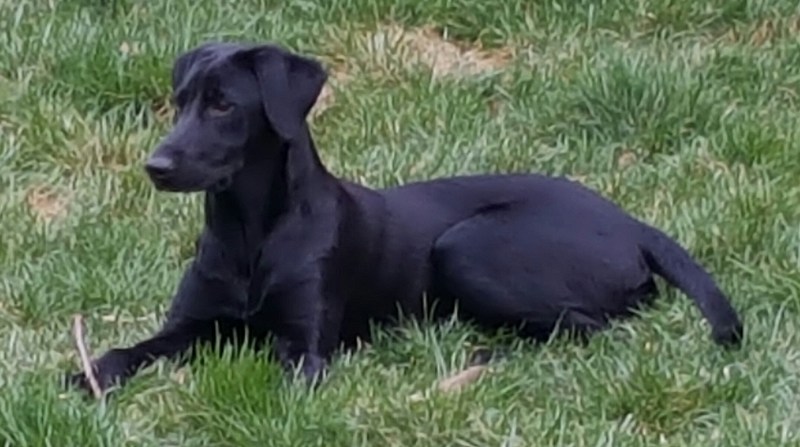
In my previous post, I mentioned my reluctance to focus too much on steadiness during Lightning’s Stage 1 training to avoid risk of diminishing his motivation for retrieving. But after another few training sessions, I decided that, while that may be a risk with some dogs at a similar stage, it might no longer be a risk with Lightning.
At the same time, I don’t want to proceed to full-blown Stage 2 training with Lightning because I feel he is still benefiting from a steady diet of marking challenges. He now delivers to hand more often than not, but I’ll wait till Stage 2 to formally train it. And I don’t want him learning about handling, which will be a major objective in Stage 2, until he has more experience with land and water marks.
Nor do I think it would be disastrous for him to continue breaking from the start line as soon as the gunner fires, rather than waiting until sent by the handler. But given his excellent motivation for running gunner-thrown marks, I thought we might try some additional steadiness training.
Besides getting started learning another necessary skill, it would have some other advantages. First of all, the more he practices breaking and deriving the reinforcement of his exhilarating bursts into the field, the more difficult it might be to change that habit, especially without the use of aversives. Secondly, and perhaps more importantly, it’s not possible for him to develop a strong habit of running high quality lines straight from the start line to the mark if he’s already running before the throw.
So for today’s session, I gradually introduced Lightning to running gunner-thrown marks while waiting until sent. I used a rubber mat at our start line. We had a single assistant, Liza. She and I both wore white jackets. Her throws alternated to both sides. Lightning wore a flat collar with a tab.
I had Lightning run six marks with 2″ bumpers at distances gradually increasing from 20y to 60y, with no gunshot or hey-hey-hey. We then changed directions and ran another six marks, all at 60y with 2″ bumpers, again with no gunshot or hey-hey-hey. Finally, we drove to a different location and ran six marks at 80y, alternating between black and white 3″ bumpers and again alternating the direction of the throws, with Liza firing a blank pistol for each throw.
Although the performance criteria for completing the marks kept increasing, our handling mechanics were the same for every mark. First I would maneuver Lightning into a sit at heel at least partially on the mat and facing the gunner. I would cue the sit with a single tweet, adding a verbal cue on the few occasions needed. I also got him up and repositioned him if necessary, until he was reasonably well aligned toward Liza.
Next, I reached down to his neck and slid the collar around so the tab was at the top, then grasped the tab with a strong grip but so that the tab itself was slack. With my eyes on Lightning, I used my free hand to signal for Liza to throw. I then held tight onto the tab to prevent Lightning from breaking. At the instant he relaxed, I dropped the tab and called “Lightning” to send him, and he raced away, grabbed the bumper off the ground, and ran back to me with it.
In the early going, Lightning tried to break when Liza silently threw the bumper but it was not difficult to hold him. During the second group of six marks, he didn’t even try to break on some of the retrieves, so the tab never became taut on those retrieves.
But when we switched to the larger bumpers, which have streamers and are perhaps more exciting, and especially with the added excitement of gunfire, Lightning tried much harder to break than he had before. Yet by the last of those marks, Lightning was again remaining steady until sent, even with the gunfire.
My key consideration for whether to continue working on steadiness was whether I saw any drop in Lightning’s motivation for the work. I did not. At the line, he remained locked in on the gunner and the thrown bumper. When sent, he launched like a rocket, generally overran the bumper a few feet, then spun around and picked it up as he raced back toward me. He even delivered the bumper to hand rather than dropping it on the ground most of the time, even though we haven’t trained that for field retrieves yet.
I might mention that sometimes when I blew whistle Sit, Lightning would lie on the mat, still alert and locked in on Liza, but crouched down on his stomach rather than sitting. I have no idea why. It didn’t slow his launch.
Given Lightning’s success with this training, I think today was a new watershed. From now on, unless I see some deterioration in his motivation or performance, I’ll use his tab to enforce steadiness on all marks. Once he goes thru a sustained period of not trying to break no matter how exciting the situation, a time will come where I won’t bother putting the tab on him any more. Based on today’s work, that may happen sooner than I would have expected.
 Lightning's Journal