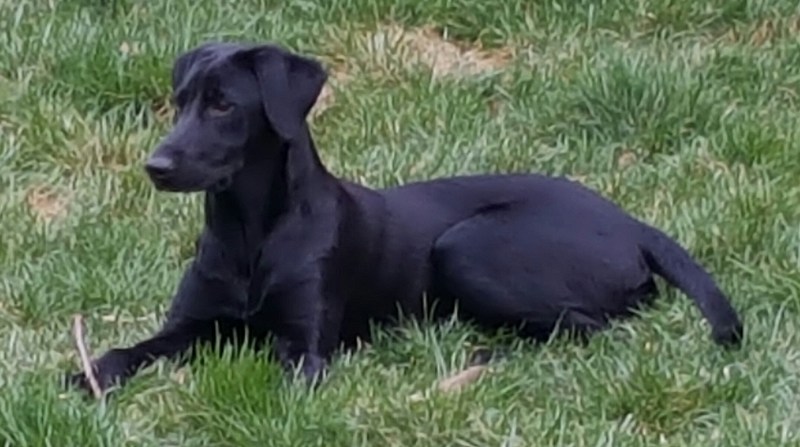
As I’ve mentioned before, I’m developing a program I call Positive Retriever Training (PRT) and modeling it on the Total Retriever Training (TRT) program developed by renowned field trainer Mike Lardy. I’m using PRT to train Lightning for a career in field trial competition.
As you’ve seen in my previous posts, I’ve modeled PRT Stage 1 on the section called Socialization and Introduction to Field in Mike’s TRT Flow Chart but not discussed in detail in his video. I also included in PRT some topics not covered in Mike’s program, such as playing catch with a tennis ball and nail trimming.
My original intent was to go onto Stage 2 with Lightning when we had carried out all the Stage 1 training and also when Lightning had finished teething. I was expecting to start Stage 2 about the time Lightning turned six months old, which was three weeks ago. But I felt at that time that Lightning had missed too many weeks during Stage 1 because of my back injury and then because of the winter weather, so I decided to continue work on Stage 1 objectives until I felt Lightning had a well developed understanding of, and motivation for, the retrieve pattern, that is: go out, pick up the bird, and bring it back. Over the last several days of practice, continuing the kind of work I’ve described in previous posts, I’ve come to feel that we’re now ready to begin PRT Stage 2.
PRT Stage 2 is modeled on TRT Basics. During the next several months of Lightning’s training, I’ll describe all the work in this positive approach to the training. But as the indispensable basis for the PRT program, we’ll begin by familiarizing ourselves with Mike’s TRT material.
First, look at the Basics section of the TRT Flow Chart (available online). The left column is called “Yard Sequence”, the right column, “Field Sequence”. This layout is significant both horizontally and vertically: horizontally because the yard work and field work are to be done in parallel, so that the dog progresses down both columns simultaneously; and vertically because the steps Mike describes in each column are to be worked on in the order he lists them. That allows the later concepts to build on the earlier ones. PRT users the same approach and works toward the same objectives in the same sequence, but with some modifications, especially the elimination of force as both an objective and a method.
After you’ve looked at the model for PRT Stage 2 as shown in the Basics section of Mike’s TRT Flow Chart, next watch the first disc of Mike’s TRT video. That will be the basis for our next phase of training.
It is impossible to overstate Mike’s success and contributions to the sport nor my respect for his work. Virtually every second of his program is filled with brilliant insights as applicable to PRT as to Mike’s own TRT program. But since PRT involves training without physical aversives, I’d like to provide some notes to the material in TRT first disc, from the perspective of the PRT approach, addressing those areas where the two approaches differ:
- The first statement I would disagree with is that pressure is necessary. That’s because I look at a dog’s performance from a behavioral point of view. The dog will behave in a particular situation according to a wide variety of factors, including instinct, health issues, and classical and operant conditioning. All of those factors add up to a single rule that controls all behavior: the subject will do what feels best. Using pressure to build the dog’s reinforcement history for particular behaviors, thus making the desired choice feel best, is certainly effective, but to me pressure itself is not the fundamental concept. Rather, any approach that develops the same reinforcement history for the same behaviors would, by definition, be just as effective. That statement in itself doesn’t guarantee that other approaches are possible, but the success of my two Goldens, and the hoped for success of Lightning, have shown and will continue to show that pressure, in the form of physical aversives, is not required to train a competition retriever.
- I will also just say that I disagree that it’s possible for a human to recognize “lack of effort” or “not trying” in a dog’s behavior. To me that’s mind-reading and is simply not possible. My belief that you cannot distinguish lack of effort from making mistakes is as axiomatic to me, as the belief that you can tell the difference is to Mike and his many followers. It might be an interesting debate, but other than stating my position, I won’t go into it further here. Needless to say, PRT doesn’t depend on the trainer being able to make such a judgment. In terms of Mike’s approach, another way to look at it is that a PRT trainer is always in the education phase, and never switches to the punishment phase.
- Mike begins the section on formal obedience by saying that he’ll be using a heeling stick and choke chain. Though we’ll be training the same cues — Heel, Sit, and Here — in PRT, we won’t be using those tools. For example, where Mike pulls on the chain to train Here leaving heel position, we use the same verbal cue but add a hand gesture as a visual cue if necessary. Of course, like Mike, we reinforce correct responses with encouraging words and tone. Depending on the dog, we can also use treats if that improves performance. We don’t use treats to lure, however, since that becomes part of the cueing and the dog won’t understand what to do when the lure isn’t used. Instead, use treats as rewards after the correct response. While treats help train pretty much any Stage 1 dog, for many dogs they add little if any benefit to training a dog in Stage 2 and beyond. Use experimentation to determine what works best for each of your dogs. As for having the dog sit when you stop, we described that training during Stage 1. The dog does not need to be on a line or have any aversive physical contact to develop the level of heeling skill needed by a competition retriever. In fact, even more refined versions of heeling are routinely taught to dogs in other sports without the use of physical aversives.
- That said, I think the method Mike demonstrates for practicing Here and Sit during heeling is fine within the PRT program provided you don’t jerk the line, as Mike says to do within TRT, but instead gently guide the dog with the line. Since Mike’s “jerks” appear quite gentle anyway, there’s little difference. However, I might mention that Mike says one thing but seems to demonstrate something a bit different: he says to use the correction only if the dog doesn’t respond correctly, but he often pulls on the rope while giving the verbal cue rather than waiting a moment to see whether the dog will respond correctly to the verbal cue. Mike is one of the great training masters, but as he himself often expresses, the dog needs to learn how to avoid the correction. The dog in the video is unable to avoid several of Mike’s jerks on the rope no matter how willing he is to respond to the verbal cue, because the jerk happens simultaneously with the cue.
- I guess it goes without saying that PRT doesn’t use the Force Fetch method. We call the corresponding step in PRT “Formal Fetch”. The objectives are nearly the same, except that we don’t consider training the dog the meta-skill of dealing with force as a necessary or desirable objective.
- In my post “Training Take it and Out” from a few weeks ago, I described a different approach to training Lightning to take an article in his mouth during Stage 1 than Mike demonstrates in the video in the Force Fetch section. I think training the dog a “Take it” or “Fetch” cue using positive reinforcement is preferable to physically forcing the article into the dog’s mouth. Mike, however, demonstrates a fairly gentle approach to doing so.
- Of course a PRT trainer would not cuff the dog under the chin during Hold training. In fact, you’d want to maintain a higher Rate of Reinforcement than Mike demonstrates, rather than repeatedly cueing Here without taking the bumper until the dog drops it and needs, in Mike’s approach, a correction. By staying in the education phase, the correction is never needed. Instead, after an incorrect response, you adjust your interaction so that the dog can again be successful and incrementally reach whatever level of skill is required.
- I’d like to emphasize that, aside from the previous notes, I really liked Mike’s section on training and proofing Hold. By the way, you can strengthen the Hold even more by actually petting the dog’s head and chest during the hold, and then taking the bumper.
- I have a confession to make: I’ve never watched Mike’s section on ear pinching before, because I’ve seen people use a much harsher version of it. His version is gentler than I’ve seen before, but in PRT you don’t use any ear pinch at all. The description I gave for the cue “Take it” in my earlier post accomplishes the same thing, except that you’d now use the cue “Fetch”. Aside from the ear pinch, my feeling is that Mike’s guidance on incrementally developing the Fetch cue is great. I’d have broken the Fetch session into even shorter sessions, however.
- On a theoretical note, the video mentions the power of avoidance conditioning. I’m fully in agreement with that, and I think behavioral research backs it up. But I’m not willing to use physical aversives to produce avoidance conditioning, not because it doesn’t work — it does — but because I don’t want to train that way and I don’t believe it’s necessary. You saw the young dog whining several times in the video. None of my dogs have ever done that and I don’t ever want them to. That’s a visceral reason for my developing the PRT program.
- Naturally, we’ll train Walking Fetch without the ear pinch, and we won’t use Stick Fetch at all, though we will add proofing to the Walking Fetch instead. Perhaps there are retrievers who do not develop a compulsion to fetch without the use of aversives. But my feeling is that many, at least, have that compulsion bred into them and don’t need to be tapped with a stick to acquire it.
- Mike shows beautifully how casting, the beginning of handling, organically grows out of the dog’s Fetch training. The only change we’ll make for the PRT program is that we’ll simply draw the dog away from the pile if he/she attempts to shop, rather than adding an ear pinch. Losing the opportunity to complete the retrieve is hugely significant to the dog and, like the ear pinch, will also teach the dog not to shop. I might mention that while shopping is an annoyance during training, it doesn’t actually come up in competition. A note on terminology: as Mike demonstrates, the bumpers in a “pile” are not stacked and do not touch one another.
- The last section of disc 1 provides an overview lesson on ecollar conditioning and refers you to a separate course on the full topic. We of course won’t use an ecollar. But we will use the same several sessions, at the same point in our PRT program, with the goal of achieving every bit the same quality of responses as the dogs in the video demonstrate. I would also add that anyone who is convinced an ecollar must be “cruel” can see that is simply not true by watching the video. I don’t want to use a collar, and you may not want to either, but to me, retrievers being trained under the humane methods that Mike teaches are in no sense being abused.
- I see now that we’ll also need Mike’s Total Retriever Marking course to fill out the field column of PRT Stage 2. I’ll order that and we’ll review it in a separate post.
Now that we’ve reviewed TRT disc 1, we’re ready to begin PRT Stage 2 training for Lightning. We’ll get to the subsequent TRT discs later.
 Lightning's Journal