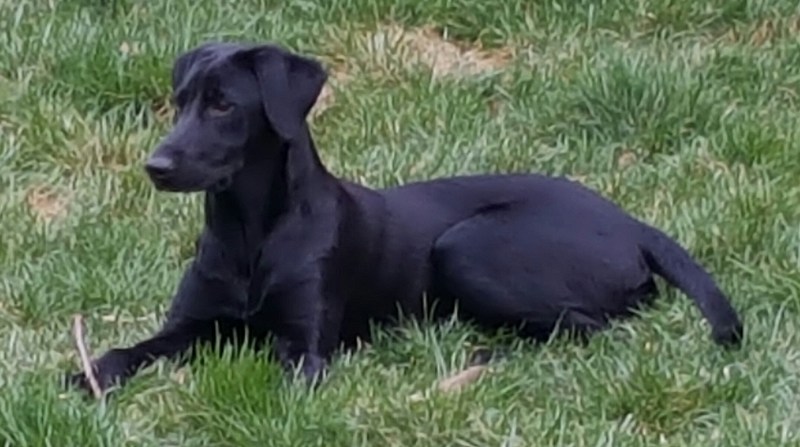
Waterdogs

Although it’s still winter and we’ve had some cold weather the last few weeks, yesterday had a high in the 60s and today reached the low 70s.

While I knew the water would still be cold, I thought today would still be a good opportunity to introduce Lightning to water deep enough for swimming. 

The process was straightforward and went well. I brought Laddie and Lightning out to a beach that we would have to ourselves and took off Lightning’s harness. I had brought two 2″ white bumpers. I threw one as far as I could without risking an injury to my back and sent Laddie. While he was swimming out, I tossed the other bumper into shallow water. Lightning immediately knew it was for him. 

Over a period of a few minutes, he worked up his courage to wade into the water and fetch the bumper. During this time, I didn’t prompt him or interact with him at all. When Laddie would return with his bumper, I’d throw it back out for him. I’m guessing seeing Laddie swimming may have normalized the idea of it for Lightning, but I can’t be sure. 

When Lightning finally retrieved the bumper from the shallow water, he ran around with it on shore for a little while and then dropped it. I immediately picked it up and threw it back out, just a little further. He brought it back sooner the second time and I continued to stretch the distance.

Around the seventh throw, the water was too deep for Lightning to retrieve without swimming. He launched himself, swam for the first time in his life, grabbed the bumper, swam back with it, and dropped it for me to throw again. 

I continued throwing bumpers for both dogs, throwing Lightning’s further each time till I was throwing it as far as I could, the same as Laddie’s. Lightning was confident swimming on every retrieve, though he still used a splashing puppy stroke and hasn’t yet learned to keep his paws under water.  

When the sun set, I brought them back to the van and towel dried them. I used our air blower on them when we got home, another new experience for the little one.

Tomorrow is supposed to be warmer than today. Along with other training, I’ll take them swimming again as early as I can arrange it. 

Trimming nails

Because I was never able to condition Lumi to having her nails trimmed without stress even after many attempts, I began having Carol, our holistic vet, take care of Lumi’s nails, and then Laddie’s as well when I got him about eight years ago.

When I got Lightning four months ago, I assumed I’d have Carol do his nails as well. But last month it was a huge struggle, and when we came for our latest appointment last weekend, he was uncomfortable around her. She did Laddie’s nails but not Lightning’s, and at the end she said, “You’re going to need to do Lightning’s nails, Lindsay. I won’t be able to take care of him if he’s afraid of me.” I could see that. Vaccinations, blood draws, chiropractic adjustments, and so forth would all be too difficult.

I’m pretty sure I could have started conditioning Lightning to let his nails be trimmed when he was younger using the same approach I’ll describe here, but at least I can say that this approach worked well for Lightning at the age of six months. Now he relaxes while I do his nails.

An online search will show you several articles and videos on how to use a Dremel to trim your dog’s nails. I read a couple of them and found them helpful. They describe what angles to use and how to get close to the quick but not too close. They even suggest a final coating of petroleum jelly or olive oil.

For equipment, I use a variable-speed, cordless Dremel with 120-grit bands, and I use it at or near the slowest speed, 5000 RPM. 

Here were the steps I used to condition Lightning to having his nails trimmed, a series of short sessions over a period of a couple of days:

  1. I’m right-handed, so I got Lightning comfortable lying quietly on his left side on the couch with all four feet accessible as I knelt on the floor beside him. He didn’t have to get into that position himself. Rather, I wrapped him up in my arms and lay him down. As he lay there, I gave him small dabs of PB from the end of my finger along with kisses, and I spoke softly and gently to him. At first, every time I released my hold, he tried to get up and I tightened my arms again to keep him restrained. His efforts diminished and finally I could release tension without him trying to get out of position. Once he was relaxed, I wrapped my hand for a moment around each of his feet, going from one to another in random order repeatedly, again offering dabs of PB, and again gently restraining him when he attempted to get up, till he remained still on his own. By the third session, when he readily relaxed, I began to separate his toes and touch his nails with my finger, accompanied by occasional tastes of PB At the end of each session, I released him with “OK” and he leapt off the couch.
  2. After a few such sessions, the next step was similar, except that I took each of Lightning’s paws and then touched the top of his nails with the Dremel turned off. Lightning readily allowed me to do this to his back paws. However, perhaps because of his experience with Carol and her grinder, he was adamantly opposed to the Dremel touching his front paws while lying on his side. Luckily, I found he was surprisingly relaxed about it when I put him on my lap with one arm wrapped around him to hold his front paws and hold the Dremel in my other hand. From then on, I found that a number of positions worked equally well.
  3. In the next step, I continued as before but now with the Dremel turned on, humming and vibrating, always at the lowest speed. At this stage, I touched him with the grinder’s handle and did not let the grinder wheel touch him.
  4. At last, starting with just a split second on each nail, I began to apply the grinder wheel lightly to his nails as I held each nail in position.
  5. I gradually reached my final version of nail trimming, where I still use no pressure and still don’t stay on any nail more than a second. I still give occasional dabs of PB during the process, though I may stop that eventually. I apply olive oil to the nails after trimming them. I plan to trim them about once a week. 

By the way, as long as I was going thru this process with Lightning, I went thru it with Laddie, too. I suppose he didn’t have the negative associations that Lightning had, because he was more relaxed from the beginning. I guess I’ll be able to take care of trimming nails for both of them from now on.

Update: See the follow-up post, Daily nail trimming (with video).

Returning thru cover

For a dog at Lightning’s stage, already with good experience returning well on marking retrieves, a particular challenge that needs to be addressed explicitly is returning thru obstacles such as cover, especially with a bird. This is a different picture from returning when the handler is in clear sight at the start line, and both of my Goldens tended to break down on their returns when we first began to train on such lines years ago.

So today, while driving around looking for a good place to throw a few poorman marks for Lightning, I spotted this area off the side of a dirt road in a nearby park :

20160304_160706

These were not long retrieves, but there were lots of landing spots I could throw the bird to where Lightning would have an obscured path back to me once he picked up the bird.

Not surpassingly, his first few returns were unsatisfactory. He would pick up the bird and then ignore my come-in whistle, instead playing with the bird or carrying it sideways or further away. On those retrieves, I had to go to him. If necessary I would have used his check cord to draw him back to the start line, but it didn’t happen to be necessary. Once I was close to him, he was willing to chase me back carrying the bird.

I don’t know whether further reinforcement than just the chance for another retrieve was necessary, but I had some sliced ham with me and used that to reinforce a whistle Sit once we were back at the start line. Not only did that create a strong positive association with the return, but Lightning also readily gave up the bird to get the treat.

After several retrieves that showed gradual improvement, Lightning finally began picking up the bird and coming straight back. A few more sessions in areas with high grass, both in clumps and strips, and other obstacles such as logs, mounds, and ditches, will hopefully strengthen Lightning’s returns even more.

Whistle sit

Since Lightning is not yet being trained to handle, he has no need for a whistle Sit cue, and we can only use a verbal Sit in most situations outside of field training. Whistles don’t go well in our house or in most public settings.

But the whistle Sit will play a vital role in approximately half of the retrieves Lightning will someday run in competition, namely the land and water  blinds, as well as occasional other use. So before running Laddie and Lightning on retrieves in yesterday’s session, I took a few minutes to train a whistle Sit to Lightning.

I had planned to use a mechanism called anticipatory response as the basis for transferring Lightning’s understanding of a verbal Sit to an alternate cue, a single whistle tweet, for the same behavior. To use that method, you give the new cue, and when the subject doesn’t respond, you give the known cue and reinforce when the subject responds. After s few trials, the subject begins to anticipate the known cue and responds to the earlier cue in order to receive the reinforcement sooner. Within anther trial or two, it’s no longer necessary to prompt with the older cue, and you can just practice with and reinforce responses to the new cue

So I had brought along sliced ham to use for reinforcement, but it turned out I didn’t need to prompt with a verbal Sit more than once or twice. Lightning seemed to have a natural Sit response to the single tweet, so all I needed to do was give him a bit of ham each time he responded correctly.

I didn’t want Lightning to learn the incorrect concept that he should always come in front of me to sit, so as soon as he was responding to the whistle, I moved about and used hand gestures to guide Lightning so that we could practice a wide variety of othec contexts for him to hear the whistle and respond, such as beside me at heel or at distance from me, trusting me to rush to him with his treat when he responded correctly.

Later I tried a sit whistle while Lightning was waiting for a mark to be thrown during retrieval practice, and he instantly sat without taking his eye off the gunner. I was pleased. That’s the kind of reflexive response I was aiming for. From now on, we’ll continue to practice and reinforce Lightning’s whistle Sit so it will already be available when we begin training handling in the next phase of our program.

Lightning at five months

Lightning has now been with me nearly four months. That included an initial six weeks of virtually no training as I dealt with the most acute phase of my back injury, another six weeks of the kind of early retriever training I had planned for Lightning, and then a prolonged winter period when weather conditions, including the historic blizzard known locally as Snowzilla, limited us exclusively at times to indoor training. Even that training was limited further by Lightning going thru teething and showing discomfort carrying even 2″ bumpers, so that he would carry them by their ropes instead.

As a result, I’ve decided to extend our schedule for the initial phase of Lightning’s training, rather than my original plan of moving into the next phase after teething.

As I mentioned previously, that’s not because we’re missing many checkmarks in our planned activities, based on Mike Lardy’s Socialization and Introduction to Field training phase. In fact, the only missing item I’m concerned about is introduction to water retrieves, and for that we’ll have to wait till the weather is warmer in our region regardless of our other training activities.

But just because Lightning has some experience with various skills doesn’t necessarily mean it’s time to go onto the next phase. Instead, I want him to have as deep and rich an experience with foundation skills as if we had been able to train outdoors this entire time. Hence the decision to extend this phase.

I think Lightning has pretty much finished teething, since he’s carrying 2″ bumpers by the bumper again instead of by the rope. And now the weather has been better for a few days, so we’ve had training sessions most days, though it snowed again last night. 

Here then are the things we’re continuing to work on:

  • Heeling. This involves practicing a number of maneuvers, including walking beside me and then sitting when I stop, coming toward me and then looping around at my side to sit facing the same way I am, and swinging from heel at one side to heel at the other. We practice all of those equally on both sides. I use high-value treats to reinforce every sit. I usually do not have to cue the sit. 
  • Self-control. For example, although Lightning loves to rough house with Ryley,  DW Renee’s 8mo Golden, he has also learned to stop and come to me when I cue Stop and Here, and then sit quietly at my feet or on the couch next to me for long durations while Ryley continues attempting to entice him to resume playing. 
  • Hippity-hop. My cue for what most trainers call “kennel”, cueing Lightning to jump up into his crate in the back of our van, accompanied if necessary by a sweeping hand gesture. I always reinforce with treats. Lightning is still quite small, but he’s big enough to jump into the back of our van. 
  • Leave it. We haven’t proofed this outdoors yet, but we often practice it in the house, typically with a treat in my hand or on the floor. This also gives Lightning an opportunity to learn “OK” as a release cue. 
  • Leash walking. This remains a challenge for me because of my back injury as well as because of the weather, but we practice it regularly. I’ve made no effort to merge it with Lightning’s heeling skills, which I regard as for shorter distances. For leash walking, I’m just looking for Lightning not to pull forward. It took years to get there with Lumi and Laddie, and Laddie still often pulls on lead, so I’m not expecting Lightning to become good at walking on a loose lead overnight. But it’s coming.
  • Catch. Lightning often brings me a tennis ball to throw to him so he can rise up on his hind legs and catch the ball in the air, over and over again. I haven’t worked on it outdoors yet. I’m a little worried that he could injure himself jumping, either landing the wrong way, or from the impact of repeated landings. So we just play catch in the house for now. After he’s 14mo and his plates have closed, jumping will be safer, though I’ll still need to be cautious to avoid a ligament tear.  
  • Retrieving. This, of course, is both our favorite activity. Whenever possible I get one or more assistants. I always ask for one bumper retrieve first, and then we train either with bumpers or ducks. We go a variety of different places to train, and I vary the terrain on the lines Lightning runs as much as possible: up, down, and across hillsides, running thru cover, changes of surface, and always avoiding running in mow lines, ditches, or other channels but always running across them on diagonals. Lightning still wears a 15′ check cord attached to his harness when we run retrieves, but he’s extremely reliable on his returns with bumpers and almost as reliable with ducks. We mostly run singles, but occasionally we throw in a double. I don’t require steadiness from Lightning and allow him to race out in the field as soon as the gun fires, and I have my assistants do the same when they’re handling him. I sometimes let him hunt if he misses the mark on his send-out, but I also often call for help from the gunner in those situations to instill in Lightning that looking for the gunner is a good Plan B.
  • Poorman retrieves. This is how Lightning and I, or Laddie and I, practice without an assistant. Lightning has become reliable at waiting in place at least till I throw, and most of the time also waits till I return to his side to send him. This self-control is related to steadiness, but has not and probably will not automatically transfer to steadiness during ordinary marking. I think that for most high energy, high prey-drive dogs, training for steadiness will be a separate and distinct activity in a later stage of training. I feel that too much emphasis on steadiness training in the early stages risks permanently impairing motivation, and that’s not a risk I want to take.

Despite the fact that Lightning seems to be past teething and has worked on nearly all of the items planned for this stage of training, he’s had no experience with flyers or water, and as I mentioned, he’s had far fewer training days than if we had been able to train as I would have wished by now. Since I don’t plan to run him in Derby, the only stake restricted to younger dogs, we have is no urgency to move on to the next stage of training. Instead, we’ll continue in the current stage, taking the time to lay a solid foundation for Lightning’s future career in field trial competition.