Doubles

As we’ve discussed, PRT Stage 2 follows Mike Lardy’s TRT Basics model of parallel training in yard work and field work. In TRT, that’s reflected in the TRT Flow Chart, the TRT video program, and the the TRM program, all key resources for the PRT program.

Lightning and I are now entering exciting new ground in both the yard and field progressions. As discussed in the previous post, it’s time to begin simple casting in the yard work.

On the field work side, we’re now ready to begin training doubles. Mike’s TRM program, including both the video segment on Doubles and the manual thru page 24, describe and illustrate the training process.

The only differences for the PRT program are these:

  • Obviously no collar, no collar conditioning, and no collar corrections or any other physical corrections. At this stage Mike only suggests a collar correction as an option for remedying a no-go anyway. I have never had a dog no-go at a training day or competition so I’m not an expert on dealing with the problem, but I believe Mike’s general explanation that such difficulties indicate you are trying to push the dog too fast is sage advice. In a word, back off. Work more on the Stage 2 skills you’ve already taught, and keep working on them till they’re easy, automatic, virtually reflexive for the dog. Then gradually move forward in the training progression, never skipping any steps.
  • In Mike’s videos, as reflected in his flow chart, the dog at this stage is still learning steadiness on a taut lead. In PRT, I don’t suggest ever using a taut lead, but instead suggest having the tab loose on every mark unless the dog tries to break. Only then does the tab become taut. As an example of how this is working, Lightning is completely steady quite often on gunner-thrown marks now, so he has little awareness that any relationship exists between being steady and wearing a tab. I believe that will pay off when, someday, he needs to be steady in competition, where he’ll be required to run with no collar. But by then, hopefully he’ll have been steady in training for a long time.
  • Mike’s material contains so much invaluable information that I’m reluctant to highlight any particular point for fear of inadvertently implying the other ideas are less important. But I don’t think it can be overstated that the dog should not be running a high percentage of doubles at this stage. Mike suggests no more than one in three multiple setups. He mentions one symptom of running too many multiples — head swinging — and the way to avoid the issue, and for that matter address it if it develops: running mostly singles off multiple guns. But just as importantly, running singles off multiple guns strengthens the dog’s marking in other ways besides teaching the dog not to head swing. Multiples are fun, challenging, and interesting, but pin-point marking is the foundation for a dog’s success in competition, and running singles off multiple guns is the tool to use throughout the dog’s career to continuously strengthen that foundation.

Lightning has been delivering to hand in our field work as well as yard work for several weeks now, so requiring delivery to hand, as Mike’s materials indicate, won’t be a change for Lightning and me in the field. However, now I’ll routinely have Lightning come to heel and sit before taking the bird, practicing both sides to keep them balanced. A dog is not required to come to heel for a competition delivery, but as Mike shows, it’s part of sound line mechanics when running the memory birds of a multiple. I’ve heard that Mike actually takes the last bird of a series from front position as the dog is approaching in competition, a way of letting the dog know that’s the last bird of the series. That’s not a universal practice, but I like it, though delivery at heel is also attractive.

Another issue is how to train doubles alone or with just one assistant. Certainly there’s no substitute in running doubles for going out with two gunners whenever possible. But since Lightning knows how to run a poorman single, we can put that skill to use to train doubles, too, using a modified version of the same three steps you’d use with two gunners:

  1. Bird-in-mouth: With a single gunner, you’d walk out to a stickman, throw the first single, walk back to the dog, send the dog to pick up the single you just threw, have the dog come to heel and hold the bird while the gunner throws the second mark, take the bird, and send the dog to pick up the second mark. Working alone, you’d walk out to one stickman, throw the first mark, walk back and run the dog on that mark, bring the dog to heel and facing a second stickman, take and discard the bird behind you, walk out and throw the second mark, walk back, and send the dog to the second mark. This loses the dog’s opportunity to watch a throw while holding the bird, but the dog still practices coming to heel to deliver and then (after a delay) watch the next throw. I think that having the dog hold a bird or bumper all that time would not be particularly beneficial, and could potentially be counterproductive to good mouthing habits.
  2. Throw memory bird as a single first, then run the double: With a single gunner, first have the dog run that mark. Then, have the same mark thrown again, leave the dog in a sit at the start line, walk out to a stickman and throw the second mark, go back to the dog and send for the second mark, and finally send for the memory bird, that is, the mark the gunner threw before the poorman mark. Working alone, throw a poorman single, then throw a poorman double with two stickmen, reiterating the single as the first throw and the last bird picked up. Without gunners it’s hard to get much distance and you don’t have anyone to help, so poorman doubles are a weak substitute for training with at least one gunner, and preferably two, but if the dog can do them, they do strengthen the dog’s concept of a double.
  3. Simple double. This is the same as the previous step but without throwing the single first.

As I’ve mentioned before, I avoid training with launchers, but many fine trainers user then when gunners aren’t available. I just can’t make any recommendations for using them effectively.

So now Lightning and I have our work cut out for us for some time to come. In our yard work, we’ll be working on simple casting, and in our field work, we’ll be working on singles off multiples as well as doubles. In both cases we’ll also continue to practice and strengthen all our previous Stage 2 skills. I expect that Lightning will turn 8mo before we go onto the next steps in our program.
Simple casting, no shopping

This morning was gloomy and damp with temps in the high 40s, and I wasn’t able to arrange for anyone to train with, but the dogs and I still had a good session.

First, I ran Laddie on a 300y+ blind through areas of knee-high grass and next to a line of trees.

Next I tossed a variety of bumper sizes and colors in a rough oval and had Laddie lie down in the center, and ran Lightning on a Walking Fetch proofing drill using that course. I heeled him on both sides, and I used all three variations of the drill — Fetch/Sit/Drop, Fetch/Heel/Here (past Laddie and one or more other bumpers) /Sit/Drop, and Here (without picking up a bumper) /Sit. I reinforced with bits of Muenster. Lightning’s performance was enthusiastic and sound throughout, and on top of the other Walking Fetch proofing setups we’ve run the last couple of weeks, I feel that Lightning is now ready for the next step in Stage 2 of our Positive Retriever Training (PRT) program, Simple casting.

The video segment “Simple Casting” in Mike Lardy’s TRT video, upon which PRT is modeled, is a masterful example of how to train skills, and casting skills in particular, incrementally. Watching it also gives you a sense of what to expect in your own dog’s work and the typical pace of progress over several days.

In Lightning’s case, after our morning session, Lightning and I reviewed the video and then started the training in our yard. Lightning was very interested in the video. He even tried to retrieve Mike’s bumpers on the screen twice!

I only saw a few changes to Mike’s approach that we’ll use for simple casting in PRT:

  • When working with a single bumper in one of more positions, we won’t use a line. We’re looking for solid responses to Here after each retrieve without physical enforcement.
  • We’ll use treats as little or as much as needed to optimize performance. In Lightning’s case, the fetches may be so self-reinforcing that treats would be a distraction, but we’ll use them if we see performance drop.
  • Of course we won’t use ear pinches. Treats play the corresponding role of reinforcing the Fetch in PRT.

As Mike explains in the video, about halfway thru the simple casting progression, we begin to use piles of bumpers rather than single bumpers. At that point, even in PRT, we want the dog on a line so that we can gently draw the dog away from the pile if necessary, not giving the dog an opportunity to shop.

I’m out with the dogs so much that, even though Lightning has officially been working on Walking Fetch, I’ve often cast him to bumpers lying in the field to save myself having to go and pick them up. Therefore, Lightning was readily able to do all the single-bumper variations Mike illustrates in the video in his first session. I only needed to switch verbal cues to “Over” and ”Back”. That was easy because Lightning didn’t really care what the verbal cue was, he was just looking for a release signaled by my body language so he could dart to the indicated bumper.

We’ll put on Lightning’s harness and check cord and begin working on casting to piles, continuing to follow the steps Mike explains in the TRT video, in our next simple casting session.

Update: As we worked thru the entire progression over several sessions, at one point I tried something with Lightning that Mike doesn’t do on the video: I made piles with collections of different sizes and colors of bumpers, including 3″ bumpers with ropes and streamers. Lightning’s performance deteriorated. But in the next session, I first tried one more time sticking entirely to 2″ white bumpers with ropes but no streamers. Lightning’s performance improved again immediately. Lightning is fine retrieving 3″ bumpers with ropes and streamers for marks in our field work, and I think they improve visibility and can even help improve a dog’s marking skill. But I wouldn’t use them, or any other distracting article, for the simple casting drill again.

First LWL ducks, first decoys

Today, Laddie, Lightning, and I had the opportunity to train with friend who is also a fine trainer, handler, and judge. He’s organized a small group for weekly training at an excellent property about an hour and half from home and was kind enough to include my dogs and me in the group.

Before we worked with the group, I ran Lightning on a Walking Fetch drill with a variety of bumper shapes and colors. He’s about equal in skill for all three drill variations, and we’ve continued proofing from day to day, but I’m not satisfied enough yet with the quality of his Here and Fetch responses in distracting environments to go onto our next yard work task, casting, though I can hardly wait to get to it.

Temps were in the mid-50s, borderline for water training, and I think some of the dogs might have shown some minor avoidance on their water entries. But it was great getting Laddie and Lightning some water work after weeks of land-only training.

We started with a four-blind drill that included two blinds tight past a gunner in a chair, and one of those was under the arc of a poison bird. Laddie had some difficulty with that one but got the entire drill done. The trainers could modify the work, of course, and I only saw one other trainer attempt the poison bird blind, but his dog ended up picking up the poison bird rather than continuing to the longer blind. I got to run Lightning on the poison bird as a mark. We practiced our line manners coming to the start line, I provided minor support with his tab to prevent a break, and he ran a nice mark, delivering the bird to hand. We don’t often get to work with birds, so I felt that was valuable. But for me, his nice return in a new and distracting location, and among unknown trainers and dogs, was the best part, since field recall was always the greatest challenge when I started training Lumi and Laddie for field.

Next came a Q-level water triple. Laddie ran it without help but cheated the water re-entries, so that’s something in addition to taking casts into wind that I want to focus on with him this spring.

After the big dogs had run the triple, my friend took some birds to one side of a 30-40y wide channel and I took Lightning to the other side, and my friend threw three walking land-water-land (LWL) singles, two well up the embankment and one at water’s edge. Lightning squared his water crossings but aside from that did a nice job, running straight to each bird once ashore, picking the bird up, and bringing it back to me across the water. This was only his fourth day of swimming, his second of LWL retrieves, and his first LWL retrieves with birds, so it was a good milestone.

The other milestone came earlier, while Lightning and I were waiting for my friend to set up on the other side of the water. Possibly because that water is sometimes used for Hunt Tests and Hunt Test training, there were several decoys floating in it. I’m not sure Lightning will ever see decoys in competition because I guess they’re not used in field trials, but it was a good opportunity to have him learn about them, so I threw a white bumper near a few of them for him. It’s always amusing to watch a young dog learning about decoys.

Although the day had all the highlights mentioned above, probably the best highlight for me came when my friend was ready to start throwing and I needed to wrap up the game I was playing with Lightning and the decoys. I had thrown the last bumper so that Lightning would have to swim past two decoys on the way to it and it had drifted pretty far out while Lightning was detouring around the decoys. Lightning lost track of his direction, and I guess it was a bit hard to distinguish the side view of the bumper from the decoys from his angle in the water. Since we haven’t trained casting, I had no trained way of getting him back on the correct line, and besides it was getting to be a pretty long swim. I thought I’d need to bring Laddie out of the van to pick the bumper up.

But first, I tried calling hey-hey-hey and faking a throw to the bumper. Lightning turned in the water and swam straight out to it, swimming past both decoys on the way out and the way back. It was just a simple Junior-level open-water retrieve to all appearances, but it was actually a nice addition to the rest of the day’s work given the subtle challenges involved.

Thinking like a dog

I’m continuing with Lightning’s yard work on PRT Formal Fetch step 4, proofing the Walking Fetch. Besides the training, it’s an interesting opportunity to observe a major difference in the way dogs and humans think.

How can Lightning, who is thoroughly fluent with the Walking Fetch performed with 2″ bumpers in the backyard, perform so badly when I try it with 3″ bumpers?

And then, why, when I go back and retrain it from Formal Fetch step 1 (Hold), and then proceed thru steps 2  (Fetch Game) and 3 (Walking Fetch), with 3″ bumpers, does he then become equally fluent with both sizes?

And yet, again, why doesn’t that fluency carry over to other proofing variations such as changes in location or terrain without additional retraining?

From a Behaviorist point of view, the answers to those questions don’t matter. You observe behavior and train accordingly. You don’t try to read the dog’s mind or emotions. You certainly don’t speculate that the dog is being spiteful, stubborn, stupid, or lazy, or exhibiting any other character flaw. You don’t expect the dog to generalize, for example by picking up a bird at training day based on yard training with a 2″ bumper. If the dog does so, great. If not, no surprise. The behavior just needs more proofing. That’s what step 4 is all about.

However, it’s also interesting to speculate: what is happening when the dog won’t pick up the 3″ bumper though fluent with 2″ bumpers? You’ve got high value treats available and the dog knows it. The dog wants those treats., and lunging for a 3″ bumper should be just as thrilling as for a 2″ one.

If you’re a dog trainer, you may have seen this or analogous situations before. From reading your dog, you may have your own theory of what is going on. I have my own. You may be right and I may be wrong, since I at least am not a doggie mind reader. But this is my theory.

Lightning simply doesn’t understand what I’m asking him to do. For the moment, set aside the facts that he knows the Fetch cue inside-out and the 3″ bumper is almost identical to a 2″ bumper. Instead, look at his behavior. He wants to respond, both because he wants the treat and because he’s come to love fetching to an almost fanatical degree. But for all the world, he has no idea what I’m asking him to do. He can’t even make a good guess. Run around in circles? Sit with tongue hanging out? Lick my hand or face? Dude, the bumpers right there! Fetch!

I think a tremendous number of instances of incorrect responses are simply that a dog’s mind is different from ours in judging similarity of one situation to another. As a result, if anything is different, the dog simply doesn’t know what you mean.

I find this theory helpful. But I think the Behaviorist approach is also fine. That is, don’t worry about why, just train based on observation of behavior.

What I don’t enjoy seeing is a trainer attributing bad motives to a dog who isn’t responding correctly, and then punishing the dog accordingly. What if the dog really doesn’t understand, no matter how obvious it is to you? Would you punish the dog that way if the dog really doesn’t understand? I don’t think so. At least I’d hope not.

Introducing retired guns

As Lightning continues building reinforcement history with the Walking Fetch in his yard work, a glance at Mike Lardy’s TRT Flow Chart shows that in the parallel field work column, the next training step is “Introduction to Simple Retired or Hidden Guns.”

Mike does not, however, cover that topic in the TRT program. Instead, he refers us to a separate program called Total Retriever Marking with Mike Lardy.  That program, which I’ll abbreviate TRM, is comprised of four discs and also includes a manual, which, per the manual itself, “contains significant material beyond what is on the video.”

For the purposes of this post, we are interested only in page 18 of the TRM manual, “Introduction to Retired and Hidden Gun (Manual only).” However, I think any trainer would benefit from first reading all of the manual up to that point and watching the corresponding TRM video material. I saw no conflict between our PRT program and any of that TRM material. Instead, I found it an opportunity to again watch one of the world’s great retriever trainers explaining his craft.

Little of the TRM material differed from our PRT program to this point. In some cases Mike used longer marks than I did with Lightning, for example when introducing singles of multiple guns, perhaps because I was working with a single assistant and couldn’t physically walk very far too three stickmen we were using. On the other hand, Mike recommended a much shorter distance for dogs at Lightning’s stage to be running marks than I’ve used at times. Mike seems fine with an upper limit of 125y or so, whereas Lightning has been running marks of 200y, 300y, and more at times for several weeks. Mike is a far more experienced and knowledgeable trainer, and I’ll begin to follow his guidelines on distance now that I’ve heard them. But fortunately Lightning has good natural marking ability and seems generally to be running straight to marks in spite of my error.

For our purposes, every sentence on page 18 of the TRM manual contains critical information with the exception of the second paragraph followed by a bullet item, both about hidden guns. Since I’m training Lightning for field trials, he may never run a series with a hidden gun, so we won’t focus on training for hidden guns. However, if you’re training for hunt tests, hidden guns are the norm and retired guns don’t occur.

For introducing Lightning to retired guns, I took the dogs out with an assistant and we used walking singles and also singles off multiple guns. The gunner would retire behind a nearby tree or other object, or by sitting down on a chair and opening a camouflage umbrella. At this stage, I felt letting Lightning watch the gun retire before sending him was beneficial because it showed him the concept, rather than having the gun magically disappear while he was retrieving a different mark, as will occur in more advanced setups.

In fact, Lightning had already been introduced to the concept of a retired gun because a poorman mark requires the dog to run the mark after the gunner has walked back and become the handler. Lightning has run many poorman marks when we were training with no assistant, so he had already seen many retired marks.

Because the dog might get lost, retired marks are not ideal for building the dog’s confidence on running straight to the fall, which I believe is why Mike doesn’t recommend including a high percentage of them in the dog’s field work at this stage. But at the same time, retired guns can also help promote running straight to the fall: on a retired mark, the dog can’t succeed by running to the gun first and then hunting up the bird, because the gun’s not visible. So practicing occasional retired guns helps train the dog to run straight to the fall, not toward the gun.

For our land-based field work, I’m continuing to run Lightning mostly on walking singles and singles off multiple guns, sprinkling in occasional retired guns and occasional doubles, or running poorman marks when no assistant is available. I’ll go on with such sessions, continuously strengthening Lightning’s marking skills, until I finish proofing Lightning’s Walking Fetch in his yard work. At that point, we’ll be ready to advance to the next steps in both yard and field work.


Installing an off switch

I’m not sure all dogs in all situations need an off switch. But we have three big dogs and two are less than a year old, so without some intervention the house would be in an uproar for hours at a time with their wrestling. Yes, we can and do separate them with physical barriers, but I like having them in the same room with me yet able to relax when I want them to, and that takes a little training.

Actually, I did this training with Lightning months ago without thinking much about it. But when I repeated the training today with Ryley, my wife’s big Golden, I realized it’s not really that obvious how to do it and might be helpful to explain.

My version of an off switch is calling the dog up onto the couch next to me, where he/she can nap or he/she can watch the world but not interact. Other variations include training the dog to lie on a mat while you engage in other activities near by, or training the dog to lie down on the floor beside you.

I only have one rule for this training: if you’re the dog, you cannot leave until I say so. I accomplish this by physically restraining you. For example, if you manage to get partially down, I wrap my arms around  you and pull you gently back up. If you brace your feet against me or the couch in preparation for a break, I gently move them so that you’re not braced any more.

In the first session, I maintain physical contact for a long time. With Ryley, it was a good twenty minutes. Once he started to relax, I released my grasp a little, and then began a gradual process of tightening if he started to prepare for a break, loosening in response to him relaxing.

I had no other rules. He was allowed to sit up or lie down, face any direction, shift as much as he wanted. Of course it took some guesswork whether he was preparing to break when he shifted, and sometimes he was, but as long as I never let him get all the way down, but always brought him back up to me, over a period of about an hour he gradually stopped trying to escape entirely. He got lots of petting and encouragement, and I got occasional kisses. It was not a battle, just quiet, gentle, friendly training. 

I’ll repeat this with Ryley several times over the next few days, and expect that it will get easier and easier. Eventually, as with Laddie and Lightning, I expect that I’ll be able to pat the seat cushion next to me a couple of times and he’ll disengage from whatever activity he’s in the middle of, jump up, and curl up next to me. If he doesn’t in some of my earlier requests, I’ll go to him and lead him up onto the couch. But as the Borg say, resistance is futile. That’s the key.

Again, other people train variations on this version of relaxing and variations on the cue for it.

What about using treats for this training? I know some people use treats and others don’t. For my approach they wouldn’t add any value, and they also introduce the risk of accidentally training an undesirable behavior chain: the dog tries to break, you stop him, he relaxes, you give him a treat. Unfortunately, if you’re not careful, you’re training him to attempt a break whenever he wants a cookie. Obviously if you are using treats, stay away from inadvertently reinforcing that sort of behavior chain.

I’m not sure this kind of procedure is possible with every dog. If the dog showed any sign of viciousness, for example, that’s outside my area of experience and you need to get advice from someone else.

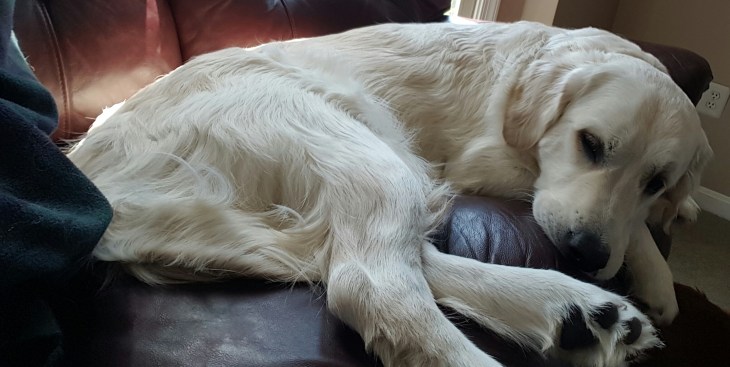
Otherwise, it might be a useful thing to train. Here’s Ryley relaxing next to me on the couch, a new skill he just learned today. Below is Lightning, who jumped up on the other side of me on his own. Laddie, not shown, was curled up at my feet.

20160414_12515120160414_125232

Formal Fetch step 4: Proofing the Walking Fetch

In Mike Lardy’s TRT program, the last step of Force Fetch is called Stick Fetch. The corresponding step in the PRT program is called Proofing the Walking Fetch. As with Mike’s program, the goals are to enable the dog to perform well with distractions, and to develop a powerful compulsion to retrieve and deliver even under difficult conditions. The difference is that we build that compulsion with positive (reward) rather than negative (avoidance) reinforcement.

The following checklists cover a cross-section of Walking Fetch proofing variations, which we’ll use in combinations to test the dog, and as a guide for strengthening reinforcement history wherever needed:

Locations

  • Indoors
  • Yard
  • Enclosed field
  • Meadow
  • Vicinity of training group
  • Training group
  • Vicinity of event

Surfaces

  • Grass, even and uneven
  • Dirt
  • Swampy ground
  • Shallow water

Distractions

  • Food
  • Toys and balls, placed and thrown
  • Bumper and birds, placed and thrown
  • Live birds
  • Children and adults, familiar and strange
  • Dogs, familiar and strange

Articles

  • Colors of bumpers
  • Sizes of bumpers
  • Ducks and pheasants, male and female
  • Warm and cold birds
  • Fluffy and wet birds

Once the dog is able to perform Walking Fetch under all those conditions in any combination, the dog is ready for some of the most difficult conditions of receiving a Fetch cue that might occur in competition. Of course you won’t be giving treats in that situation. In fact, you may not be using treats in the field at all, in training or competition. But this yard work has given the dog has a high reinforcement history for fetch and delivering, and the integration of those behaviors into retrieving in the field will continue to act as powerful intrinsic reinforcement.

In addition, the dog learns that delivery often leads to another retrieve, possibly the strongest reinforcer in a retriever’s psyche. Every time that happens in the dog’s training and competition career, the delivery is again reinforced.

With the accomplishment of proofing the Walking Fetch, Formal Fetch training in PRT’s yard work progression is complete.Then, based on Mike’s TRT Flow Chart, as shown in the parallel paths of yard work and field work, the dog is ready for us to start requiring delivery to hand in PRT’s field work progression. Whereas that requirement might have worked against our goals in earlier training because the dog might have been reluctant to return to the handler when it meant giving up the prized article, now delivery to hand, with its high reinforcement history from our Formal Fetch training, is integrated into the dog’s concept of the retrieve pattern. We are ready to go onto the next step of yard work. 

Training with a field trial group

Typically, a puppy being trained for field trial competition will have trained with field trial groups many times by the time the puppy is 7mo. But due to circumstances such as my health and the severe winter, as well as the general difficulty of getting invited to train with field trial groups, yesterday was actually our first opportunity this year and Lightning’s first ever. It is impossible to overstate how grateful I am for such opportunities.

While we were waiting for the group training to start, I aired the dogs and then set up a Walking Fetch course for Lightning’s first session with that drill, which I described in an earlier post.

Out of curiosity, I ran Laddie on the course first. It was a trivial drill for him and he showed his usual over-the-top exuberance for the work.

Next I ran Lightning on the course. He did great with the Fetch cue but couldn’t bypass a bumper without trying to fetch it. That’s why we worked on distraction proofing this morning, that is, the next day, also described in an earlier post.

For group training, the pro had designed an unusual and difficult all-age level quad with a flyer for the first series, and a double blind with both blinds past the flyer station for the second series, which Lightning of course sat out.

After taking a turn working at one of the gun stations for awhile, I ran Laddie in the first series as a double double, and later, ran him on both blinds. From that work, I saw that Laddie was sound physically, which is great, but a little rusty on his skills, especially taking casts into the wind. I also saw that I was extremely rusty as a handler for both the marks and the blind. For example, when Laddie stepped off the mat while I was calling for the first double, I stepped off also rather than calling him back to heel. And when he repeatedly refused casts into the wind, I just kept recasting him rather than walking out to get him and rerunning the blind. 

When it was Lightning’s turn to run the quad, I called for four singles, and for the first mark ran him with his 15′ check cord in case he decided to play keep-away on his return. But even though four gun stations and all those white jackets were in view, plus additional white diamond-shaped stickmen, adding up to a potentially confusing picture for an inexperienced dog, he picked up the bird and ran all the way back to me with it, never dropping it, and delivered it to my hand though I’m not yet requiring it.

I was pleased, and would guess that our work with stickmen last week, plus of course all our previous training, paid off in the quality of his return. I took off his check cord, leaving him wearing only a flat collar with a tab, and decided to call for a double with two of the remaining marks, the flyer as the go-bird. Again, his returns were excellent, with no dropped birds and delivery to hand both times.

Finally I ran him on the 300y+ mark. Again he picked up the bird, ran all the way back, and delivered to hand.

I held Lightning’s tab loosely to prevent a break on every mark. It was necessary but only barely so. He attempted breaks for an instant till the tab went taut, then he would drop back down into an alert, coiled sit. We also rehearsed good line manners, coming out of the holding blind for the first mark and coming to heel after each delivery.

In terms of where we are in Lightning’s field work, I felt especially good about his returns, since I’ve found the field recall to be the most challenging skill for a positive trainer to train.

On the other hand, though Lightning took good lines on the marks, he needed help from the gunners finding the birds on every mark, or at least I called for help rather than allowing him to hunt outside the area of the fall. I also simplified Lightning’s first mark, which was supposed to be an odd semi-retired mark where the gunner stays visible but moves a considerable distance away from the original throwing position while the dog is picking up the go-bird. For Lightning, I just asked the gunner to sit down after the throw without moving away. In addition, Lightning and I had to move up before I could get him to lock in on the long mark, which was in a hip pocket configuration with the flyer and was thru a stand of trees besides being so long. Of course I didn’t retire the long mark either.

That’s how the day went. It was long and physically grueling, at least for me, but for all of us, immensely rewarding.

Formal Fetch step 3: Walking Fetch

Lightning’s work with the Fetch Game and response to the Fetch cue are now so enthusiastic that it’s time for us to go onto the next step of Formal Fetch training, corresponding to Force Fetch in Mike Lardy’s TRT video. For both TRT and our.PRT program, the next step is  the Walking Fetch drill.

The PRT Walking Fetch is the same as the TRT Walking Fetch with the following exceptions:

  • We don’t use ear pinches.
  • Instead, we use high value reinforcers such as bits of cheese or meat to build high reinforcement history for fetching and delivering
  • We don’t walk the dog on a lead, but instead rely on a high Rate of Reinforcement (ROR) to keep the dog engaged and to shape correct responses.
  • We train for fluent heeling on both sides.

As Mike demonstrates in the video, we start with a field of scattered 2″ white bumpers. Then we walk the dog at heel, sometimes on our left and sometimes on our right, past each bumper, turning thru the field of bumpers randomly and often. As we walk,  we want to have good responses for any of the following three variations:

  • Cue Fetch, then Sit, then Drop (take the bumper), give treat, then cue Here to continue walking.
  • Cue Fetch, then Here and walk past one or more bumpers, then Sit, then Drop (take the bumper), give treat, then cue Here to continue walking.
  • Walk past one or more bumpers without carrying a bumper and without cueing Fetch, but cueing Here if necessary, give treat

If the dog isn’t as fluent with one of the variations as the others, we’ll ask for that variation more often, giving us more opportunities to reinforce a correct response.

As the video’s narrator mentions, our goal with this drill is for the dog consistently to show the kind of lunging enthusiasm Mike’s dog shows on each Fetch cue.

But for the PRT program, Walking Fetch also has a broader goal: to develop a high level of skill with all the cues involved. Therefore it’s not time to finish working on Walking Fetxh until the dog exhibits fluency on all three variations, being able to bypass bumpers off lead as well as having great responses to Fetch, Sit, and Drop, plus Here with or without a bumper, while heeling on either side.

The first time I tried this with Lightning, I got great responses to the first two variations, but he could not do the third variation, which doesn’t include picking up a bumper. So for our next session, I started with the distraction-proofing training plan described in the previous post, and at the end, varied whether to cue Here in order to bypass the bumper, or to cue Fetch for Lightning lunge for the bumper. That worked, but Lightning’s enthusiasm for the Fetch was somewhat diminished from previously, probably because he wasn’t quite certain what the rules are yet.

Obviously we’ll continue working on the Walking Fetch until Lightning is completely fluent with both Here and Fetch, and meanwhile his enthusiasm for Fetch has fully returned.

Then we’ll go onto step 4 of the PRT Formal Fetch training, thoroughly proofing the Walking Fetch, which I’ll discuss in a separate post.

Distraction proofing

I’m now going to tell you about one of the most magical dog training methods in the world. It’s magical because it doesn’t seem possible that it would work so well, but if you try it, you’ll see that it does.

Let’s say the dog has a favorite article that she is just crazy about. You have no problem with her enjoying it, but she ignores you when you try to you call her away from it. The article might be an inanimate object, such as a bumper, or a bird from the freezer. It might be food. It might be children. It might be other dogs or other animals. It might be several of these things or other things if I’ve somehow left anything out. For Lightning, it’s all of the items I mentioned except food.

I need to fix all of them for Lightning eventually. That’s the whole point of recall. But let’s start with the bumper, since I have an immediate need to fix that now that Lightning and I have begun working on the Walking Fetch drill (see next post). 

There are two versions of this method. First, the version I was taught years ago:

  1. Place the article on the ground in an area free of distractions.
  2. Take the dog off-lead to a position some distance away, where the dog can easily see the article but because of the distance from the article is focusing on you instead. That could be 100’away or 20′, or any other distance, depending on the dog and the article.
  3. Stand sideways to the article and toss a high-value treat a few feet in front of you.
  4. Watch the dog run to get the treat and then use your recall cue to call the dog back to you. For an American field retriever, the recall cue is Here.
  5. If the dog glanced at the article either running to the treat or coming back to you, you’re too close. This is the “no-glance” rule and is the key to the magic. If the dog did glance, take a side-step away from the article.
  6. If the dog did not glance at the article, take a side-step toward the article.
  7. Continue in that way over and over, gradually moving closer to the article, until you can toss the treat over the article. My Lumi-girl was fanatical about her volleyball when she was a young dog. When I used this method to proof her, she actually tripped on the volleyball, so intent was she not to glance at it as she ran to her treat and then ran back to me. I couldn’t believe it.
  8. Although we usually train in short sessions, take as long as you need to complete the training for one article, assuming the dog stays engaged. If you need to start pretty far away, it can take a while to get all the way to the article.
  9. Over time, proof for other directions at the same location, and other locations, retraining as needed. 

Here’s an alternate version:

  1. It’s the same as the first version, except that instead of tossing the treat, you heel the dog back and forth with the article to your side. As you walk one direction, the dog is on your left and the article is some distance away on your left. As you walk the opposite direction, the dog and article are now on your right.
  2. The sequence is: Cue Here, then walk a few paces, then turn 180 degrees facing the dog as you turn. The dog wiil naturally turn toward you at the same time, that doesn’t need to be trained. When you’re facing the way you came, cue Heel if necessary to bring the dog to heel position, then cue Sit. Give the dog a taste of a high-value treat. You can use the same kind of treats as for the first version, but you can also use non-throwable treats like a taste of PB, cream cheese, or cat food. 
  3. As before, walk closer the next time if the dog did not glance at the article, but follow the no-glance rule and move further away if the dog did glance at the article.

The advantage of the second version for field retrievers is that you get to practice, and build reinforcement history, for heeling on both sides as well as the formal obedience cues Heel, Here, and Sit.

But in terms of distraction proofing, both versions are wonderfully, indeed magically, effective.