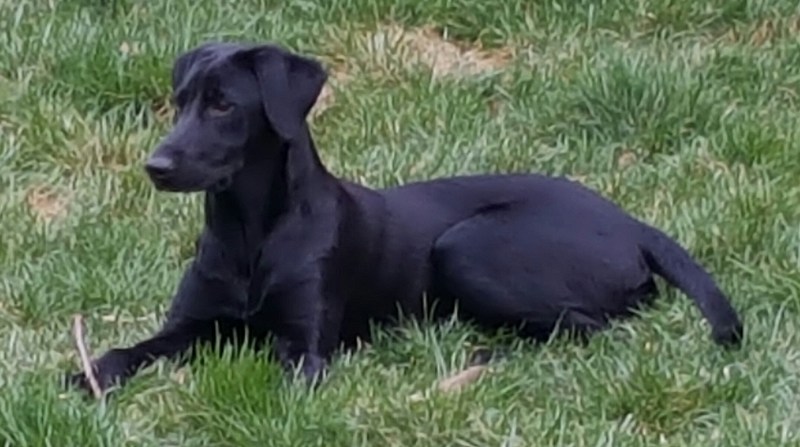
Referring to the TRT Flow Chart’s “Basics” section and the right column called “Field Work”, I think Lightning is a bit ahead of the game on lead steady. But I want to continue working with him on singles with guns out till his returns with multiple guns out (or stickmen out) are satisfactory.
Meanwhile, I’m satisfied with his performance on formal obedience for the “Yard Work” column, especially because we’ve now integrated those skills into every retrieve in the field, so we’ll continue to work on them continuously anyway.
Therefore, we’ll stay with the first two items for field work, but we’ll go onto the next item for yard work. In TRT Basics it’s called “Force Fetch”, but in PRT Stage 2 we’ll call it “Formal Fetch”. I’ve also heard it called “Trained Retrieve”. Whatever the name, it consists of training three cues: Fetch, Hold, and Drop. (I’ve always used “Out” but we’ll switch to “Drop” for consistency with TRT.)
You can learn a positive approach to training a formal retrieve from several online websites and videos. Generally they use an approach called back-chaining, which trains the cues in the reverse order they’ll occur. So first you train Drop, and then Hold, and finally Fetch. As the dog learns Hold and Fetch, he/she already knows what comes next, so the whole chain accumulates reinforcement history.
For PRT, however, we’ve already trained a version of Fetch we called “Take it” and a version of Drop we called “Out”. Lightning has been pretty fluent with both for a couple of months. So other than the names, only Hold is new to us at this point.
Coincidentally, Hold is where Mike begins training Force Fetch. That’s what we’ll work on now for Formal Fetch as well.
But at this point, I’ll depart entirely from Mike’s approach. Rather than copying Mike’s style of teaching Hold, let’s define a specific behavior chain and then shape it, that is, incrementally improve and reinforce each version of each step until the dog can perform the entire chain fluently.
Our definition for Hold will be that the dog be able to:
- Stay in a remote sit holding a 2″ bumper while we walk some distance away.
- On verbal Here or whistle Come-in, come to front position and, with a verbal or whistle Sit cue if needed, sit in front position while still holding the bumper.
- On Heel and a hand gesture, stand up, swing to heel position on either side, and, with a verbal or whistle Sit if needed, sit while still holding the bumper.
- Continue to hold the bumper even if we place our hand near or on the dog’s head or chest, or touch the bumper’s rope, or tap the bumper in any direction, without saying Drop.
- When we finally grasp the bumper and say Drop, the dog should instantly open his/her mouth and pull his/her mouth away from the bumper.
Because of Lightning’s earlier training as described in previous posts, and no doubt thanks to his instincts as well, sometimes, in a non-distracting room of the house, he is already able to do an approximation of that entire behavior chain. He even seems to find it self-reinforcing, so on those occasions I don’t seem to need any extrinsic reinforcement such as treats, tug, or a thrown ball.
But other times, we need a traditional shaping session. The first one, for example, looked like this:
- I tried sliced hot dogs but Lightning wasn’t interested enough. So I switched to a small bowl of cream cheese, which I dipped my finger in to give him a taste when I wanted to reinforce a correct response.
- I tried working from a standing position but leaning over was too hard on my back so I switched to sitting down on the lower steps of our stairs.
- We did about thirty trials in rapid succession.
- For most trials I started with a verbal Sit cue, since Lightning generally popped up after each trial. Sometimes I just let him keep standing.
- I presented the horizontal bumper in front of his mouth. Most of the time he just grabbed it. Occasionally he didn’t and I said “Take it,” and then he’d grab it.
- This next point might have been the most difficult for an observer to see, but it was also the most critical. Lightning would let go of the bumper after a split second. I needed to use the cream cheese to reinforce the Hold moment, not the let-go moment. Yet I also had two other imperatives: First, I needed to maintain a high Rate of Reinforcement (ROR) to keep him fully engaged, having as many successful trials per minute as possible. And second, I needed to gradually increase the amount of time he held the bumper before trying to drop it.
- Because my timing was reasonably good, it gradually dawned on Lightning that he would not get the reward if he opened his mouth before I said Good (I also could have used a clicker), but he would get the treat if I said Good (or clicked) while he still had a tight grip. Once I saw that dawning comprehension, after eight or ten trials, I began saying Hold the instant he closed his mouth on the bumper.
- Then, gradually, he held on a tiny fraction of a second longer after each few trials, though with plenty of backsliding.
- When he was clearly, intentionally, holding on for nearly a full second, we did one more trial, the best of the session. I said Good and took the bumper, and I presented the bowl for him to lick the rest of the cream cheese.
So as you can see, in a span of a few hours, we trained the behavior chain as if we were close to completing the indoor phase of this training, and later had to do a beginner’s session just trying to get Lightning to hold the bumper for a full second. For a third session later that day, with a slice of Muenster cheese folded into 16 pieces, we still couldn’t get a good version of the behavior chain, but Lightning had jumped between sessions to being able to hold the bumper in a sit for several seconds. For the final few trials, i tossed his piece of cheese behind him so he jumped up and ran to get it, then came back to me. While he was standing in front of me, I presented the bumper to him and cued Sit. The first time I did that, he dropped the bumper, and of course no treat. The next several times he sat down without dropping the bumper. Yay! Hold is a difficult skill to train.
In fact, it’s worth pointing out that as with many natural retrievers, after months of the dog retrieving marks, it would be reasonable to think, Oh, my dog already knows how to retrieve. That’s where the word “formal” comes in. Up till now, Lightning’s been doing an informal Fetch approximation. It won’t stand up in competition. It’s the formal training we’re doing now that will prepare him for the rigors and distractions he’ll someday face in the exhilaration and demands of an event.
On a theoretical note, I believe that traditional trainers view this training as forcing the dog to perform the various skills of Force Fetch. I see it differently. What I see happening is that faced repeatedly with a particular scenario, the dog, having experienced the outcome of various choices, learns to choose the behavior that produces the most desirable outcome. In other words, what feels best. From that perspective, Mike and I are doing much the same thing. Mike’s dogs feel best when their chins don’t get cuffed. My dogs feel best when they get a reward. The results are the same but I get to avoid using a physical aversive.
Over the next few days and weeks, using a large number of short sessions, we’ll continue shaping Lightning’s indoor performance until he’s solid on every step of the behavior chain, as well of course as being able to hold like the dog in Mike’s video.
When we finally have the behavior chain trained indoors, we’ll take it to the yard outside the house and re-train it there, and then again at various training locations.
When we’re done, this behavior chain, eventually minus the extra Sit in the middle, will be our delivery to hand and we’ll use it for all future retrieves. (We’ll need to train Hold for coming out of water eventually, too, but we’ll discuss that later.)
The Hold behavior chain won’t finish our yard work for the Formal Fetch, but it will satisfy our requirements for the first step, Hold, and as it happens, it will also satisfy our requirements for delivery to hand.
How long will training Hold take? That depends on the dog. I think about three weeks for Lightning, but again, Hold is difficult, and it could take longer. Nonetheless, it’s worth every second of the investment to have a solid Hold and delivery to hand.
 Lightning's Journal