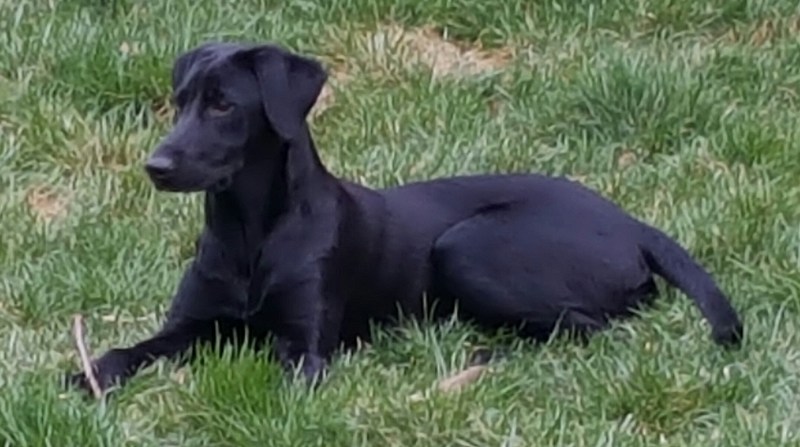
Well, my estimate for how long it would take Lightning to learn the Hold behavior chain I described in my previous post was far too pessimistic. For the indoor training, it actually took six short sessions, five yesterday and one this morning. For this last session, I broke a piece of Muenster into eight pieces but we only needed six trials, alternating left and right heel and in various indoor locations, to establish that that chain is now solid indoors. I don’t think it will take long to proof outdoors.
But that probably won’t happen today. After temps in the low 80s at times last week, this morning we had wind chills in the teens with winds gusting to 45mph.
In the meantime, we’ll start the next step of our yard work. In the TRT program’s section on Force Fetch, Mike Lardy calls this step “Ear Pinch”. In our PRT program’s section on Formal Fetch, we’ll call it “the Fetch Game”.
After again reviewing Mike’s video presentation on Ear Pinch, giving a sense of our performance objective, we’ll again depart entirely from the training method we’ll use to achieve it.
The behavior sequence for the Fetch Game in PRT is as follows:
- Leave the dog in a sit with the bumper somewhere near him/her. Don’t let the dog pick up the bumper yet.
- Walk a short distance from the dog and turn to face him/her.
- Cue Fetch. While you remain still, the dog is to grab the bumper and start running toward you.
- Run away shouting and laughing, darting left and right, possibly hiding behind trees or other objects.
- When the dog catches you, bring him/her to a sit in heel position, grasp the bumper, and cue Drop.
- Put the bumper down again somewhere in the dog’s vicinity, and walk away again for the next trial. For the hardest version, put the bumper behind the dog.
The theory behind the Fetch Game is that for Lightning, and I think for most retrievers and other predators as well, one of the best parts of a retrieve is the chase. The trouble with the normal retrieve pattern is that the chase comes first, making the return and delivery something less to look forward to, that is, less reinforcing.
The Fetch Game reverses that pattern. Instead of a chase to the prey, the chase comes after the pick up, providing one of the strongest intrinsic reinforcers in the dog’s psyche. That’s why it’s important not to start running away with all that excitement until the dog has grabbed the bumper. The grab itself is the behavior we want to reinforce.
Although our behavior chain is different from Mike’s, we’ll follow the same model he does of shaping the behavior incrementally. For example, we’ll place the bumper between the dog and us at first, and we won’t require the full delivery sequence at first. If the dog doesn’t run to us as soon as we say Fetch, we’ll say Here a moment later until that’s no longer needed. If the dog doesn’t pick up the bumper on the way, we’ll do a mini-retrieve at first, tossing the bumper a short distance, cueing Fetch, waiting a moment while the dog runs to the bumper, and running away excitedly at the instant the dog grabs the bumper. After two or three trials, we’ll experiment with fading out the toss and just placing the bumper on the ground until the dog has the idea. If the dog simply doesn’t seem to understand that Fetch means to grab the bumper, we’ll start with a session or more of incrementally shaping that behavior, much as Mike does in the video but using treats for reinforcement rather than ear pinches. Then we can build the really high reinforcement history for Fetch using the Fetch Game.
I’ll leave it to your imagination to come up with your own solutions to building the Fetch Game behavior chain incrementally, so that you can get to the point of being able to play the final version. If you’re lucky, the dog will respond correctly from the first trial, as Lightning did.
You could start this game indoors, as I did because of the unpleasant weather, or in the yard from the beginning. Unlike the comparatively difficult to train Hold cue, your dog, like Lightning, may pretty much understand Fetch immediately given his/her months of previous work in the PRT program.
Once learned, proof the Fetch Game for a wide variety of locations and distractions. For example, a cool version would be to place a thawed bird in some shallow water, cue Fetch, and have the dog grab the bird, chase you, and deliver the bird after getting to you thru some reeds or swampy terrain.
Even after Lightning is fluent with the Fetch Game, I plan to continue practicing it occasionally for some time. I believe that the more I practice reinforcing him with a chase after he has picked up the article on the Fetch cue, the greater will be his reinforcement history for grabbing the article on cue and delivering it. But I’ll be sure also to practice a Fetch, Heel, and delivery right near me, since that’s a common situation. Then, his Fetch response will be available that day when he drops a bird on the return during a competition and I need him to pick it up and complete the delivery to avoid disqualification. The judges won’t be thrilled with the dropped bird, but hopefully they’ll be pleased with Lightning’s well-trained Fetch response.
 Lightning's Journal