
I’m not sure all dogs in all situations need an off switch. But we have three big dogs and two are less than a year old, so without some intervention the house would be in an uproar for hours at a time with their wrestling. Yes, we can and do separate them with physical barriers, but I like having them in the same room with me yet able to relax when I want them to, and that takes a little training.
Actually, I did this training with Lightning months ago without thinking much about it. But when I repeated the training today with Ryley, my wife’s big Golden, I realized it’s not really that obvious how to do it and might be helpful to explain.
My version of an off switch is calling the dog up onto the couch next to me, where he/she can nap or he/she can watch the world but not interact. Other variations include training the dog to lie on a mat while you engage in other activities near by, or training the dog to lie down on the floor beside you.
I only have one rule for this training: if you’re the dog, you cannot leave until I say so. I accomplish this by physically restraining you. For example, if you manage to get partially down, I wrap my arms around you and pull you gently back up. If you brace your feet against me or the couch in preparation for a break, I gently move them so that you’re not braced any more.
In the first session, I maintain physical contact for a long time. With Ryley, it was a good twenty minutes. Once he started to relax, I released my grasp a little, and then began a gradual process of tightening if he started to prepare for a break, loosening in response to him relaxing.
I had no other rules. He was allowed to sit up or lie down, face any direction, shift as much as he wanted. Of course it took some guesswork whether he was preparing to break when he shifted, and sometimes he was, but as long as I never let him get all the way down, but always brought him back up to me, over a period of about an hour he gradually stopped trying to escape entirely. He got lots of petting and encouragement, and I got occasional kisses. It was not a battle, just quiet, gentle, friendly training.
I’ll repeat this with Ryley several times over the next few days, and expect that it will get easier and easier. Eventually, as with Laddie and Lightning, I expect that I’ll be able to pat the seat cushion next to me a couple of times and he’ll disengage from whatever activity he’s in the middle of, jump up, and curl up next to me. If he doesn’t in some of my earlier requests, I’ll go to him and lead him up onto the couch. But as the Borg say, resistance is futile. That’s the key.
Again, other people train variations on this version of relaxing and variations on the cue for it.
What about using treats for this training? I know some people use treats and others don’t. For my approach they wouldn’t add any value, and they also introduce the risk of accidentally training an undesirable behavior chain: the dog tries to break, you stop him, he relaxes, you give him a treat. Unfortunately, if you’re not careful, you’re training him to attempt a break whenever he wants a cookie. Obviously if you are using treats, stay away from inadvertently reinforcing that sort of behavior chain.
I’m not sure this kind of procedure is possible with every dog. If the dog showed any sign of viciousness, for example, that’s outside my area of experience and you need to get advice from someone else.
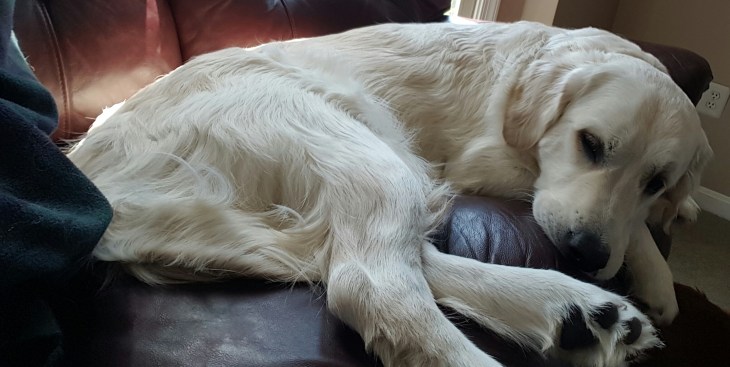
Otherwise, it might be a useful thing to train. Here’s Ryley relaxing next to me on the couch, a new skill he just learned today. Below is Lightning, who jumped up on the other side of me on his own. Laddie, not shown, was curled up at my feet.

 Lightning's Journal