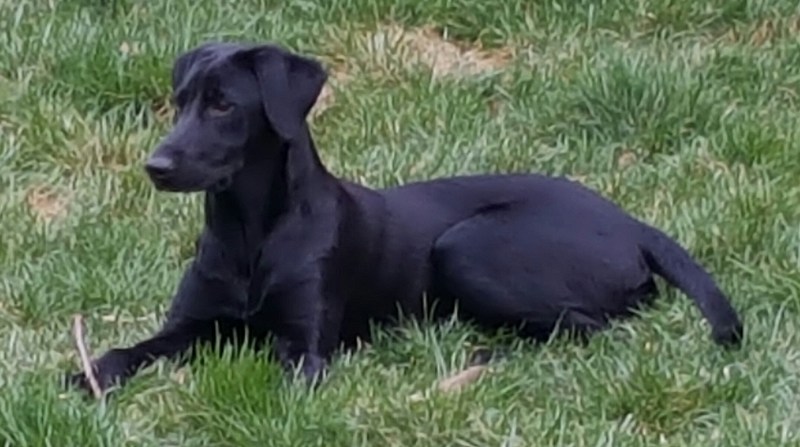
As Lightning continues building reinforcement history with the Walking Fetch in his yard work, a glance at Mike Lardy’s TRT Flow Chart shows that in the parallel field work column, the next training step is “Introduction to Simple Retired or Hidden Guns.”
Mike does not, however, cover that topic in the TRT program. Instead, he refers us to a separate program called Total Retriever Marking with Mike Lardy. That program, which I’ll abbreviate TRM, is comprised of four discs and also includes a manual, which, per the manual itself, “contains significant material beyond what is on the video.”
For the purposes of this post, we are interested only in page 18 of the TRM manual, “Introduction to Retired and Hidden Gun (Manual only).” However, I think any trainer would benefit from first reading all of the manual up to that point and watching the corresponding TRM video material. I saw no conflict between our PRT program and any of that TRM material. Instead, I found it an opportunity to again watch one of the world’s great retriever trainers explaining his craft.
Little of the TRM material differed from our PRT program to this point. In some cases Mike used longer marks than I did with Lightning, for example when introducing singles of multiple guns, perhaps because I was working with a single assistant and couldn’t physically walk very far too three stickmen we were using. On the other hand, Mike recommended a much shorter distance for dogs at Lightning’s stage to be running marks than I’ve used at times. Mike seems fine with an upper limit of 125y or so, whereas Lightning has been running marks of 200y, 300y, and more at times for several weeks. Mike is a far more experienced and knowledgeable trainer, and I’ll begin to follow his guidelines on distance now that I’ve heard them. But fortunately Lightning has good natural marking ability and seems generally to be running straight to marks in spite of my error.
For our purposes, every sentence on page 18 of the TRM manual contains critical information with the exception of the second paragraph followed by a bullet item, both about hidden guns. Since I’m training Lightning for field trials, he may never run a series with a hidden gun, so we won’t focus on training for hidden guns. However, if you’re training for hunt tests, hidden guns are the norm and retired guns don’t occur.
For introducing Lightning to retired guns, I took the dogs out with an assistant and we used walking singles and also singles off multiple guns. The gunner would retire behind a nearby tree or other object, or by sitting down on a chair and opening a camouflage umbrella. At this stage, I felt letting Lightning watch the gun retire before sending him was beneficial because it showed him the concept, rather than having the gun magically disappear while he was retrieving a different mark, as will occur in more advanced setups.
In fact, Lightning had already been introduced to the concept of a retired gun because a poorman mark requires the dog to run the mark after the gunner has walked back and become the handler. Lightning has run many poorman marks when we were training with no assistant, so he had already seen many retired marks.
Because the dog might get lost, retired marks are not ideal for building the dog’s confidence on running straight to the fall, which I believe is why Mike doesn’t recommend including a high percentage of them in the dog’s field work at this stage. But at the same time, retired guns can also help promote running straight to the fall: on a retired mark, the dog can’t succeed by running to the gun first and then hunting up the bird, because the gun’s not visible. So practicing occasional retired guns helps train the dog to run straight to the fall, not toward the gun.
For our land-based field work, I’m continuing to run Lightning mostly on walking singles and singles off multiple guns, sprinkling in occasional retired guns and occasional doubles, or running poorman marks when no assistant is available. I’ll go on with such sessions, continuously strengthening Lightning’s marking skills, until I finish proofing Lightning’s Walking Fetch in his yard work. At that point, we’ll be ready to advance to the next steps in both yard and field work.
 Lightning's Journal