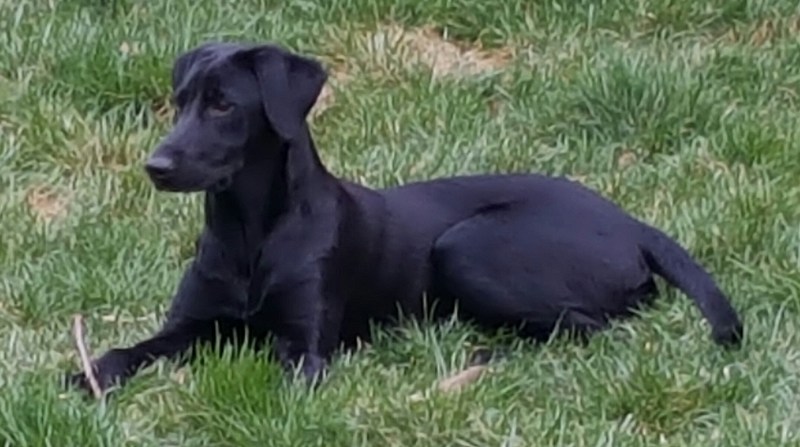
In terms of behaviors, the ecollar conditioning section in TRT’s Basics yard work sequence strengthens two cues: Sit and Here: In the PRT program, we’re addressing the same two cues using positive methods. An earlier post addressed reinforcing the Sit cue. In this post I’ll address reinforcing the Here cue, that is, recall, particularly in the context of a retriever in a field training environment.
As I’ve mentioned before, the field recall is among the most important retriever skills. Yet for a positive trainer, it is also among the most difficult skills to train. For a traditional trainer, the ecollar makes the job much easier, and if you were going to use the ecollar for only one purpose in your training, that would most likely be what you’d use it for. But I never trained Lumi or Laddie with an ecollar and they nonetheless eventually developed reasonable field recalls. That’s the same path I’m on with Lightning.
Many methods have been published for training recall without aversives, and I cannot say with certainty that no dog could be trained a rock solid field recall using a particular method in a few days. As a litmus test, the dog who has received said recall training and having learned to swim, would one day encounter a family of geese, with two or more adults and several goslings, swimming nearby. Perhaps the dog would have never seen goslings before. The dog, unrestrained, would leap in the water and give chase. The trainer would call Here. The dog, if the training had been successful, would turn around and returns to the trainer. Other difficult tests would be calling the dog away from someone the dog has just spotted a short distance away and has rushed off to greet, or calling the dog out of a play fight with another dog. Now do any of those but calling the dog from 200y away.
So maybe a program where the dog can pass those levels of challenges after a few days of non-aversive training does not exist, and maybe you cannot achieve the same quality of recall in a few sessions that a traditional trainer using an ecollar can. I don’t expect to. But recall is so important that I have budgeted about ten yard work sessions at this time to reinforcing Lightning’s recall. After that, we’ll go onto the next step in the TRT/PRT yard work sequence, pile work. At the same time, we’ll continue to take every opportunity to work on Lightning’s recall whenever the chance presents itself, with the expectation that it will be as good as a traditionally trained dog by the time we start competition.
Here are the three methods I’m using with Lightning:
- Distraction proofing. I described this method, in two versions, in an earlier post, Distraction proofing. For Lightning during this training step, I used this method with my assistant Annette holding Ryley, my wife’s young fluffy Golden and Lightning’s best dog friend, while I called Lightning to me repeatedly, then tossed a high-value treat over his head and as he ran to it, stepped closer to Annette and Ryley. I followed the no-glance rule described in the post a few times. We started about 30y away from Annette and Ryley. By the end of the session, I repeatedly called Lightning to me so that he would have to run between them or brush past them to get to me, without any attempt to interact with either of them as he rushed back to me on each Here cue.
- Walking recall. On one of my other websites, called The 2Q Retriever, I’ve described a number of positive field training methods I’ve developed over the years. I’ll be using one of those, Walking Recall, for several of my recall reinforcing sessions with Lightning at this time, and then on a continuing basis for months to come even as we proceed further in the yard work sequence, always seeking the most challenging recall contexts to practice on. I may or may not use treats in each session, depending on what I feel is having the most benefit for reinforcing Lightning’s recall at that time.
- Distraction marks. During this time, I’ll also use several sessions to run Lightning on marks where he has to run past or thru a distraction to and from the retrieve without getting distracted. I’ll use Laddie, who can sit or lie down and not get up while Lightning is racing by. I’ll also use Ryley, either being held by an assistant (adding another distraction) or using a tie-down stake. And I’ll use anything else I can come up with, such as a crate of live birds. As with the other methods I’ve described, I’ll also continue to use the method with other challenges when I get the chance in the future, even after we’ve continued in our yard work sequence to later steps.
After about ten sessions of focusing on Lightning’s recall at this time, I expect to make good progress. Then it will be time to start our next step in the yard work sequence, pile work, which I’ll describe in a later post. Meanwhile, I’ll continue to strengthen Lightning’s recall at every opportunity over the coming months so that we’ll be ready for field trial competition when the time comepost
Note: For examples of distraction marks and walking recall, see Lightning’s article in next post.
 Lightning's Journal