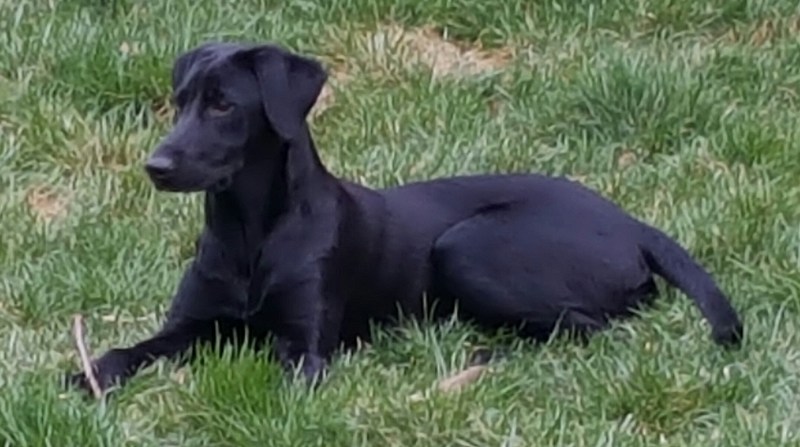
The remainder of the field progression material for the Basics stage in Mike Lardy’s Total Retriever Marking program contains a wealth of diverse information. However, it’s difficult to incorporate into PRT as individual steps because it’s not completely in sync with his Total Retriever Training video or flow chart. For example, TRM shows training of a delayed indent land triple after training doubles, something not mentioned in TRT or the flow chart. Also, some of the water training in TRM corresponds to work I did with Lightning months ago, and would have done even sooner if the weather had allowed it.
In addition to the training demonstrations, the discussion segment at the end of TRM disc 1 covers many interesting and important topics, though some only pertinent to particular dogs, and some more pertinent to a new dog owner than one who has been training his/her dog for months.
I’d recommend PRT trainers view all of the TRM Basics material, most of which is just as applicable to a positive-trained dog as one being trained with traditional methods.
Meanwhile, as I continue to work with Lightning thru the PRT Stage 2 yard progression, which correspond to the TRT Basics yard progression, I’ll expand our field progression to include the items shown on the TRT flow chart and in the TRM material.
Here’s the list of things I’ll be looking for opportunities to work on with Lightning whenever possible during our Stage 2 field work:
- Land singles, preferably of multiple guns
- Land doubles
- Occasional retired guns
- Delayed land triples, for example in the indent configuration demonstrated on the TRM video
- LWL water singles
- LWLW and LWLWL water singles (that is, re-entries)
- Water doubles
- Water marks with long water segments
- Occasional gentle de-cheating with a long line
I’ll also use a mix of marks that Lightning can nail without a hunt, with occasional marks thrown into cover and requiring a hunt. Mike explains on the TRM video that dogs are naturally inclined to use their noses and need to learn to mark visually, but can become too dependent on their eyes, so that needs to be balanced with throws intro cover that require the dog to use scent for the hunt. I think hunting strategies, like quartering and staying in the area of the fall, can also be developed by judicious use of marks that require some hunting, and calling on the gunner for help when the dog does go too far astray.
For me, the key to all of this work is training with groups as often as possible. I try to do both yard work and field work with Lightning every day, alternating Lightning and Laddie setups when we go out. Since I don’t have many opportunities to train with other trainers, I usually rely on paid assistants. But I’m always looking for opportunies to train with a group, and taking them whenever possible.
Yesterday, for example, we trained with a group of four other trainers, some with one dog, some with two, all far more advanced than Lightning and a couple also more advanced than Laddie. Our leader designed a double blind, a triple, and a double, all containing both land and water segments. Some of the retrieves were quite difficult even for the advanced dogs, and only one was suitable for Lightning without modification.
But with the group leader’s help, I was able to run Lightning on:
- A single thrown on an angle back over a narrow channel not visible till the dog was close. Lightning took a good line and leapt into the channel as soon as he got to it, swam across and picked up the bird with a small hunt.
- A long land single thru varied terrain including hills, trees, and woods behind the fall. Lightning took a good line, quickly checked out the woods, and then found the bird with s small hunt.
- A double consisting of an LWL mark made up of fairly long land segments and a fairly wide channel, thrown into the edge of a strip of high cover, as the memory bird, and a land mark requiring Lightning to run thru areas of high cover but with the bird thrown onto a patch of short cover, as the go-bird.
Lightning’s performance on all of the work was good. He came to the start line with reasonable line manners despite his enthusiasm, and made no attempt to break on any but one of the marks and of course was unable to break because I was holding his tab on the one mark, the go-bird of the double, where he would have broken without the tab. He ran good lines on every mark, and though he didn’t pin any of them, he only had one long hunt, again the go -bird of the double. He didn’t need help from the gunner on any of them. All of the marks were ducks, and he picked all of them up, came straight back to me on the run, came to heel on the side I indicated as he approached, sat down at heel, and held each bird till I took it without a drop and without sticking or freezing.
These are all fairly typical behaviors in a trained field retriever. It was good to see them in Lightning’s performance training with a group of big dogs, and demonstrated how yard work gradually merges with field work during PRT Stage 2, corresponding to TRT Basics.
 Lightning's Journal