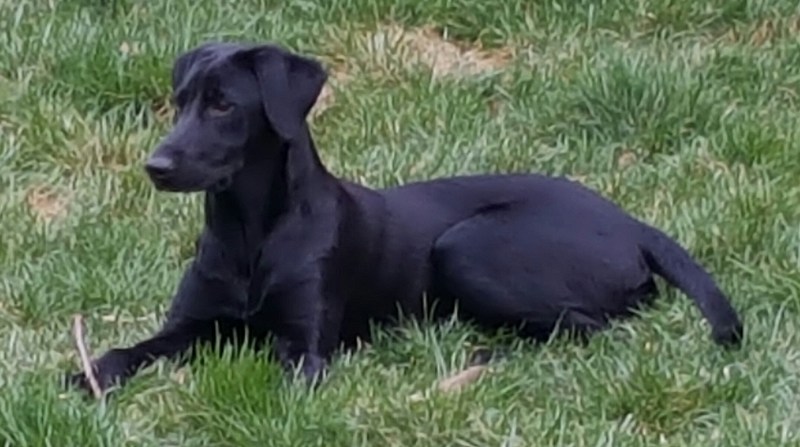
In this step, run on the same course we’ve been running the earlier steps of the double T, Lightning again ran mostly freebies to reduce the possibility of popping and to maintain motivation. For come-in from pile, the handler (myself or Liza) occasionally whistled Sit before Lightning reached the pile, then blew a come-in whistle combined with the visual cue of both hands lowered to thigh level with palms facing the dog.
As Lightning raced back to the handler, he’s find and pick up a bumper. In the easiest version, he saw the handler throw a white bumper toward him after he sat on the whistle. In the hardest version, we switched to an orange bumper and threw it while Lightning was running toward the pile.
Besides practicing an important maneuver, come-in from pile has the added virtue of reinforcing the dog’s decision to respond correctly with the exciting discover that an opportunity to retrieve has not been lost after all. I feel that +R is a valuable addition to the dog’s reinforcement history for responding correctly to a whistle even though, temporarily at least, it deprived him/her from completing the retrieve that he/she was in the midst of.
Our training window was again limited by the warm weather we’re having, with temps staying in the mid-70s all night and rising into the mid-90s during the day. But Liza and I both ran Lightning on enough trials to practice come-in from pile several times in combination with mostly freebies, and with no whistle refusals for either of us.
Tomorrow we’ll practice step 5 of the double T, the mini T. This will be the first time that we ask for a behavior on the double T course that we hadn’t practiced earlier on pile work with shorter baselines. I think adding a horizontal dimension to our yard work, as we did in simple casting, after weeks lately of concentrating entirely on the vertical dimension, will be exciting for all of us.
 Lightning's Journal