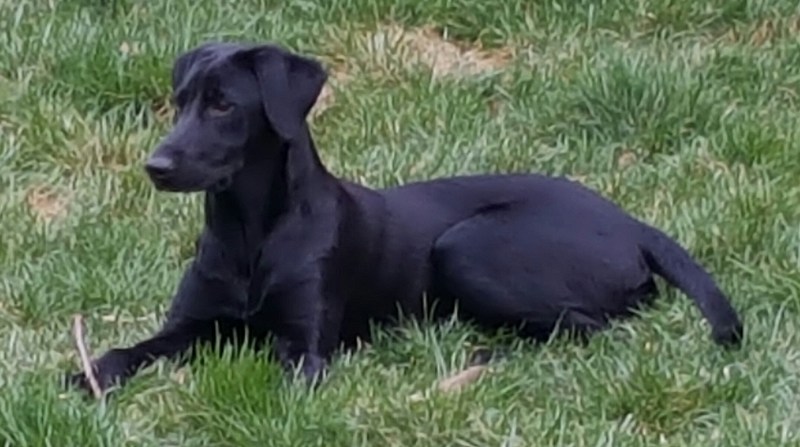
I’ve been taking Lightning out every morning for days, sometimes with Liza assisting and sometimes solo, trying to get some solid performance on step 6 of the double T, which is the full T.
I didn’t expect it to take so long based on the duration estimates in Mike Lardy’s TRT video. Lightning was making progress day to day, but it was slow. I was beginning to wonder if at last we were seeing a clear case where our not using of physical aversives, in particular the ecollar, was making a significant difference in our progress.
However, after one more frustrating session a couple of days ago, I decided to make two major changes from what we’d been doing, starting yesterday:
- Despite the recommendation to use the same course for every step of the double T, and the concern that it can to lead to problems if you try running the double T on the same course you used for pile work, I decided that the course I was using at Mrs. W-‘s field had to many issues, and that the area we had used for pile work, only a few minutes longer drive, was a significantly closer fit to what the TRT video recommended: one field was hilly and uneven, the other flat; the grass was getting higher and higher on one, was regularly mowed on the other; one was in bright sunshine on these mornings with temps in the 70s, the other had a large enough area entirely in shade and noticeably cooler.
- Though I haven’t used food for Lightning’s training in weeks, I had some chicken left over from a recent restaurant meal and thought I’d see if that helped.
The results from making those two changes were dramatic. Lightning executed the full T correctly from beginning to end yesterday morning, and then again this morning. All of the problems just melted away. As a result, tomorrow we’ll be able to go onto step 7, the double T itself.
With respect to using food, I might mention a technique called sampling. In operant conditioning, which includes the positive reinforcement quadrant, the desired behavior leads to an outcome that the subject considers preferable to alternatives. That is, by its nature, positive reinforcement occurs immediately after the desired behavior.
But that means that on the first trial, the subject has no way of knowing the training parameters, making it chancy whether you’ll get the desired behavior early in the session or will need to elicit it, possibly over several trials, before you have something to reinforce.
Sampling is a short cut: you give the subject a sample of the reinforcer before the first trial. Under certain circumstances, such as the ones we working in yesterday and today, it helps the subject, in this case Lightning, to perform well from the first trial on. That is, i began by giving Lightning a bit of food at the start line. Then, as he ran his first retrieve, he already knew that another treat was available back at the start line, and that knowledge produced a noticeable improvement in his work.
Lightning won’t always need food to incentivize him for retrieving. Of course he’s doesn’t in most situations even now. But the full T is comparatively boring, and at those distances also somewhat strenuous in the temps we’ve been having. What I found was that a high-value reinforcer at the end of each delivery overcame those disincentives, especially when we moved to a flatter, cooler field with shorter grass.
We’ll take those same lessons back to the field tomorrow as we begin the double T step 7, the actual doubler T.
 Lightning's Journal