Double T step 2: sit from pile

Today Lightning and I used the double T baseline we established yesterday to confirm that he’d still sit on whistle while returning from the pile with a bumper, as he’s been taught when we were doing pile work.

I saw two problems. First, he wasn’t sitting quickly enough. I think we’ll do at least one more session and use gunshot as clicker to strengthen the response.

The other was that I had inadvertently laid out a baseline yesterday that had a knoll a few yards to the right of the pile. It hadn’t been a problem yesterday because I gradually taught Lightning the line at distances where the knoll was at a fairly wide angle. But today, when I backed up to our 100y start line in just three retrieves, Lightning began flaring toward the knoll on sends at that distance. He’d curve back toward the lining pole en route, but I couldn’t get a straight send without shortening the baseline.

So tomorrow, I’ll gradually teach the line again as well as working on sit from pile. If that looks to be more trouble than it’s worth, I’ll just set a new baseline for the rest of our double T work.

Either way, after tomorrow’s session, we should be ready for a session of sit to pile.

Double T step 1: teach the line

This morning, Lightning and I began work on the double T. As Mike Lardy explains in the TRT video, the double T is the last step of yard work on land, and combines the skills of simple casting and pile work.

Lightning and I sat on the couch together two days in a row and watched Mike’s TRT presentation on the double T. Of course it’s very thorough, and we’ll adopt it into the PRT program simply by eliminating the elements of physical force and corrections.

One point of confusion did come up for me. In ”Tips” at the end of the section on double T, the narrator says, ”When teaching the line, the pile at the end of the T should be visible, but it doesn’t need any kind of obvious marker.” So when I tried to teach Lightning the 100y line this morning, I started out using no lining pole and had poor results. After a few tries, I decided to try it with a lining pole, and voilà, Lightning ran six good retrieves to the pile in a row, the last three at the full 100y distance.

When I went back to review Mike’s video, I saw that he also uses a lining pole for the long pile throughout the double T training, so now I’m not sure what that tip about not using an obvious marker is intended to mean.

A couple of other points: I didn’t use any remote casts with Lightning, but cast him from left or right side on every retrieve. Also, I included gunfire and games of catch during the work to maintain high quality pickups without shopping and prompt deliveries at heel.

Lightning had no problem with flaring, he didn’t pop, and he exhibited great drive on every send, so no remediation was needed in those areas.

Of course in the PRT program, we’ll skip Mike’s TRT step of forcing to pile, so tomorrow, we’ll start work on our next step of training the double T, sitting on whistle, both from and to the pile.

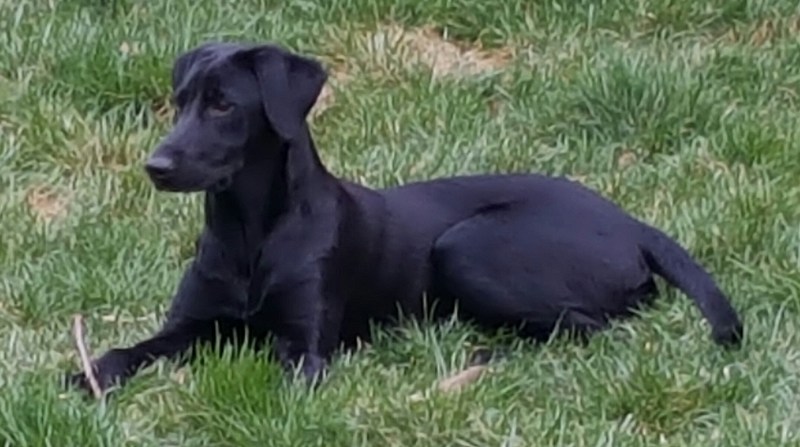
Lightning at ten months

Lightning turns ten months old in four days. Since we finished one training project, pile work, this morning and will start another, the double T, tomorrow, this seems like a good moment to take stock of his progresss.

20160703_125928

Because the PRT program we’re developing parallels Mike Lardy’s TRT program, we can track Lightning’s progress in PRT Stage 2 by checking the Basics section of Mike’s TRT Flow Chart.

Within the yard progression, Lightning is between pile work and the double T, with one last item after that, swim-by, to complete PRT Stage 2.

Within the field progression, Lightning has practiced nearly all the items in Basics to some extent, including delayed triples, which Mike’s TRT and TRM videos include in Basics though  they’re not listed on the flow chart. The exceptions are that of course we haven’t used ecollar corrections, and so far we haven’t tried conventional de-cheating, where you send the dog on a cheating mark and use a long line to prevent the cheat.

In those field objectives that we have worked on: Lightning regularly runs land and water doubles and retired land singles in addition to a primary diet of singles off multiple guns; he always delivers to hand, usually at heel; and he’s generally steady on marks.

Lightning is still small compared to the dogs in Mike’s videos; he weighed in at 44.2 lbs this morning. But he’s in excellent health, has endless enthusiasm for the retriever games of catch and fetch, always exhibits great drive in his training retrieves, and is in every way a delightful companion.