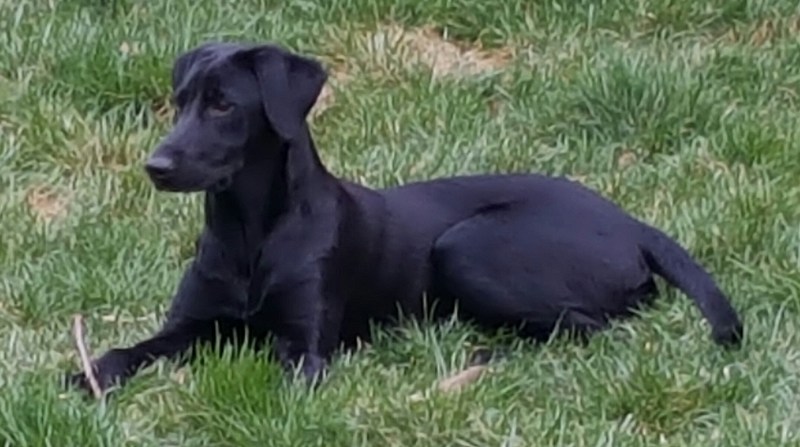
Blind drills, taught blinds, and diversion drills

With some breaks for Laddie’s competition and because of the record-breaking heat, I’ve continued working with Lightning on the Stage 3 drills that Mike Lardy, in the TRT program Transition stage, calls blind drills, taught blinds, and diversion drills.

Several goals are involved in this work for Lightning, both those that Mike sets and others more appropriate to Lightning as an individual. Here are the challenges we’ve been tackling:

Locking in on the blind when a gun is in the field

In our early blind drill sessions, Lightning would focus on Liza, my assistant, as long as she was in the field, and I couldn’t get him to lock in on the blind.

To address that, we used this sequence:

  1. Lightning runs blind with empty field.
  2. Liza comes out, throws, sits down, and Lightning runs mark. As Lightning returns with article, Liza packs up chair and walks off field. Meanwhile, Lightning runs blind. 
  3. Normal: Liza throws and Lightning runs mark. Then Lightning runs blind.

Soon Lightning understood the concept of running a blind while a gun was in the field and the problem was resolved.

Not flaring when running a blind behind the gun

Once Lightning was doing a good job with marks being thrown toward the line to the blind, we continued with the diversion drill and marks being thrown away from the line to the blind, so that Lightning was running behind the gun to run the blind. Like other dogs. Lightning tended at first to flare off the gun as he went past, running a curved line.

We readily solved the problem of Lightning flaring left by training with the following sequence:

  1. Run the blind from a position level with the gunner.
  2. Run the blind from a few yards further from the blind, so that Lightning would take a few steps before getting past the gunner.
  3. Run additional blinds from further and further back, adding a few more steps each time before Lightning would run past the blind.

Getting Lightning to stop flaring around the gun when it was on the left of the line to the blind proved more difficult, perhaps because Lightning has a slight predisposition to flare right even without running past a gun. To resolve the problem, I placed a chair on the field 20y from the gunner in the direction of the blind, on the opposite side of the line from where the gunner sat. Both chairs had their backs to the line to the blind. The second chair blocked Lightning’s curving path and he ran a straight line. We continued to use the second chair for several sessions and then found it was no longer needed.

Returns with complex articles

In order to better prepare Lightning for participation in training days, I decided it was time to stop using only 2″ bumpers with no ropes. Instead, we switched to orange 2″ bumpers with ropes for the blinds, and dokkens for the marks. We used a random mixture of mallard and pheasant dokkens.

Unfortunately, Lightning’s recall fell apart, especially with the dokkens. I tried a number things without success: bringing him out to the field on a lead instead of letting him run around, as I normally do; increasing my persistence in calling him both verbally and with a whistle, including walking to him; and conversely, calling him only once and then just waiting. None of those seemed to have any training benefit.

I also tried bringing high value treats to reinforce his returns. That seemed to help for a few sessions but then wore off. He still wanted the treats, but not enough to stop playing with the articles and just come straight back.

Finally I put on his harness and attached a 60′ line. I had Liza throw the marks so that they landed within 60′ of our start line, allowing me to draw Lightning in once he reached the dokken. I then left the line attached while sending him on the blind, though it was much further away and I couldn’t continue to hold the other ended of the line. Luckily, just wearing the line was enough to influence him to return promptly.

So now we’ll continue with those strategies for a time, and hopefully soon I’ll be able to run Lightning without the line and still get nice returns of dokkens, and bumpers with ropes and streamers. For now I think it’s the right strategy. It’ll just take some time.

Blind drills

I worked on pattern drills with Lightning for three days. The first day, I ran him on shortened versions of the left leg a few times, then the entire 100y left leg. The second day, I started by running him on the left leg, then ran him on the right leg, again 100y and at a 90° angle to the left leg. The third day, I ran him on the left and right legs, then the middle leg, again 100y and between the left and right legs. The second and third days, I neither indicated the piles with throws not ran shortened versions.

Lightning had no difficulty with any of the pattern drill retrieves, so it was time to move on to what Mike Lardy calls “blind drills” in his TRT program. Our PRT program goes to the same set of training objectives, except that we continue to use no physical aversives for force or corrections. 

For Lightning’s first day of blind drills, I used the same course we had used for pattern drills, but we didn’t use the middle leg. Here were the steps we followed:

  1. With gun sitting in chair to left of left leg, run left blind.
  2. With gun standing in front of chair, run left blind.
  3. Gun stands, calls hey-hey-hey, throws dokken toward left leg, and sits down. Lightning picks up mark.
  4. Run left blind. When Lightning veers off line toward old fall, blow sit whistle, then cast to blind.
  5. With gun sitting in chair to left of right leg, run right blind.
  6. With gun standing in front of chair, run right blind.
  7. Gun stands, fires pistol, throws dokken toward right leg, and sits down. Lightning picks up mark.
  8. Run right blind. When Lightning veers off line toward old fall, blow sit whistle, then cast to blind.

Additional details:

  • All blinds were orange 2″ bumpers with ropes.
  • I used a high value treat to reinforce returns.
  • I randomly alternated which side I ran Lightning from on each retrieve.
  • The blind piles were marked with orange lining poles.
  • I forgot to use Lightning’s tab, and he broke on step 3. I walked out, took the dokken and gave it back to gun, walked Lightning on lead back to start line, and made a make-shift check cord out of his slip lead. We then reran the mark. Lightning did not attempt to break, and when I sent him, I let go of one end of the check cord so that it slipped off his neck as he launched. I didn’t use it again, and Lightning didn’t break again.

We’ll continue work on more complex versions of the blind drill tomorrow.


Pattern blinds

To begin Lightning’s PRT Stage 3 training, we’re following the discussion of pattern blinds in Mike Lardy’s TRT program. Beyond that discussion, there’s not much to add.

Today, I selected the field we’ll use for pattern blinds and placed lining poles at the start line and the 100y left leg of the course, then placed 2″ white and orange bumpers, all with ropes, in a pile at the end of the left leg. I ran Lightning to the pile once from a shortened line, then backed up to the start line to run another half dozen retrieves the full 100y.

Tomorrow, we’ll add the right leg of the course, and the following day, if Lightning’s ready, we’ll add the center leg. Then Lightning will be able to work on the complete pattern blind drill.

Lightning begins PRT Stage 3

Within the PRT program, Lightning has now completed all of the Stage 2 yard progression on land and all of the Stage 2 field progression on both land and water. In fact, the only Stage 2 work he has not completed is the last two steps of the last Stage 2 yard drill, the swim-by. We’ve begun the swim-by and will continue as opportunities to train on water permit.

But in the meantime, it’s time for Lightning to begin Stage 3 of the PRT program. Just as PRT Stage 2 corresponds to Basics in  Mike Lardy’s TRT  program, PRT Stage 3 corresponds to TRT Transition. We’ll continue to base the PRT program on TRT, just eliminating the use of physical aversives, which traditional trainers use for corrections and force, from the PRT approach to developing the same skills in the same sequence. 

As the TRT video explains, however, sequence is more flexible in this new stage of training, and will vary with circumstances such as availability of training properties and the dog’s own pace of development. Here in Lightning’s journal, I’ll record the particular sequence I follow with Lightning, with the understanding that other PRT trainers will choose their own sequence to cover the same material. For example, you may have completed training the swim-by from Stage 2. Lightning and I still need to wrap that up.

Mike mentions in the video that this is an exciting stage of training because the dog is learning new things every day. The narrator also mentions another exciting point: in a few months the dog will be ready to run in qualifying. For Lightning, that means he may be able to begin competition as early as spring or fall of 2017. Wow!