Reducing stress to strengthen the return

Until this point, the Positive Retriever Training (PRT) I’m developing has closely followed Mike Lardy’s traditional Total Retriever Training (TRT) every step of the way through Mike’s Basics stage and PRT’s Stage 2. Now it’s time for PRT’s Stage 3, modeled on Mike’s Transition stage in TRT.

Actually, Lightning has not yet completed the swim-by drill, the last step of PRT Stage 2, because of logistic issues, but we’ll get to that as opportunity permits.

Meanwhile, however, continued work with Lightning on PRT Stage 3 handling drills, in parallel with continued development of marking skills, had been interrupted by a confusing phenomenon: Lightning, just having turned a year old, and despite a thorough foundation in carefully sequenced training objectives, has suddenly become unreliable on his returns. Sometimes he runs a nice retrieve, whatever the setup we happen to be working on. Other times he completes the outrun well, but then picks the bumper or dokken up by its rope and darts off in the wrong direction, sometimes embarking on a merry chase all over the field, completely immune to whistle or verbal cues. He looks like a complete beginner. It’s difficult to believe this is the same dog who was running the double T and 300y marks without such misbehavior a few weeks ago.

After much thought and seeking of solutions, not necessarily a waste of time but not fully resolving the issue, I’ve begun to focus on a comment my friend Jody Baker made when I introduced the issue of zoomies some time ago. Based on her work with dogs in other sports such as agility as well as field work, Jody commented that stress can be a major factor in why such behavior occurs.

Pursuing that line of thought, I’ve recently experimented with temporarily terminating Lightning’s training on handling and instead used all of our training time for marking practice. After some initial remedial measures, such as having Lightning wear a long line and using food for reinforcement of good returns, Lightning’s returns are gradually improving. The last two days, he did a number of singles and doubles, including a couple of retired singles, mostly with solid returns.

Based on this experience, combined with extensive previous experience with Lumi and Laddie when they were at the same stage in their training, I’ve come to the conclusion that PRT Stage 3 should diverge from TRT Transition in a significant way. I’m particular, PRT Stage 3 should begin with the focus entirely on marking, enabling the dog to develop a far stronger positive association with high quality returns than he/she had developed up until this time. Those returns need to be trained not only as a skill, but as a deeply embedded motor pattern that can withstand the disruption of stress when it starts to become part of the dog’s training for handling.

The reason that this isn’t an issue in TRT and other traditional programs is, I believe, because the ecollar is used to enforce a quality return. Stress or no stress, the cost to the dog of a poor return is too high a price to pay.

But for a positive trained dog, no price is extracted for a poor return. It is entirely the dog’s choice. Perhaps a treat is withheld or a long line is used to enforce the return, but to the extent that the dog is able to express his/her preferred behavior, a return directly to the handler with the article ceases to become the dog’s first choice once stress issues start to become associated with the work. Zoomies become a way to avoid and dissipate stress. And as trainers, we don’t want that behavior chain to become entrenched.

Fortunately, it appears that the behavior can be reversed by terminating the parallel stressful training  (diversion drills, for example) and focusing all our training on marking skills. The idea is that, after some period of time, solid returns will become so deeply embedded in the dog’s behavior that training of handling skills can resume without losing the dog’s ability to perform high quality returns.

This is a fundamental change to PRT as I’ve been presenting it, and this change means that Lightning’s training is not a perfect example of PRT training, since Lightning and I have engaged in training handling apparently before Lightning was ready. Hopefully I and others using PRT for other dogs will avoid this mistake by deferring the introduction of stressful drills until the dog’s marking and return skills are more extensively practiced.

Accordingly, I will sort this post out of order in the Table of Contents so that the reader will encounter this discussion before reaching the posts on training objectives I now think should be deferred. I’ll also try to develop a sort of litmus test for how to judge when it’s time to begin the handling drills. At this writing, I don’t yet know what that test is.

Wagon wheel

As Lightning’s PRT Stage 3 continues, our next task has been training the wagon wheel drill that Mike Lardy describes for the Transition stage of TRT. The PRT version is virtually identical, the only difference being that I work on Lightning’s line mechanics, including as required for the wagon wheel, with no lead or other physical connection between us.

The first day of our work in the wagon wheel, Lightning was able to pick up a circle of eight 2″ white bumpers with no errors. So starting on the second day, we began working on him picking up a 2” red bumper on a line between two 2″ white bumpers tossed into place after the red bumper was tossed. That was much more difficult, and required repeated use of “no, here” as in the no-no drill we’ll be working on after the wagon wheel.

Obviously the wagon wheel has great value in developing communication between handler and dog, line mechanics, and lining skill. As Mike explains in the TRT video, introducing “no, here” in a gentle, non-aversive way will also provide value to later training tanks.

However, after watching Lightning’s behavior on retrieves, both in these drills and in separate marking practice at this time in his development, I have come to believe that the work we have been getting into, especially the diversion drill and now the wagon wheel, are more stressful for Lightning than I had previously understood,  so we’re going to set aside his training on handling skills for now.

I’ll discuss that topic further in a separate post, which I’ll sort into the Table of Contents out of order and earlier once I’ve completed it.

Meanwhile, when the time comes to return to the wagon wheel, we’ll continue until Lightning is comfortable with the entire 16-bumper configuration as well as with “no, here” as a gentle, non-aversive cue for use on a poor initial line and later analogous situations.

As a final point, when I say non-aversive, I don’t mean to say that “no, here” doesn’t function as an aversive, because it does. Retrievers don’t like being called back, and will alter their behavior to avoid it happening. But the aversive quality of the cue comes from the fact that the dog is losing the opportunity to complete the retrieve, not from the way the cue itself is expressed by the handler. A neutral or even cheerful “no, here” is just as effective as a correction to an incorrect response, terminating that trial and setting up for the next one.

Late summer logistics

Here’s a recent conversation with my internet friend Patrice, which she asked me to preserve on Lightning’s blog for possible future readers:

Patrice: This is something I’d like you to write several blog posts on — how do you organize your life, space, and time so that you can train as much as you do? You work full time, right? Lack of nearby space, and working full time are my biggest impediments, especially in the shorter days of winter.

Me: Hi Patrice. I’m not sure I have enough for several blog posts, but here’s a try: Yes, I work full-time, a GS-14 for Treasury. I also work an average of 50 hours a month building a software app for a client, as my side job. I have virtually no social life, have pretty much given up TV, and can get along on small amounts of sleep when I need to. I apparently have a mild version of Asperger’s, which may account for unusually high focus and endurance with annoyingly infinite attention to detail. I work at home most days and have great flexibility in my hours, though these days doctors visits are taking a ridiculous amount of time. I love my wife, my kids, and my friends, truly I do, but since Lumi, my life is really about my dogs. Typical day in any particular time frame would look very different, but typical day until my latest bout of leg injury: up at 4am, get ready for day, drive 30-60 minutes picking up assistant(s), drive 60+ additional minutes to/from training location, 2-4 hours training, drop off assistant(s). I’ll spend additional time on dogs each day for things like trimming nails, playing fetch, cutting up raw food, etc., but that’s about all the time we have for training on weekdays. In bed (with dogs) around 10pm. Not unusual to train virtually all day on Saturday and/or Sunday as well as any holiday, counting events, workshops, and club training days as “training”. As for locations, I do have access to several excellent training grounds within about two hour radius, generally too far. But I’ve found dozens of fields, construction sites, parks, etc., over the years where I can take the dogs and my assistants to train, depending on what we’re working on as well as weather, and also accommodating my assistants’ schedules. I think schedules and other circumstances are highly individual and question whether knowing mine would help anyone. Virtually every successful trainer I know sends at least some of their dogs to pros at least some of the dogs’ careers, largely because of time though of course they also want their dogs to get quality training. All this makes a high demand on time and finances. In addition, at least for me, the demand on emotions is just as high. Anyway, does any of this help, or would more detail about anything be useful?

Patrice: Lindsay, nice try. I want at least one blog post so the information won’t get lost in the bowels of Facebook. I’ve been wanting this ever since I started reading your blogs. Please. I’ve always thought that the logistics are at least as important as the methods and practice. (It must change seasonally, right?)

Me: OK, Patrice. Was that post about the right amount of detail? I’ll try to make it a regular feature. I’m sure others also interested since important to you.

Poorman doubles and triples

In PRT Stage 3 as in Stage 2, the dog’s training is divided into parallel paths: combinations of land and water, marks and blinds, and various goals for each. On a given day, you might wish you could work on water handling, but you don’t have access to a technical pond that day. Similarly, not having an assistant constrains you on running marks or diversion drills.

But one drill exists that a dog at any level can benefit from, a drill retrievers love once they understand the concepts. They may be able to play the game without losing motivation longer than you can, given that a lot of shoe leather is involved and I for one am going thru a stage of unfortunately low endurance.  It’s a good workout and great practice for the dog.

The drill is poorman marks. I’ve used poorman singles with Lightning for months, and now he’s able to do doubles as well. I did poorman triples with Lumi and Laddie for years, and I think Lightning may also be ready for triples soon if not already.

Here’s what a typical poorman double would look like:

  1. Bring Lightning to heel on a rubber mat. This is a skill he’ll need in competition, and it makes it clear to both of you if he creeps while you’re throwing.
  2. Cue Sit and walk out into the field carrying your pistol and two articles for throwing. I typical bring a combination of 3″ bumpers with streamers and dokkens in various types and colors. If Lightning creeps, I go back and reposition him.
  3. I usually throw the long mark first, but it’s good to mix them up. Of course I also alternate which direction I throw first. I might even throw both to the same side but at different distances.
  4. Walk back to the mat and run the dog on each mark. At this stage I always run Lightning on the go-bird first, but at some point I might mix that up occasionally as well.

As you can see, many important skills are incorporated into a poorman multiples drill:

  • Patience and steadiness at the line.
  • Good line mechanics on the sends.
  • Retired guns, thus learning to remember marks by background and other features, not just relative to where the gunners are.
  • Gaining comfort with the concept of multiples.
  • Perhaps the most important: developing ever increasing confidence that if you run to the exact spot you saw the bird land, it will be there when you arrive. Some dogs do not learn that lesson and instead run to the area of the fall and then begin to hunt, rather than trying to nail the mark. Lower scores are the result.

Of course many other options are available: occasionally throw into cover for practice and to make a hunt more likely; use stickmen to help dog learn to take advantage of that info; add factors such as cross wind, hills, and strips of high cover to introduce the dog to those as well. As they say, the only limit is your imagination.

Today I ran Laddie on a couple of nice blinds thru points of cover, then ran both dogs on a battery of poorman doubles at different distances. Even with temps in the high 70s, they were ready to keep working when I had to tell them I had had it for the day. Luckily they forgave me.

Lightning at a year old

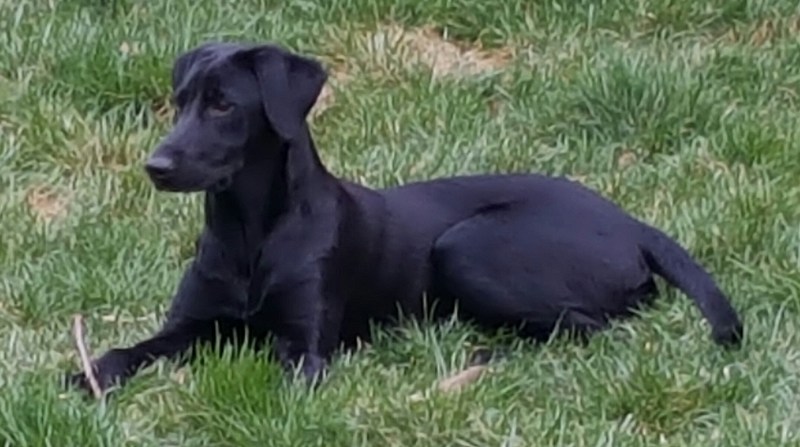
Lightning is now a year old. He’s still 44lbs, and still  a joy. But a few weeks ago his training stalled in the early work of PRT Stage 3, corresponding to TRT Transition. We were in the middle of blind drills and diversion drills, where he was making good progress on those concepts, when his recall and returns abruptly began to fall apart. It may have been because I was using dokkens for the marks, I’m not sure. But it soon got to the point where he couldn’t come straight back even with a 2″ bumper.

I had no choice but to turn our focus to his returns. We trained nearly every day, though hampered by a typical assortment of factors: record warm temperatures, crippling pain in my ankles and knees, and limited availability of my assistants, who are now in college rather than high school. But we got a lot of work done and made gradual progress.

It’s a difficult topic to write about from an instructional view, because I don’t know whether your dog will even have this issue, and I’m pretty sure there’s no cookie-cutter solution that works on all dogs that do develop the problem, unless you want to depart PRT and begin using an ecollar. I think the one common solution is not to get frustrated and not to give up. Understand that this is probably the most difficult skill you’ll ever have to teach your dog, it’s hard, and it’s going to take time and patience.

That said, here are some of the things I’ve done that I believe proved helpful in Lightning’s return training:

  • Endless games of fetch, indoors, yard, and fields, with every available article. I occasionally ask for steadiness, but usually not. Lightning can play this game for dozens of fetches. It seems almost impossible for him to get tired of it.
  • Short walking singles with an assistant, with Lightning on a long line. I use lines of 15′, 30′, and 60′. Sometimes I throw, sometimes my assistant throws. We use a wide variety of articles, from 2″ bumpers with ropes, to 3″ bumpers with ropes and streamers, to duck and pheasant dokkens. If Lightning doesn’t bring the article back, the handler gently reels him in. He usually tries to grab the article to bring with him but it doesn’t matter whether he’s successful in that or not  He learns a useful lesson either way.
  • For reinforcement, I’ve used the heel and catch game, gunshots, and food. Overall I felt we made best progress with food, though you don’t have to use secondary reinforcement (the food) on every retrieve because the work itself still provides the primary reinforcement. If that’s not the case with your dog by this time, you’re probably not going to get much further IMO. But Lightning still makes noticeable improvement on his returns when I reinforce with food, and I feel it would be stupid for me to be too stubborn to realize that and refuse to leverage it.
  • Occasional marks without a long line mixed in during the walking singles. Finally, finally, a day comes when you can do a whole session with no long line, and just gradually build up some distance.

A few other nuances are involved, such as choice of terrain and so forth, but it’s really kind of boring to talk about. It’s just a lot of work and a lot of faith that it will eventually pay off. And indeed, finally it has done so with Lightning and we are nearly ready to resume our PRT Stage 3 training. I expect relapses, which we’ll address the same way. I may not always discuss them further in this journal.

How hard is it to win a field trial?

A couple of old internet acquaintances were kind enough to tag me in a Facebook thread and invited me to say something about the challenges of winning a retriever field trial. I thought I’d pass the posts along here:

Patrice Dodd: You should see if you can find Lindsay Ridgeway’s blogs. He has trained Golden Retrievers to Master Hunter level and has won JAMs in field trials, in the USA. All positive trained. He has adapted Mike Lardy’s program with significant modifications.

Greta Kaplan: I have known Lindsay for ten years or so. So far he’s not winning field trials and that is the key point here. He is aware of this discussion, I promise.

Me: I trained Lumi to JH, SH, WC, and WCX. She was a fabulous marker and often lined blinds. She took First in the first competition she ever ran in. I trained Laddie to JH, SH, MH, and WCX. He took First in both of the first two competitions he ever ran in. He received a JAM in his very first field trial, when he was still three years old. He’s since earned many more JAMs and Reserve JAMs, and took Third in a trial with 33 dogs last fall, mostly professionally trained and many being handled by pros as well. He is a superb marker. Many friends with more accomplished pro-trained dogs have told me they consider Laddie more talented. But by all means, let’s focus on what my dogs haven’t achieved yet.

Greta: Sorry, Lindsay Ridgeway. That was not my intent. I tagged you in the other thread because I knew you were out there doing it. I have to admit here that I have no understanding of the titling structure for field trials so it’s hard for me to know how truly competitive those things are. Are there levels of competition? What are the top awards?

Seriously, no slight was intended.

Me: Thanks so much for tagging me. Very interesting to me. Yes, four main kinds of FT stakes: Derby: for dogs under 2yo, no handling allowed, specialized, difficult marking tests, not interesting to me Qualifying, also called qual/Q/minor: open if dog has not won two of them, same skills as all-age, usually a bit easier on average, some all-age options never occur in Q. Tasks: land and water multiples, usually triples, plus land and water blinds. All-age, separated into two stakes, Amateur (am) and Open. Same dogs, but handler cannot be a pro trainer in the am. Most dogs in all stakes are trained by pros. Placements in all stakes are dominated: pros (except am stake), field trial property owners, multi-dog amateurs who travel south for winter training, north for summer training. Despite quality breeding and pro-training, many dogs never finish a trial or earn a JAM.

I would say greatest challenge to finishing a stake is difficulty of stake itself, though I think some politics involved. Greatest factors to one of four placements, especially First and Second (which in Q earns unofficial designation Qualified All Age QAA): handler often has hundreds, possibly thousands of stakes under belt; handler often running multiple dogs, essentially do-overs; unfair situations for some dogs, such as change of wind or unintended help by gunner, but part of the game, evens out over time; few would deny politics sometimes involved, that is, personal relationships. Deciding factors in this order, I think: experience of handler, breeding of dog, training of dog, running order; even luck sometimes important. Not sure whether breeding or training more important, both crucial, but both less important than handling skill/experience in general.

So with respect to a positive trainer winning, so many issues besides whether you use aversives, such as: do you have: Group A: time to train hours every day for years on end, tolerance for intense physical and emotional demands, pretty serious money including high quality trial-bred dog. Group B: opportunity to travel south for winter, north for summer, opportunity to run multiple dogs in a stake, good social skills, other mysterious factors I haven’t discovered yet. Groups A and B both crucial. Laddie and I only have Group A. Many people have told me what Laddie has accomplished is amazing.

So yes, it’s somewhat harder and more time-consuming to train without aversives. No videos or programs available for positive advanced competition training except the PRT program I’m developing in Lightning’s Journal. But too many other crucial factors to prove that a dog trained that way can’t win. Most dogs can’t win even with traditional training.

Virtually all pros and experienced trainers believe it would be impossible for positive-trained dog to win, which cannot be discounted; they should know. But they also don’t believe a positive- trained dog can earn an SH, MH, Q JAM, Q Reserved JAM, or Q Third, and Laddie has done all of those, so puts their ability to predict in question. I’ve probably run out of time with Laddie. He’s almost 10yo and I have health problems that limit our training right now. But I think Lightning will finally get that win some day if Laddie doesn’t beat him to it.

Oh, I forgot to mention huge importance of access to quality field trial grounds for practice several times a week plus training group with experienced, successful trainers willing to share knowledge. I use paid assistants, generally high school kids. We usually train at construction sites or parks till we get kicked off. Slight difference from pros with multiple high-quality properties in North and South for year-round training, plus experienced training assistants and large community of peers who have used virtually identical training programs for success with many dogs. As far as I know, no one else in America is doing what I’m doing. Maybe some will and Lightning’s Journal would save them a lot of missteps, but it’s a long road.

Greta:  THANK YOU for filling that in.