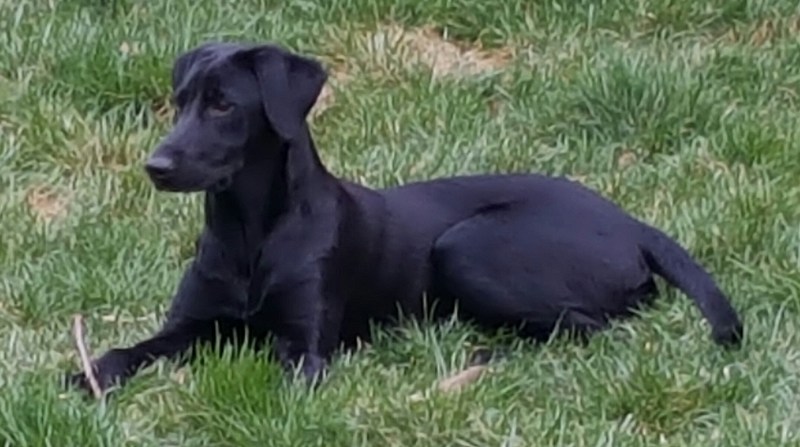
In PRT Stage 3 as in Stage 2, the dog’s training is divided into parallel paths: combinations of land and water, marks and blinds, and various goals for each. On a given day, you might wish you could work on water handling, but you don’t have access to a technical pond that day. Similarly, not having an assistant constrains you on running marks or diversion drills.
But one drill exists that a dog at any level can benefit from, a drill retrievers love once they understand the concepts. They may be able to play the game without losing motivation longer than you can, given that a lot of shoe leather is involved and I for one am going thru a stage of unfortunately low endurance. It’s a good workout and great practice for the dog.
The drill is poorman marks. I’ve used poorman singles with Lightning for months, and now he’s able to do doubles as well. I did poorman triples with Lumi and Laddie for years, and I think Lightning may also be ready for triples soon if not already.
Here’s what a typical poorman double would look like:
- Bring Lightning to heel on a rubber mat. This is a skill he’ll need in competition, and it makes it clear to both of you if he creeps while you’re throwing.
- Cue Sit and walk out into the field carrying your pistol and two articles for throwing. I typical bring a combination of 3″ bumpers with streamers and dokkens in various types and colors. If Lightning creeps, I go back and reposition him.
- I usually throw the long mark first, but it’s good to mix them up. Of course I also alternate which direction I throw first. I might even throw both to the same side but at different distances.
- Walk back to the mat and run the dog on each mark. At this stage I always run Lightning on the go-bird first, but at some point I might mix that up occasionally as well.
As you can see, many important skills are incorporated into a poorman multiples drill:
- Patience and steadiness at the line.
- Good line mechanics on the sends.
- Retired guns, thus learning to remember marks by background and other features, not just relative to where the gunners are.
- Gaining comfort with the concept of multiples.
- Perhaps the most important: developing ever increasing confidence that if you run to the exact spot you saw the bird land, it will be there when you arrive. Some dogs do not learn that lesson and instead run to the area of the fall and then begin to hunt, rather than trying to nail the mark. Lower scores are the result.
Of course many other options are available: occasionally throw into cover for practice and to make a hunt more likely; use stickmen to help dog learn to take advantage of that info; add factors such as cross wind, hills, and strips of high cover to introduce the dog to those as well. As they say, the only limit is your imagination.
Today I ran Laddie on a couple of nice blinds thru points of cover, then ran both dogs on a battery of poorman doubles at different distances. Even with temps in the high 70s, they were ready to keep working when I had to tell them I had had it for the day. Luckily they forgave me.
 Lightning's Journal