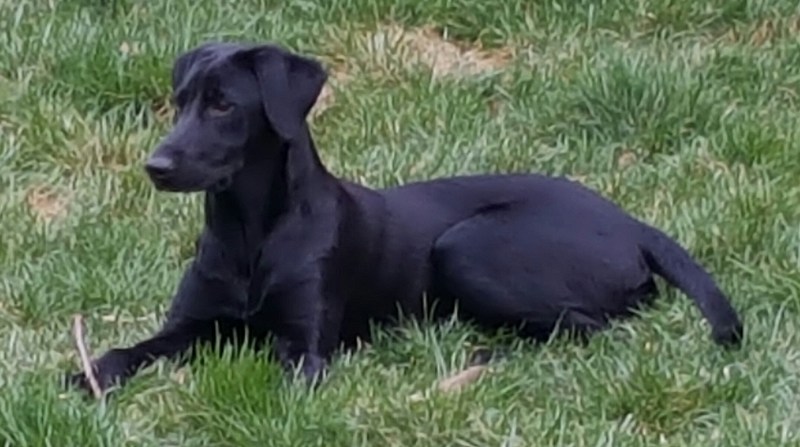
As Lightning’s PRT Stage 3 continues, our next task has been training the wagon wheel drill that Mike Lardy describes for the Transition stage of TRT. The PRT version is virtually identical, the only difference being that I work on Lightning’s line mechanics, including as required for the wagon wheel, with no lead or other physical connection between us.
The first day of our work in the wagon wheel, Lightning was able to pick up a circle of eight 2″ white bumpers with no errors. So starting on the second day, we began working on him picking up a 2” red bumper on a line between two 2″ white bumpers tossed into place after the red bumper was tossed. That was much more difficult, and required repeated use of “no, here” as in the no-no drill we’ll be working on after the wagon wheel.
Obviously the wagon wheel has great value in developing communication between handler and dog, line mechanics, and lining skill. As Mike explains in the TRT video, introducing “no, here” in a gentle, non-aversive way will also provide value to later training tanks.
However, after watching Lightning’s behavior on retrieves, both in these drills and in separate marking practice at this time in his development, I have come to believe that the work we have been getting into, especially the diversion drill and now the wagon wheel, are more stressful for Lightning than I had previously understood, so we’re going to set aside his training on handling skills for now.
I’ll discuss that topic further in a separate post, which I’ll sort into the Table of Contents out of order and earlier once I’ve completed it.
Meanwhile, when the time comes to return to the wagon wheel, we’ll continue until Lightning is comfortable with the entire 16-bumper configuration as well as with “no, here” as a gentle, non-aversive cue for use on a poor initial line and later analogous situations.
As a final point, when I say non-aversive, I don’t mean to say that “no, here” doesn’t function as an aversive, because it does. Retrievers don’t like being called back, and will alter their behavior to avoid it happening. But the aversive quality of the cue comes from the fact that the dog is losing the opportunity to complete the retrieve, not from the way the cue itself is expressed by the handler. A neutral or even cheerful “no, here” is just as effective as a correction to an incorrect response, terminating that trial and setting up for the next one.
 Lightning's Journal