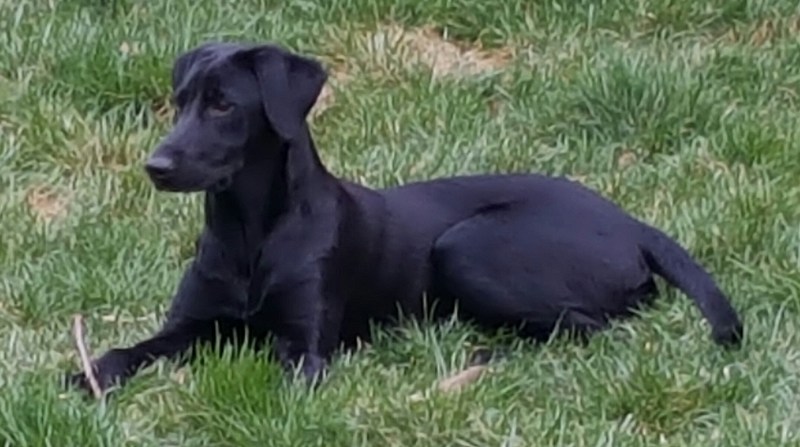
Once when Lumi, my first Golden, was two years old and we were competing in agility, she ran up a teeter at a practice session, apparently thinking it was a dog walk, and was unprepared when it dropped out from under her. Although she had always loved the sport, she didn’t want to go near a teeter again after that.
With advice from other trainers, I tried for months to solve the issue as a training problem using a wide variety of methods. At last I learned from a sports medicine vet who we began seeing that Lumi had a chronic wrist injury, possibly dating from that very incident. No amount of training was going to compensate for the fact that running the teeter caused her significant physical pain as the teeter banged against the floor. Lumi’s agility career was over. That’s when we switched to field work.
Fast forward a few years. Now Laddie, my second Golden, and I were at a training workshop a year ago and Laddie began to exhibit some odd behaviors. He’d chew grass when I stopped him with the whistle, and after retrieving a bird at one point, he tried to bring it to his crate in the van rather than to me at the start line. On a water drill, he repeatedly took wrong lines when sent, avoiding the water, until finally one of the other trainers noticed a subtle irregularity in his gait. Luckily I pulled out of the workshop rather than trying to fix what looked like a training issue. An orthopedic specialist told me a couple of days later that Laddie had a groin injury and said he might need months of treatment and rehabilitation. Luckily he only needed a few weeks of rest. What he didn’t need was me trying to address his strange behaviors as a set of training issues. Those problems disappeared once he was healthy.
So you’d think I’ve learned by now, but unfortunately sometimes these cases only look obvious after you figure them out.
In particular, for some time lately, Lightning’s returns have fallen apart, with him playing games of keep away, dropping the bird at the line when I cued Heel, and other avoidance behaviors. Yeah, just like an untrained dog. He wasn’t too bad with a bumper, but I couldn’t fix the problem with birds no matter what I tried. Then this week I learned that he currently has a liver problem from a long course of antibiotics he’s been on for a staph infection, and today I learned, furthermore, that liver problems can make a dog nauseous.
I immediately realized that that’s why Lightning started refusing his normal diet of raw meat several days ago and would only eat other items, in some cases only if I hand-fed him. It took hours more, and a long, enlightening conversation with my dear friend Jody Baker, before I realized something else.
Lightning hasn’t forgotten how to retrieve. Rather, retrieving was making him feel sick, especially picking up limp, cold ducks. He didn’t want to bring a duck back to me, even if he could stand to carry it, because I’d throw it for him again.
As in the previous incidents with my other dogs, what looked like a training issue turned out to be a medical issue, and no amount of operant conditioning, positive or otherwise, was going to fix it.
OK, as a trainer, you don’t want to constantly be making excuses for your dog. Often behavior lapses are in fact training issues. But what these examples had in common was the oddness of the lapses: my dogs suddenly refusing to perform behaviors they had not only previously learned, but had always seemingly previously loved. They suddenly were acting like untrained dogs.
I will confess to a feeling of guilt in all these cases. I didn’t listen to my dogs when they tried to tell me they were hurting, and I let them down by trying to “train” them past their injuries. I guess I won’t dwell further on how this makes me feel about myself. But I hope I’ll learn to recognize the difference between medical issues and training issues sooner in the future. I’d hate to make that kind of mistake again.
 Lightning's Journal