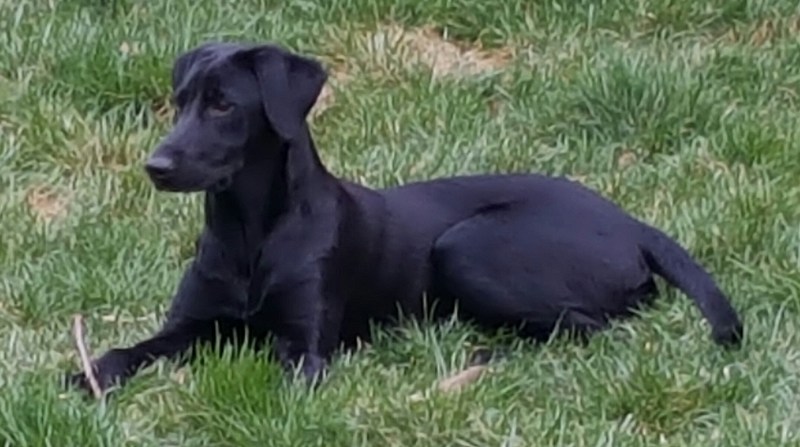
Lightning seems to be back in excellent health, and in a couple of days he’ll be fifteen months old, so here’s an update. For weeks now, my assistants and I have been trying a variety of methods to address a problem in Lightning’s performance so serious that no further progress in Lightning’s training was possible till the problem was resolved: Lightning’s tendency to go into a game of keep-away rather than returning with the article during a retrieve. He stopped doing it some time ago with 2″ bumpers as long as they didn’t have ropes, but it has been a maddening problem for any bumper with a rope, as well as 3″ bumpers even with no rope, to say nothing of dokkens and birds.
We’ve tried many methods to address the issue, variations of running Lightning on a long line, using many kinds of positive reinforcement for correct performance, and even running Lightning and Laddie simultaneously to bring out Lightning’s competitive streak. We’ve met with some success with several of the approaches. But none was able to produce consistent results.
Finally yesterday I came up with a way to add negative punishment to the mix. In the science of operant conditioning, negative punishment, abbreviated “-P” or “P-“, means causing a behavior ( an undesired response) to become less probable by removing reinforcement, or by removing the opportunity for reinforcement, when the behavior occurs.
Here’s the method I came up with: My assistant and I stand some distance apart, but both about the same distance from my van. One of us handles Lightning, the other acts as gunner and throws bumpers. If Lightning returns to the handler with the bumper, he receives one or more kinds of reinforcement, such as a bite of a cheeseburger (no bread), or a tossed toy or bumper. Then the handler calls him to heel for another retrieve.
But if Lightning picks up the bumper and goes into keep-away mode, the handler calls out “Stop” and then both the handler and the gunner start walking toward the van. Lightning may continue to run around with the bumper for awhile, but soon he realizes he’s alone out there and brings the bumper to the handler. The handler reinforces that delivery in some way and we all go back to setting up for the next retrieve.
Once I had worked out the basic approach in my mind, I planned to use it with 100% constituency for several sessions, in the hope that Lightning would eventually learn the no-reward-market (NRM) “Stop”, and gradually learn to avoid it and the associated -P of having the retrieve game stop, by making good returns. I thought it might take a week or so before we could evaluate whether it was working, that is, whether correct responses were becoming noticeably more probable than incorrect responses.
Well, it took a lot less than that; it took about five trials. The first few times we used it didn’t seem to make any difference, and Lightning continued his annoying practice of going into keep-away mode after picking up the bumper. But soon he noticeably shortened the time he stayed in his game before bringing the bumper to the handler who was on his way to the van, and finally he began bringing the bumper straight back to the handler after picking it up.
The progression wasn’t perfect. Lightning would display extinction bursts as he gradually tested the new rules, but by the end of the session, he was able to run a nice momma-poppa double with both retrieves over 100y. Of course we worked toward that setup incrementally from the original setup.
That was yesterday. This morning I went out with a different assistant and we used the same method again. Lightning needed to re-learn that keep-away would end the retrieve game, but it didn’t take long. By the end of today’s session, he was able to run a series of triples, with the gunner throwing a momma-poppa and the handler throwing the go-bird from the start line.
So far we’ve worked with 2″ and 3″ bumpers, all with ropes. Tomorrow we’ll try it with dokkens, and in subsequent sessions hopefully a time will come where Lightning won’t bother to go into keep-away mode with bumpers or dokkens at all. Then, hopefully, we’ll be able to use the method with thawed birds, and eventually, finally, flyers.
If all that goes as hoped for, we’ll be able to resume the steps of our PRT program. It will be too cold for water training till next spring, but we have plenty of land work to do, on both marked and blind retrieves and associated drills, in the meantime.
Dogs are all different, and I don’t have the data to know how other dogs who stop bringing the article back would respond to this -P solution. But hopefully it will prove to be a useful tool for some of them at least. It’s been invaluable for Lightning’s training.
Update: Although all dogs are different, and the method described in this post might work for some retrievers, it turns out that it was not successful for Lightning over the long haul.
What happened was that as each day went by using this approach, Lightning became increasingly likely to go into sustained keep-away mode. The tendencies were subtle, so it took a few days to realize what was happening. But eventually it was clear that this approach was having the opposite of the desired effect.
I’m not sure why. It may be that Lightning became less concerned about me stopping the retrieve game, as he learned that we always resume once he was done playing keep-away. Or it could be that the more keep-away he played, the more reinforcing it was, gradually outweighing in value the retrieve game.
Thus, at least for Lightning, the -P method described in this post was a bust, possibly even setting Lightning further back.
This has been the challenge of developing a new training method. Sometimes you need to test a false path to discover it won’t work it.
However, in a later post, I’ll describe an alternate method I’ve come up with, using both a long line and a rubber ball, that has been far more effective.
 Lightning's Journal