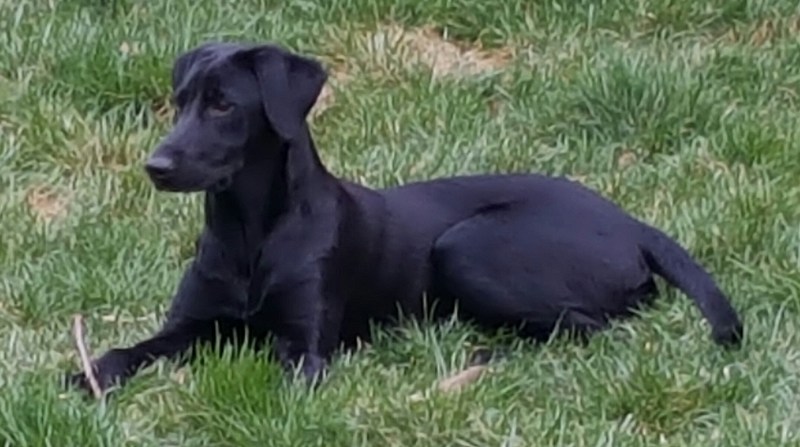
Bird boy blinds, or BB blinds for short, do not appear to be part of Mike Lardy’s TRT program, but they are widely used by traditional trainers and provide a useful drill for a dog like Lightning in Stage 3 of the PRT program, corresponding to TRT Transition.
BB blinds are sort of the handling equivalent of walking singles for marks. As the handler sets up at the start line with the dog, an assistant walks out into the field with a bunch of retrieval articles. One by one, the assistant places an article on the ground and steps away, and the handler sends the dog to pick up the article, practicing handling cues along the way.
Here are some details covering the specific version of BB blinds that I’m currently using with Lightning:
- Sometimes I handle, sometimes one of my assistants handles and I act the bird boy. I feel that having Lightning work with various handlers strengthens his understanding of what we’re practicing.
- We generally use a mat at the start line for Lightning to set up on.
- We randomly run Lightning from either side of the handler. We also randomly have the bird boy step away to either side of the blind, generally about 10y. Over time the dog practices all four combinations of sides.
- We use 2″ red bumpers as our articles. I believe some trainers begin with white bumpers.
- Currently we plant a lining pole just behind the retrieval article. We may stop using a lining pole in the future.
- We start at around 70y and gradually lengthen the blinds to 200y or more during the session.
- The first step of the handler’s cueing sequence is to position the standing dog so that he/she is facing the blind. It’s important for both marks and blinds for the dog to be aimed correctly before sitting down.
- Cue “dead bird”, then, if necessary, “sit”. The dog gradually learns that “dead bird” means a handling retrieve rather than a mark, so control will be paramount and the dog is not being asked to hunt as is the case on a mark.
- If necessary, the handler adjusts the dog’s position until the dog is locked in on the blind, with back, head, and eyes all in line. You can adjust the dog’s position by using Here and Heel verbal cues along with physical body language and hand motions, tapping on the legs, and so forth. You can also have the dog stand up and sit back down in the improved alignment.
- Once the dog is aligned, the handler places his/her hand vertically just in front of the dog’s head, so that the dog’s head will almost brush the hand while launching. Actual physical contact would be illegal. Some handlers move their hand while launching, but many handlers believe it is preferable to hold the hand still, like a gun sight.
- The hand is an affirmation that the dog is locked in correctly. If the dog looks away, the handler lifts his/her hand away and says Nope, Uh-uh, or some equivalent. When the dog looks back in the correct direction, the handler says Good and puts his/her hand back into position.
- As soon as the dog is locked in, the handlert sends the dog immediately. A delay tends to cause the dog to lose confidence in his/her alignment.
- Most handlers launch the dog using the dog’s name for marks, but using the cue “Back” for blinds. We always use Back for blinds, including BB blinds. Again, the dog gradually learns to distinguish between the hunting mindset of a mark and the control mindset of a blind with that extra information.
- The handler may also use loudness of the launch cue to indicate distance of the mark or blind. I believe that’s valuable for marks, but I feel that a quiet Back is usually best for blinds. The dog does not need to know in advance how far the blind is. The dog’s mindset needs to be that the dog will get all navigational information during the blind from the handler.
- The dog may be able to line the blind, since the dog watches the article being planted, the lining pole is visible, and the bird boy is nearby. Ideally, the handler would let the dog line the blind at least half the time to build and maintain motivation for the drill.
- But some of the time, even if the dog is on a good line, the handler cues a whistle sit, then uses a verbal or visual Back cue, or both, to send the dog the rest of the way. For a dog in the PRT program, BB blinds are a good way to focus on training a high quality whistle sit.
- If the dog slips the whistle, the handler instantly calls out “Sit”. The dog will eventually learn to respond to the whistle and the verbal Sit will be unnecessary. Only the whistle is used as a sit cue in competition.
- If the dog doesn’t sit even on the verbal cue, the handler calls out, “Pick it up,” the assistant rushes to pick up the article before the dog gets to it, and the handler walks out to the dog, gently slips on the dog’s lead, and walks the dog back to the start line, using little or no additional communication. This Walkout ritual, though quiet and gentle, has enormous impact on the dog’s behavior, and can be used throughout the dog’s career to train and fine tune the dog’s response to handling cues.
- If the dog gets to the blind before the assistant is able to reach it on a Sit refusal, is not the end of the world. The dog should never be punished for a successful retrieve. It’s simply a lost training opportunity for the whistle sit, not a big deal. Just call the dog in. Granted the dog has been reinforced for ignoring the Sit cue, which is a step in the wrong direction, but hopefully it doesn’t happen too often. To make it less likely, don’t blow the sit whistle when the dog is too close to the blind for the verbal Sit and Pick It Up to be used if necessary.
- Some trainers get in a habit of cueing Sit just as the dog reaches the blind. While that is sometimes necessary in competition, it can be risky to practice it too much even if you’re confident the dog will take the Sit. If the dog begins to anticipate your sit whistle and inadvertently learns to automatically at the sight or scent of the blird, that counts as a pop in competition and can ruin a dog’s career. I believe that most judges will not count it against the dog if the handler uses a “safety” whistle to prevent an overrun when the dog is next to the bird and the dog simply picks the bird up rather than first sitting, so I allow that response in practice as well. To distinguish a safety whistle from a true Sit, I often immediately whistle come-in afterwards: “tweet, tweet-tweet-tweet.” That combination becomes the whistle equivalent of, “You’re right near the bird, fetch it up.”
- Speaking of popping, it’s a minor fault if it happens occasionally, especially on blinds, but must not occur often. Watch carefully to see whether it is increasing with whatever approach you’re using to deal with it. If it is increasing, you are inadvertently reinforcing the pop rather than training the dog not to do it. With Lightning, if he turns to face me when launched, I simply lower my hand to my side and quietly say, Nope, come on in. So far, that seems to be gradually extinguishing his occasional popping. It probably happens when I’m not letting him line the blind frequently enough, so I add more of those freebies to the session. In any case, I’ll save a larger discussion of popping for another post.
- In Lightning’s case, the handler throws his ball for him once or twice after each delivery. That minimizes incidents of keep-away on the return.
All the contingencies I’ve discussed may result in the BB blind seeming complex for you and/or your dog at first, but keep at it until it becomes a simple confidence-building tool. Then you can use it even in the future when needed, to tune-up your dog’s whistle sit.
 Lightning's Journal