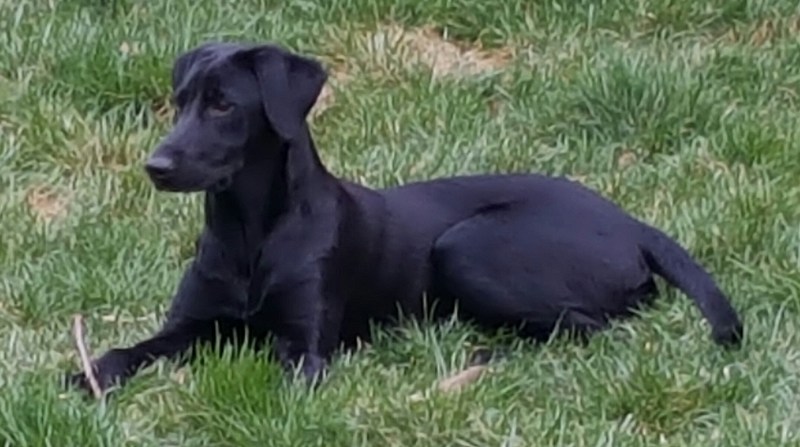
As Lightning turns 16 months old, temps have dropped into the 20s with wind chills into the teens and below, and snow flurries are becoming common. Lightning is training almost every day, but unfortunately without his training buddie. Laddie had a Stage 2 mast cell tumor removed from his forearm several weeks ago and it’s still healing.
In terms of our PRT program, Lightning is well into Stage 3 for land marks, is also in Stage 3 for land blinds, and is in Stage 2 for water work. He’ll have to stay in that last stage till winter is over, since it’s too cold to train in water, but I expect to continue his progress on land in the meantime.
In one way Lightning is not like other dogs at this stage of training: we always have the handler throw Lightning’s red ball for him once or twice after he’s delivered the last article of a series. This seems important to Lightning, because his performance diminishes markedly if we forget to do it. Of course we’ll need to fade it eventually since training equipment is not permitted in competition, but it keeps Lightning’s performance at a high level for now so I feel it’s worth continuing to use it.
For marking, Lightning runs a lot of doubles, some singles, and some triples. Distances are sometimes short, often up to 200y, sometimes even more, with factors such as wind, hills, and high cover. I rarely have the article thrown into high cover, though. To encourage high quality marking, we usually follow the guidance, “Hard to get to, easy to find.” Every once in a while we do throw into cover, however, to introduce that skill gradually.
When Lightning needs to hunt on a mark, I handle only when he clearly makes the decision to avoid a factor. I allow him to hunt without help as long as he stays in the area of the fall, but call for help from the gunner if he gets too far afield. I’m probably more likely to call for help than a lot of trainers, because I want Lightning to have a well-developed sense of Plan B: When you forget where the fall is, look for the gunner to get your bearings. And I handle as little as possible on marks because I don’t want Lightning to start popping. Eventually we’ll need to practice handling on marks, since it’s needed occasionally in competition, but it’s not something we work on now.
We use a lot of configurations for doubles, triples, and singles off multiple guns. Sometimes the guns are widely spaced, sometimes we run hip-pockets and reverse hip-pockets which are quite tight, sometimes a single gunner throws multiple marks either from the same spot or by moving to different spots for each throw, and sometimes we retire a gunner. By end of winter, we’ll add more complexity, as we adapt Mike Lardy’s land marking training concepts from the TRT advanced phase.
We use a wide spectrum of retrieval articles for marking, including: white, black, and black/white bumpers, with and without streamers, 2″ and 3″; duck and pheasant dokkens; and birds, frozen and thawed.
For marking series, most of my assistants like to handle as well as throw, so about half the time, I’m one of the gunners rather than the handler. We also train in a wide variety of locations and orientations. The idea is for Lightning to generalize the principles of retrieving as much as possible without tying them to particular setups.
For marking, Lightning has two intermittent flaws we still need to work on at times. One is that he occasionally goes into keep-away mode after picking up the article. We address that by having the handler return to the vehicle until Lightning brings the article, and by running Lightning on a long line as needed. Sometimes we keep the mark within the length of the line so the handler can hold on. Sometimes we run long marks but with Lightning wearing the line. None of those measures is needed very often. Sometimes we get thru an entire session without any incidents.
The other flaw is that Lightning sometimes picks up the go-bird on a double and then runs with it to the memory-bird, where he switches articles and returns to the handler with the memory-bird. The handler can then send him back to pick up the go-bird, but that pattern is called a switch and results in a DQ in competition. When Lightning starts doing that, we repair it by running him on a long line with the go-bird short enough that the handler can hold on and prevent the switch. As soon as Lightning stops trying to switch, we can remove the line and stretch out the go-bird again.
Because of Lightning’s occasional keep-away, which seems clearly to be an avoidance behavior associated with stress based on when it occurs, I’m still doing relatively little handling with him. For example, we haven’t gone back to drills such as wagon wheels yet. But he does seem comfortable running cold blinds as long as 200y, either with or without an orange lining pole, and takes whistle sits, and casts, with great enthusiasm. He has too many cast refusals — that is, slipped whistles and casting in the wrong direction — for competition, but he’s coming along and having fun with his blinds.
One handling drill we do use, which I learned from a trainer and isn’t in the TRT program as far as I know, consists of a setting up a series of lining poles at distances from short to long, each with a pile of bumpers, and then running Lightning on each of them, starting with shortest one first and then stretching him out. I think Lightning enjoys, and learns a lot from, that drill, without it being too stressful for his current level of development. The guy I learned it from would set up the identical course day after day, but I haven’t been doing that. Maybe that would be better, I don’t know.
I’ll end this post by mentioning what a relief it is that we finally found a solution to Lightning’s keep-away habit, which at times seemed to be getting worse rather than better, depending on what approach I was experimenting with to address it. In all honesty, at times it seemed almost hopeless. Yet here we are, practicing pretty much as normal for Lightning’s stage of development, with keep-away ever diminishing and hopefully someday to be entirely in the rearview mirror.
 Lightning's Journal