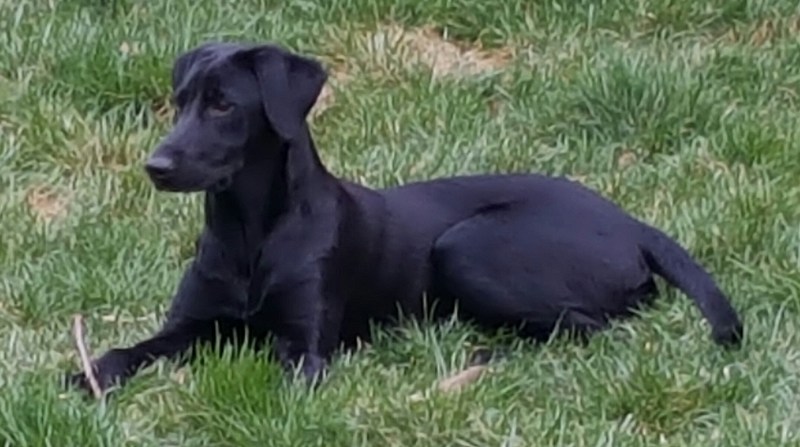
On the sixth, Lightning will be eighteen months old, and well into some aspects of Stage 3 of our PRT program, comparable to TRT transition. On the positive side, he’s healthy; mostly steady at the line; runs singles, doubles, and triples at distances typically 80-200y, including some retired memory birds; takes a nice line on marks and blinds; is improving his sit whistle and casting; and runs fairly long blinds if they have minimal diversions. On the negative side, he’s had little water work yet though he had some last fall, and he still goes into keep-away when stressed. The keep-away issue can usually be switched off by running him on a long line. When not stressed, he doesn’t need the line.
I’ve included some videos taken by Annette from today’s two-hour session. Laddie is still recovering from surgery so all of today’s work was Lightning. Temps were in the 30s with moderate wind, so Lightning didn’t seem to get too hot, and we kept a bowl of water near the start line for him. But after running nine blinds and about three dozen marks, he may have gotten a bit tired toward the end, resulting in some avoidance behavior (keep-away) that we worked thru until we ran a nice triple to end the day.
BLINDS
For the blinds, I set up three poles in a line 40y apart, with three orange bumpers at each one, and had Lightning run them in random order from a couple of start lines that allowed him to see more than one pole at a time. We ran closer to one end, so the lines to the poles were at different distances and angles, and Lightning was required to run to the blind I selected, even if it meant running past closer ones. In one case he ran to the wrong blind, so I put him in a sit when he returned and tossed the bumper back to the pole it had come from. I eventually sent him to that blind again, but not till he’d run the one I asked him to.
Since I train my dogs to run from both sides, I ran Lightning randomly from either side during this drill. At the beginning I ran him on a long line so I could catch him if he decided to go into keep-away mode, but when I saw he wasn’t doing that, I took the line off for the rest of the blinds.
To keep up Lightning’s motivation and reduce likelihood of popping, I ran many of the blinds as freebies, meaning that I let Lightning line the blind without blowing my whistle. Today he never slipped any whistle when I did blow. All of the casts were slight angles back to the left, since Lightning invariably stops with a loop to the right.
At the beginning of the blinds, I was running Lightning and poor Annie was taking the video with frozen hands. About halfway thru, two other assistants, Sean and Evan, arrived and I lost control of Lightning for awhile as he ran to greet them. But we were then able to finish up the last of the blinds. By that time, I noticed that the longest pole had fallen over, so Lightning had to run that blind without being able to see the pole, even though the second pole, which he needed to run past, was still standing. He did a good job and didn’t appear to be too stressed, since he didn’t go into keep-away mode on his returns.
For both the blinds and the marks, these days we always throw a ball for Lightning once or twice after each retrieve (on blinds and singles) or setup (on multiple marks). I’ve found that Lightning is far less likely to go into keep-away mode when we do that. Using a training aid is not be legal in competition, and I’ll fade it when I can, but for now, it improves Lightning’s returns noticeably.
After viewing this video, I’m sorry to say that my handling is quite poor. I move my hand when sending Lightning, I cast too quickly after Lightning sits, and I tend to just flick my arm on the Back casts rather than giving a clean, crisp cast. One of Bob Bailey’s aphorisms is that videos are the best training equipment since treats. Sigh. I hope I can learn something from this one.
Anyway, here’s a video of this afternoon’s triple blind drill:
MARKS
If I hadn’t had Annie videotaping, I would have run Lightning some singles with the guns out and perhaps some doubles as well as triples. But since we would only have two gunners, I decided to stick with triples during the entire marking session.
Today, Evan did the handling while Sean and I threw from the field, moving around to various distances and angles. Although we have lots of cover on this field, our rule for Lightning is to throw onto an area of low cover, making the marks nearly always easy to find. In one case, I threw the go-bird into cover and Lightning required a hunt. I think it’s beneficial that we get to the point of throwing into cover for Lightning — we nearly always throw into cover for Laddie — but right now I’m more interested in Lightning learning to run a straight line. I’ve seen with other trainers that throwing marks into cover for young dogs seems to train them to run an approximate line to the area of the fall and then hunt. Sometimes, of course, that’s necessary on a long or difficult mark in competition, but placements in a trial tend to go to dogs that nail most of the birds without a hunt, so that’s the style of marking I want to encourage.
Lately we’ve been running marks with dokkens, the retrieval article that Lightning is most likely to stress over other than real birds. For that reason, as well perhaps as other reasons such as the presence of so many of his young friends, the difficulty of some of the triples, the late-afternoon lighting and shadows, and the icy, swirling wind, Lightning did behave as though stressed, necessitating that we ran him on a long line. A 60′ line is pretty heavy and I’d rather run him naked, but until he stops being at risk to go into keep-away mode when stressed, we need the line to prevent time-consuming keep-away chases.
Sean and Evan have both been handling Lightning on marks a lot lately and are getting better and better. Today, Evan was scrupulous about running Lightning on the side of the throw, since I haven’t yet burdened him with other considerations. He also showed nice patience on one of #2 birds, where Lightning had selected the shorter memory bird and Evan had made up his mind to run Lightning on the longer, more difficult memory bird in the center. I’m not sure why Evan made that decision, since taking the outer, shorter bird as #2 would have been reasonable, especially since Lightning wanted it. But Evan stuck with his decision, and once Evan got Lightning locked in on the middle bird, he did a nice job of taking the line Evan had chosen for him.
I’d like to make a few comments on Evan’s handling, I hope not to embarrass him, but for readers interested in what they see in the videos:
- Sometimes Evan doesn’t use his guide hand the way I want him to. I want it to act sort of as a gun sight, and to be held completely still until the dog has run under it when sent. And while the dog is lining up, I only want it to be in place when the dog is locked in on the mark, so that the hand placement acts as a reinforcement for locking in. I want it pulled away if the dog looks away.
- Evan tends to turn to the next throw too soon after the previous bird has been thrown, taking the dog’s focus off the previous fall before the dog has had a chance to fully grok it. I want to give the dog time to hold his concentration on every throw, as if that may be the go-bird, not to anticipate another throw and take the previous one for granted. In fact, if the dog does head-swing, I’d like to seem him sent immediately even though all the birds may not have been thrown yet. (Running singles off multiple guns also addresses the same issue, as well as encouraging quality lines to the fall, though we didn’t do that today.)
- In the videos, you can sometimes hear Evan talking to the dog (“sit”) while the birds are being thrown. That would get the team disqualified in competition, and we should not be doing that in training at this stage in Lightning’s and Laddie’s development, though it may possibly have been helpful when the dog was first learning to be steady.
- Our rule is that if the dog creeps forward while the birds are being thrown, the handler is to instantly call out the phrase “Pick it up” (or “Pick it up please”). Of course that’s instructions to the gunners to pick up the birds they’ve already thrown, but it also needs to be used in a consistent way as a no-reward marker for Lightning. I’ve found with my dogs that calling for the birds to be picked up tends to cause creeping to diminish quickly. In at least one of the videos, Evan elects not to do this when Lightning creeps. Unfortunately, that’s like taking ten steps backwards in Lightning’s training. Consistency is critical. Otherwise, the dog behaves as though maybe this will be the time he or she gets to creep without losing the opportunity to retrieve, and it may take several reps before the dog is convinced that creeping will never work again.
- By the way, after “Pick it up,” I ask that any birds that are down be picked up and re-thrown silently when called for. That’s because dogs are excited by gunfire, making it reinforcing. Since we don’t want to reinforce creeping, we don’t want to fire the gun again on the birds that were already thrown. Firing the gun again could tend to create an undesirable behavior chain: watch the birds, creep, and get to watch the birds with gunfire a second time.
- During the training today, it appeared that Evan kicked Lightning a few times while trying to get him lined up on one of the #2 memory birds. That would get him disqualified for touching the dog, and more seriously, for intimidation. Though it was gentle, it’s not the way we want to train. As an alternative, Evan could have let Lightning have the bird he wanted, or he could have swung Lightning around to his other side as a reset, or he could have kept trying to get him lined up without kicking him. Any of those would have been preferable.
- Evan consistently does a nice job, when Lightning returns to the line, of lining him up on the next mark as Lightning sits down. If you try to line the dog up after he’s already sitting in a different direction, it’s not unusual for him to take a wrong line when sent. That’s less likely if he’s sitting on the correct line in the first place.
- Originally I trained Lightning to hold onto the bird until he’s come to heel and sat down, but as far as I know, there’s no rule that the dog has to do that, and I finally decided that the risk the dog will drop the bird while coming to heel is not worth the higher style points some judges may give for the dog sitting while still holding the bird. By taking the bird as the dog arrives, a drop is less likely and you can focus on getting the dog to sit on the exact line to the next bird. This may not be best for all dogs, but it seems to work best with my dogs. In these videos, I believe Evan always takes the bird as Lightning arrives, though sometimes when I’m handling Laddie or Lightning, I do ask them to sit at heel before I take the bird, just for practice.
Here then are Annie’s videos of three of the dozen or so triples Lightning ran this afternoon:
 Lightning's Journal