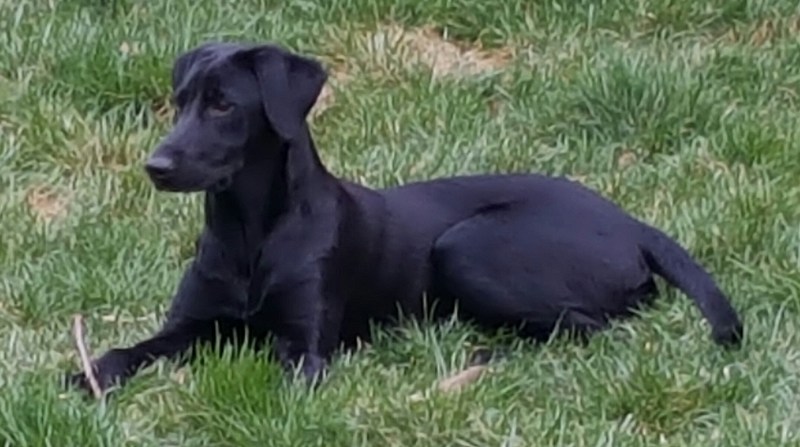
In today’s post, I won’t attempt to cover everything that the dogs and I have been doing last four months, including a trip to Colorado. But above all I’ve been addressing Lightning’s keep-away games on both land and water. That’s what this post is about.
I’m fairly confident now that my friend Jody Baker was correct when she suggested that stress is the common denominator that triggers the keep-away behavior, similar to the zoomies in agility dogs.
I have tried many approaches to repairing the keep-away problem: long lines, high-value treats and toys as reinforcers, challenging vs easy terrain, using Laddie as competition, yelling, silence, driving away, and many other strategies. Some have been somewhat successful, but none has produced consistent results.
Now I have hit upon something that has been dramatically successful, almost magical: using the Walkout for keep-away.
The Walkout is my name for leaving the start line and walking out to pick up the dog when he has performed incorrectly, such as not sitting on the whistle. I don’t speak harshly to the dog, and I don’t do extra training such as heeling. I just walkout, slip in a lead if necessary, and we walk together back to the start line. Then we try again.
I have never understood in behavioral terms exactly how the Walkout works, but it really is magical, much more powerful as a training method than I would have predicted.
However, perhaps because I don’t understand exactly why it works, I’ve never really tried it for keep-away.
Well, three days ago I was training alone with the dogs in a large field, our first land work after many weeks of water training exclusively because of the summer heat. Even that day was rather warm, but I felt both dogs would be able to deal with it if we didn’t work too hard or long.
I won’t go into how Laddie is doing, but when I took Lightning out and tossed a 2″ roped bumper a few feet away for him to bring back to me, he immediately went into his most mischievous version of keep-away. He grabbed the bumper by its rope and raced out into the field. He visited the woods next to the field and also tore into the center of the field, generally maintaining a distance of at least 200y away from where I was waiting.
I won’t go into all the thoughts that went thru my head, but for some reason, I decided to go after him on foot. I’d cut him off when he looped around, and just doggedly pursue him when he ran straight away. Sometimes I got closer, but then he’d build up more distance again. He was oblivious to any cues such as Here, Sit, No, and various whistles.
But after several long minutes, he finally stopped and looked at me, and fetched me the bumper when I called him.
I repeated this procedure over and over. The first couple of times I tried reprimanding him when he finally came back, but that didn’t really make good behavioral sense to me, and anyway it didn’t help. But even when I worked in complete silence, I could see that the chases were lasting less and less time. And after about half a dozen chases, Lightning ran a straight retrieve when I tossed a bumper for him. I tried different distances, and finally needed to do one more Walkout after a particularly long toss. But mostly the rest of the session was a pleasure. I had to keep it shorter than I would have liked, though, because of the heat.
The next day, I brought along Liza, one of my assistants, and we trained at the same field. This session we ran some blinds and some marks: singles, doubles, and triples. Lightning had a small number of keep-away instances, and I again used Walkouts. I’ve experimented before with having my assistants do the chases, and that never seemed to improve Lightning’s behavior. But in that second session, again, when I did the Walkouts myself, Lightning immediately began performing well the next setup. And we only had a small number of instances. Also, the chases didn’t last very long.
The third day, that is, yesterday, I brought Liza with me again, and we went straight to marking setups. Amazingly, Lightning didn’t go into keep-away a single time!
As for reinforcement, all except for the first couple of retrieves the first day, I rewarded Lightning’s returns by throwing his beloved red ball for him. In the case of a multiple, i’d only toss the ball after the last retrieve.
For the blinds, I used 2″ red bumpers. For the marks, I had Liza throw dokkens.
Ok, that’s all the hard data I have right now. We’re having thunderstorms today and tomorrow, but we’ll get back out as soon as we can.
I don’t know how to apply this training to Lightning’s keep-away games in water, where he races up and down the shoreline just out of my reach as he’s returning. I’ll report on that when I have more information.
And I should say that I don’t know to what extent all the months of other work I’ve been doing with Lightning, usually training for several hours a day plus countless games of fetch in and around the house, has pre-conditioned his response to the Walkouts I’ve just started using. I’ll need to experiment with other young dogs to learn more, or wait to hear from other positive trainers who try it.
In addition, I’m still mystified by what is going on in terms of behaviorism”s operant quadrants. It seems to be this: Lightning likes running around carrying retrieval objects by the rope. He also likes retrieving the way I want him to (no keep-away). But the two behaviors compete for his preference. However, he does not seem to like playing keep-away when I add the element of a Walkout, at least not as much as a straight retrieve. And if he comes to believe that I’ll undoubtedly do a Walkout if he initiates keep-away, he doesn’t bother. So the Walkout becomes something to be avoided, just as it does when training the whistle sit.
Again, I don’t understand why. The Walkout is apparently aversive, since it triggers an avoidance response. But why should it be aversive? Why doesn’t it just make keep-away more fun?
I don’t have an answer. Also, we have a lot more experimenting to do. Will this work when I use more gunners? Will it work with ducks, both thawed and flyers? Will it work in other locations and terrains? Will it work at longer distances, say 200y+? Will it carry over to water without me having to wade into the water?
I’ll write more as learn some of the answers.
 Lightning's Journal
Interesting. My dog will fail to go, but she rarely plays keep away. I hope I remember to try a Walk Out if it comes up.
LikeLiked by 1 person