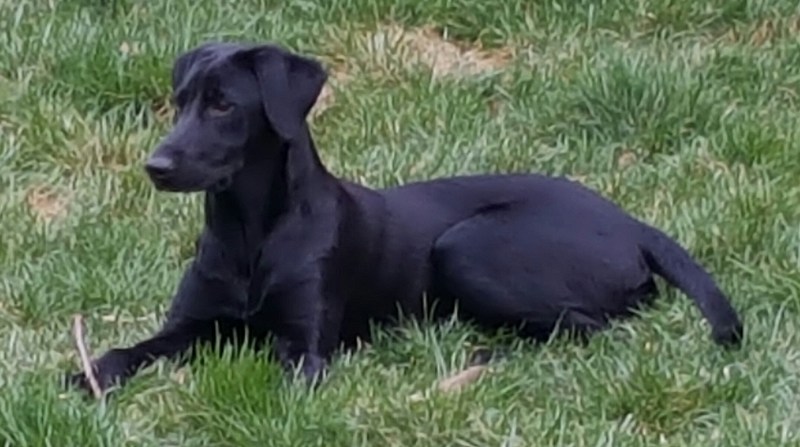
As I described in the previous post, the Walkout has given us an effective tool for dealing with Lightning’s occasional games of keep-away. Quietly walking out to him once or twice when necessary greatly shortens the duration of each incident and generally ends the problem for the rest of the session. Sometimes we have sessions with no incidents at all.
I still would not want to run him in a group training session because even one Lightning keep-away incident might be enough for us, even Laddie, to be excluded from the group in the future. But we’ve made good progress.
We continue to train virtually every day, and I’ve added some more elements the last few sessions:
- I give Lightning (and Laddie) dokkens to run around with when we first arrive at our training location. For Laddie, carrying around something just makes his warm-up adventures more fun, and I think he’d be equally happy with a bumper or possibly even a tennis ball. But for Lightning, this has the additional benefit of giving him a chance to run around freely with a dokken, even carrying it by the rope, hopefully getting that annoying behavior mostly out of his system for the day. I’ve experimented with not doing this, since one could speculate that giving him the opportunity to rehearse the behavior might actually make the problem worse, but my observation is that it distinctly helps to reduce or eliminate later keep-away incidents to let him play that way during warm-up.
- If possible, I set up a holding blind and mat at our start line, and wear a white handler’s jacket. These trappings take more time and the jacket is not comfortable in the summer heat, but the goal is to create a consistent context for retrieving without keep-away.
- Although I don’t have access to a location suitable for land training that also has ponds most days, if a puddle is available from recent rains, I set up our start line nearby. This has the advantage of providing a good distraction for the distraction-proofing stage we’re now in, and perhaps more importantly, provides a high-value reinforcer after running a single or multiple retrieve. As soon as Lightning returns with the last dokken, I toss his beloved red ball as usual, but toward the puddle, encouraging him to frolic and cool off as long as he likes, usually just a few seconds, before we return to the start line for the next sequence. The idea is to not deprive him of his play and cooling off, but instead to separate them in his mind from the retrieval pattern. If no puddle is available, I put his water dish a few feet to the side of the start line, not as interesting to him as a puddle but I think still a way to reduce stress, especially when we’re training in 80 degree and up temperatures.
- When we have time, we sometimes work on handling drills during our session, but my primary focus at this time, as it has been for months, is getting Lightning to the point where we would be able to train with a group, assuming I can find one to train with. Above all, that means no games of keep-away when we’re taking our turn at the line. For now, our focus is on land retrieves, though eventually we’ll have to solve the problem for water, too, if it still exists when we begin making the long drives to facilities with technical ponds.
- The training plan we use pretty much every day is a typical positive trainer’s example of shaping a desired behavior with increasingly accurate approximations of the desired behavior, using reinforcement to build motivation for the work and an increasing probability that the subject will correctly perform the desired behavior in the future when presented the opportunity. Although the point that this is a shaping process may be obvious, it’s a departure from the PRT approach, based on Mike Lardy’s TRT program, that I’ve been using for Lightning, since I see no evidence that traditional trainers like Lardy need to break off from their usual training sequence, in this case for months, to address a flaw in the dog’s development. But our PRT program does need room for repairing such a flaw before we can move on to the next training steps.
- We’re able to run out current drill with a single assistant, such as Liza. We start by putting out six lining poles in a straight line away from the start line. Currently they’re spaced at 20y intervals; I plan to increase that to 25y and then 30y, and maybe even larger gaps, when Lightning is ready and if we continue using the drill instead of switching to something else.
- Liza goes out to the closest lining pole with six dokkens and a pistol. When she’s ready, I bring Lightning out of the holding blind and call for our first sequence. The first few times we started with singles, and didn’t even run any doubles if Lightning couldn’t do a good job with the singles. Lately, I’ve been mixing it up a little to avoid predictability. For example, I might ask Liza to throw a double at pole 1, then a single at pole 2, then a single at pole 3, then a double at pole 3 or even back at pole 2, and so forth. Of course we alternate which side I run Lightning on and which side Liza throw to. Also, importantly for Lightning, I ask Liza to skew the angles of the throws so that the memory bird is thrown on an angle back, and the go-bird is thrown on an angle in, creating maximum distance between the falls. This tends to minimize the chance that Lightning will pick up the short bird and then run with it to the memory bird before bringing me the bird he already has. Lumi and Laddie both stopped doing that early in their training, but Lightning still does it if the falls are too close to one another. We’ve concentrated on repairing the problem previously, successfully but apparently not permanently, and we will again in due time. For now the focus had to remain on extinguishing keep-away.
This incremental training plan is working well. We can sometimes get through a whole session with no keep-away, and rarely have more than an incident or two, for example perhaps on the first double at pole 5. If we continue using this plan, I think we’ll soon be running doubles at 180y as we get to the end of a session.
At that point, I’d like to switch from dokkens to thawed ducks, and I’d like to add triples to the mix, not necessarily in that order. Then a time will come when we won’t have to start the session with the easiest work, but perhaps start right off with a double at one of the longer poles. I’ll also increasingly begin to train with multiple gunners again.
Defeating keep-away has been a big job. But we’ve made progress, and I’m beginning to believe that eventually, Lightning will become a normal retrieving dog with no games of keep-away, and we’ll be able to resume training perhaps to someday run Lightning in field trials.
 Lightning's Journal