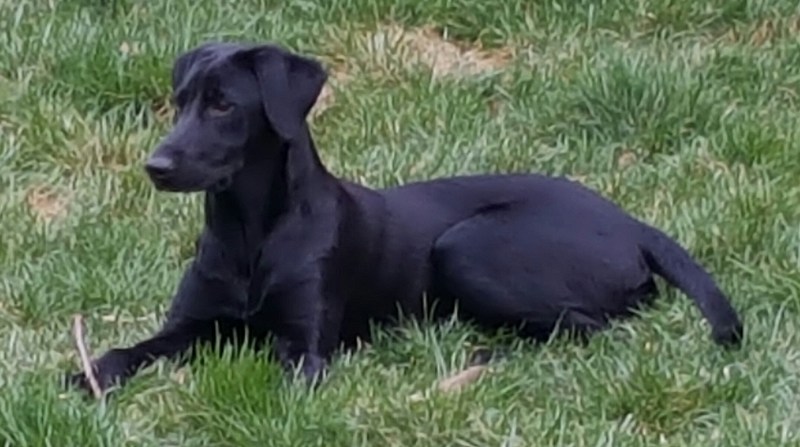
It’s mid-July and Lightning will be 3yo soon. Whereas he was training at a good pace relative to traditionally trained pups for his first year, once his keep-away genes kicked in, his progress slowed to a crawl.
His inventory of discrete skills has changed little since my earlier posts. He can run big triples, even with one or two hidden guns. He understands a most handling cues because he does them intermittently, but he often does what he feels like doing instead of taking a cast, and his whistle sit response rate is under 50%. He’s pretty steady at the line, but his honoring is unreliable. He would appear to have issues yet a solid foundation to build on.
But he still likes to play keep-away in unpredictable ways. Sometimes he’ll go the whole training session and make every return beautifully. Other days, he takes off with a bumper or dokken and refuses to bring it back for half an hour or more, and we get in virtually no training at all. Most commonly he mixes good returns with bad ones in a seemingly random sequence all within the same session.
I have tried and continue to try many experiments. His returns usually seem to be more reliable if the handler throws his red ball for him a time or two after he finishes a setup. Sometimes throwing a bumper has the same benefit. If the weather is warm, his reliability improves dramatically if we keep a water bowl for him near the start line, suggesting that sometimes he isn’t returning because he’s searching for water. He is also more reliable on land retrieves than water retrieves, and more reliable in familiar terrain than when we try out a new field. I’m not sure if he cares who the handler is. Sometimes it seems he’s performing better for one than others, but it might not be the same next session. If he seems about to begin keep-away, sometimes clapping, calling Here, using his name, or whistling seems to bring him in, but often he ignores the cue. He is pretty impervious to food as a lure or as reinforcement toward the next rep.
I could list a lot more observations, but I question whether it would help anyone to read them. I really don’t have any answers.
Well, that’s not true. I know that when I experiment with showing some anger when he finally arrives, it makes him less likely to return the next time. I know that he makes hundreds of solid retrieves at home and on walks every day, and never breaks into keep-away, as long as the handler is throwing the article for him and it’s not in water. I’m almost certain that keep-away is a reaction to stress in many cases, for example when I’m trying something more confusing to him than our usual fare. And I know his returns are getting better and better.
The mystery for me is whether his genetic compulsion to retrieve will ever overtake his playful, adventurous, and possibly mischievous compulsion not to. In other words, will be ever outgrow this so that one day, hopefully before he reaches old age, we can resume our training program?
Until then, I’ll just enjoy his high quality performance when he does well, and of course continue take pleasure in our daily outings and “work,” such as it is, together.
 Lightning's Journal