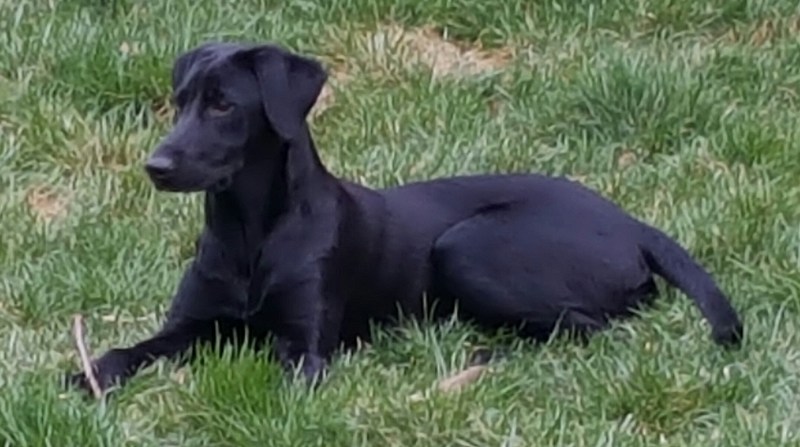
Nearly a year has passed since my last post, and Lightning’s keep-away tendencies are still too unpredictable for competing or even training with a group. I suppose the issue could possibly be solved quickly with an ecollar, and if my primary goal were to train Lightning for competition, it’s long past time when I think that would have been the best available solution.
But training Lightning and my other dogs for competition has always been secondary to other considerations. My entire objective in training Lightning, and Lumi and Laddie in days gone by, was to make the effort to see how far I could bring a dog in retriever competition without using physical aversives, and that objective remains more important to me than success in competition.
Over the last year, Lightning and I have done many things together. I have developed many strategies intended to overcome his keep-away habit. Actually I have had a lot of success. But I haven’t found a silver bullet. I think one of the most important strategies I’ve developed is simply giving Lightning time at the beginning of each session, and as required throughout the session, to run around with his to bumper as long he wishes until he decides on his own to bring it to me. These moments of free reign are apparently of paramount importance to Lightning, and I have found no form of reinforcement for working together that is strong enough to eliminate his insistence on also playing by himself sometimes. I have been able to improve his ability to focus on a particular set of tasks and then let him run around in his own, but I can’t eliminate the free time completely, and I also don’t have 100% success even with the channeling games, so I won’t go into them at this time. Perhaps someday it will seem worthwhile to describe some of them.
Meanwhile, I did want to describe some training we’ve been doing lately that I think would benefit any retriever being trained for competition, even though in Lightning’s case he may never be predictable enough to compete. The training we’ve been doing is to get Lightning as comfortable as possible with keyholes.
A keyhole is a point in a retrieval line that passes between narrowly placed barriers, often trees. Dogs have a natural inclination to run to the outside of one or the other of the obstacles rather than running between them, even when they realize that that is taking them off their line.
For a retriever to be comfortable running thru a keyhole is important for both marks and blinds. For marks, the dog who runs the most direct line will score highest with the judges, and avoiding a keyhole can even get the dog so far off line that he can’t find his way back on line without being handled. For blinds, it is just easier to handle a dog thru a keyhole if the dog is already comfortable with taking those kinds of lines, and easier means a better chance of success running the blind well.
Another advantage to working with Lightning on this particular skill is that I don’t have to pay for assistants to train with Lightning and me during these sessions.
Now for a description of the keyhole training. In the early stages, I would put Lightning in a sit, walk the line I want him to follow between the particular obstacles (typically trees) I’m using at the time, toss a white bumper to the end point of that line, and then go back to send him on a Back cue. The distance from our start line to the keyhole would only be a few yards and the distance past the keyhole to the article would also only be a few yards, both of which distances could be adjusted to assure success. We worked with two or more different keyholes in the same session, repeating them in random order. I would typically throw a fun bumper once or more after every keyhole or two to keep up Lightning’s interest, since just running a long series of uninterrupted keyholes was likely to result in some stress and the inevitable breakout into a game of keep-away.
Once Lightning was able to run these easy keyholes, I’ve begun adding any number of difficulties a little at a time:
- Lengthen the line, especially the line before the dog reaches the keyhole. The further he travels to get to the keyhole, the less likely he is naturally to go thru it.
- Use diagonal keyholes, so that the dog must pass on one side of the first obstacle and on the opposite side of the next one. Particularly difficult is running across a slope with the second tree on a lower level than the first, so that gravity is adding to the suction to pull the dog outside the second tree.
- Use lines with multiple keyholes, either multiple pairs of trees, or trees in a zigzag pattern for the dog to run thru the middle of.
- When planting the bumper, walk around the keyholes while the dog is waiting in his sit, even though the dog will need to take a direct line rather than the path he saw you take.
- Use an orange bumper so that the dog is less able to rely on seeing the bumper in the distance in order to hold to the correct line.
- Strengthen your ability to send the dog on a desired line by planting the bumper when the dog can’t see where you’re planting it.
- After planting the target bumper, toss one or two other bumpers, typically white ones, on angles to either side of the correct line and closer to the dog than the target bumper. Take time to line him up and get him locked into the correct line before sending him, and consider it a success only if he runs straight to the correct bumper. If it’s reinforcing, you can send him to pick up the diversion bumpers afterwards.
- If you have wind, set up a line that will require the dog to hew into the wind to stay on the correct line.
- Introduce other obstacles in combination with the keyhole, such as a log for the dog to jump over or underbrush for the dog to run thru.
- Set up keyholes for water retrieves, both on land before or after the water segment as well as keyholes during the swim.
- Combinations of any and all of these, and of course any other challenges you come up with.
Even for a dog with a tendency to get the zoomies like Lightning, these drills can be so much fun that the dog will stay in the game for a reasonably long session, especially if interspersed with fun throws and free play as the individual dog requires. And if Lightning ever does outgrow his keep-away games, allowing us to think about competing, we’ll already have the valuable asset of his being comfortable running thru keyholes in his toolbox.
 Lightning's Journal