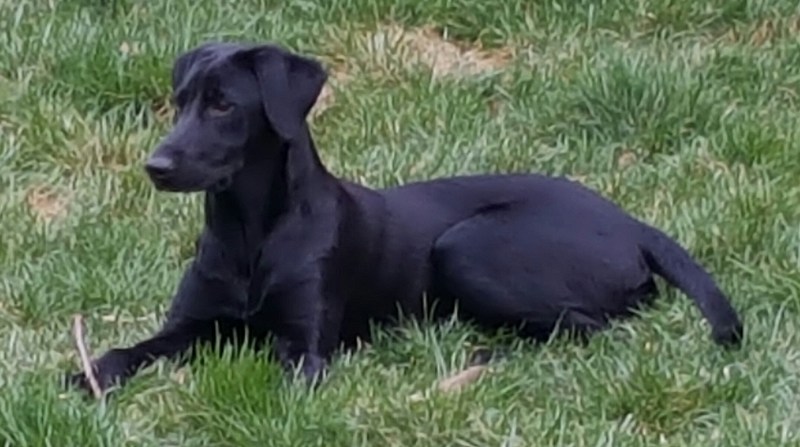
Why now?
In this post, I’m going to describe the Three Toy Game, a training method unlike any I have seen before, not in traditional nor positive retriever training, agility training, musical freestyle training, or general clicker training.
Since I believe the method could have value to others, I want to share it and include it in the Positive Retriever Training (PRT) system being developed here in Lightning’s Journal.
Yet I have only used this method with a single dog, Lightning, my black Labrador Retriever. And I am still in the proofing stages of the training’s water version. It’s always possible that something will go wrong, either a failure of the method ultimately to deliver the desired results — preparing Lightning’s retrieve for competition — or some unintended side effect.
Still, for me, the Three Toy Game seems to hold the solution to one of the most difficult training challenges I have ever encountered: repairing a retriever’s tendency to go into a game of keep-away at times instead of completing a retrieve. And I know Lightning is not the only retriever ever to display this tendency, although I do not know what factors — nature or nurture — trigger it in particular dogs.
I wish I could publish the Three Toy Game as a rigorously proven method. But we never know what lies ahead. If I try to wait until the circumstances for publishing it are ideal, that time may never come and I may never have the opportunity to share what I have learned.
So with apologies for the method’s lack of proof at this time for effectiveness with a large number of dogs, and the refinements (or even abandonment) of the method if and when such proof is attempted, here is the Three Toy Game as currently developed for Lightning.
Who Is This For?
I cannot say with certainty what the prerequisites are for having success with this game. This journal has described pretty much all of Lightning’s previous training, but I doubt all of it would need to be completed in order to begin using the Three Toy Game. I think you could use this game once the dog can run marks on land and water, that is, when the dog is ready to begin pile work or any time thereafter.
I also cannot say whether this game would be of any value to someone whose dog does not have a tendency to play keep-away. For all I know, it would teach keep-away to a dog who didn’t previously show that tendency! But all of my retrievers have had a problem with keep-away at some point in their development, generally starting at around a year old. I eventually solved it with Lumi and Laddie using combinations of other approaches, but I wish I had known about the Three Toy Game with them. It might have saved a lot of time.
Finally, the dog cannot be a runaway risk. Lightning may disappear for as much as 20 minutes at a time when we’re playing or training outside, but he always comes back. If you feel there is any risk that your dog could get lost or choose to run away, please don’t try the Three Toy Game as described here. Perhaps some variation could be developed that would work for your dog.
The Three Toy Game
Here’s a bullet list describing the Three Toy Game:
- The three toys are: the keep away (K) toy, the hard (H) toy, and the easy (E) toy. Let me explain each of them, and then go over the training chains, or sequences, with which they are combined to create the desired reinforcement history in the dog.
- Every second or third throw is with the K toy, using a consistent cue such as Go Play. The article should be something the dog has shown he likes to play keep-away with, but preferably not something that would be used in a training group or competition, such as a bumper or dead bird. I use an old, half-chewed dokken for Lightning’s K toy. Hand or toss the toy to the dog, cue Go Play, and just let him play keep-away with it as long as he wants. Perhaps counterintuitively, using the K toy for reinforcement in each training chain is the key to training the dog not to play keep-away when the retrieve counts.
- Don’t lunge for the K toy when the dog approaches you with it while playing. Instead, wait for a cheerful, motivated delivery. Make sure he has really decided he wants to deliver it.
- Important and difficult: Don’t attempt recall or any other curtailment during the keep-away retrieve. It just trains the dog to ignore or even be repelled by your recall cue, and reinforces keep-away by making the keep-away game more interesting for the dog.
- If the dog is fairly hungry and you’re using really high-value treats, you may be able to significantly reduce your wait time on the K returns by reinforcing delivery with a treat. As always with treats, don’t use them as a lure. Keep the treat out of sight until the delivery, then instantly hand or toss the treat to the dog.
- The H toy represents your training objective. I like using a dokken that’s in good condition for the H toy. It’s “hard” in the sense that I have found it extremely difficult to train Lightning not to go into a game of keep-away with dokkens.
- Set the H retrieve up consistently as a competition-like mark, not a fun throw. As with a poorman mark, the cueing sequence is Heel, Sit (I don’t use Stay), then walk out to place the toy, return to the dog, Sit, send on the dog’s call name, and finally, Here. Unless it’s obvious the dog is going to fail the retrieve when he picks up the H toy, I would suggest that you not omit the recall cue (“Here,” or later, a whistle). This is a good time to help it become solidly associated with successful retrieves.
- Start with very short distances for the H toy. Reinforce delivery of the H toy instantly by handing or tossing the dog the K toy and cueing Go Play.
- The dog eventually needs to be able to do the H retrieve without seeing that you have the K toy waiting to give him, since you can’t bring training equipment to the line in competition. But you might want to hold the K toy in your hand for the pup to catch a glimpse of while setting up the H retrieve in the early training.
- If you’re using treats for the K retrieves, you also need to use treats for the H retrieves, because otherwise the dog is likely to start failing the H retrieve in anticipation of the K retrieve’s treat. This is the same behavioral mechanism that causes false starts in races and looking up instead of keeping your eye on the ball in sports. So if you are using treats, give the treat upon delivery of the H toy, then immediately hand or toss the K toy and cue Go Play, and then use another treat for delivery of the K toy. I suppose you could use treats for the H toy and not the K toy, but then you’d lose the benefit of slashing the amount of time your dog will play keep-away with the K toy.
- The E toy is retrieved as a big fun throw, that is, allowing the dog to run out ahead of you while you’re throwing, and is run in a way that the dog has a high probability of completing the retrieve. The importance of the E toy in the Three Toy Game is that it injects low stress yet successful, no keep-away, retrieves into the training chains, enabling the dog to practice that behavior in every sequence. I like to use a 2″ white bumper for the E toy because I can throw it a long way, which motivates Lightning, and he has a long history of returning 2″ bumpers without playing keep-away, at least in certain locations. Reinforce delivery of the E toy by instantly handing or tossing the dog the K toy and cueing Go Play. Even if you’re using treats for the H and K deliveries, I don’t see any advantage in treating after the E retrieve. It is already self-reinforcing to a high degree, plus the K toy is coming.
- Running these three kinds of retrieves in haphazard fashion has never let me decrease Lightning’s keep-away tendencies on competition-style retrieves. But I finally learned how to chain them so that the reinforcement factors at play would produce that result. That is the basis for the Three Toy Game.
- Now here’s the training sequence for the first few sessions:
- — K (“Yay, I get to play keep-away today.”)
- — E/K (“That was easy, and I see that I get to play keep-away when I bring back the E toy.”) Repeat one or more times.
- — E/K/H/K (“This time I had to complete a retrieve with one of my favorite toys without playing keep-away, but I see that I still get to play keep-away afterwards.”) Repeat one or more times until totally confident on the H retrieves with no keep-away.
- — Finally, sets of E/H/K and H/E/K randomly intermixed (“I get so many fun throws and I get to play so much keep-away. NBD, I can do all of these chains.”) These are the first chains where the dog must perform more than one E or H retrieve before getting to play keep-away. This is a tremendous confidence booster for the trainer. When the dog can do these, you can know you’re on your way to having a dog who can run marks without going into a spontaneous game of keep-away, though there’s still a lot more work to complete this training.
- After several sessions and you have high confidence in all the patterns, you can incrementally refine the training in many ways: Use doubles for H, then triples; increase distances for H; use a tweet-tweet-tweet whistle instead of Here for the H recall; toss H instead of placing it; call Hey-Hey-Hey when placing or tossing H; use assistants to throw H; use a holding blind when running H; use a gunshot for H; use a dead bird for H; use a flyer for H.
- As with any training, you need to do location proofing. Important and frustrating: you may need to start almost from scratch in new locations.
- Also as with any training, you need to do distraction proofing: introduce the work to environments with people, wild birds, crated birds, etc.
- For land training, Lightning and I went on hikes while playing the Three Toy Game.
- For water training, because of the long waits while Lightning was playing keep-away, I sat in a folding chair placed at various locations near the water while waiting for Lightning to finish his keep-away retrieves. I would stand up and remain standing for the other retrieves. When I trained with treats, the chair was unnecessary because the time of the keep-away waits was slashed.
- For failed retrieve with E or H: rerun the identical E or H once the dog brings the article back, then continue the chain. If using treats, do not reinforce the failed retrieve.
- Unlike early training where short sessions work so effectively, I played the Three Toy Game in long sessions, as long as Lightning remained motivated by all elements of the game. For example, we were able to continue playing this game continuously on two-hour hikes for land training. For summer water training, in 90s temps with 105° heat index, Lightning only began failing H retrieves after about 90 minutes. Don’t continue the session once the dog begins repeatedly failing H retrieves, assuming you’re pretty sure you haven’t made them too hard too soon. At some point the dog is no longer learning effectively. Try to quit before that happens if possible.
- Using a long line for the H retrieves might accelerate the training, or might destroy it. It’s possible that the dog just learns not to play keep-away when on a long line. I have tried fixing Lightning’s keep-away with a long line many times in various ways without good results.
- I would greatly welcome feedback from other positive trainers who try the Three Toy Game with their pups.
 Lightning's Journal