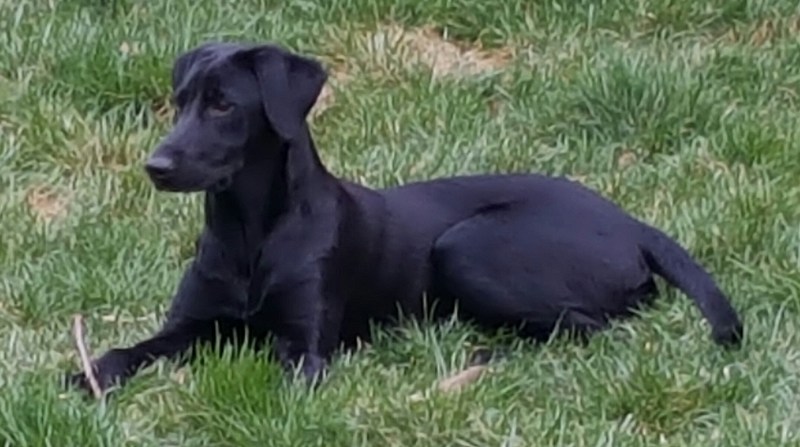
The Three Toy Game is somewhat complex, and it took me many months to discover a sequence of events for incorporation into the PRT program that would enable Lightning to run single, double, and triple marks, even with throws into or across water, and even using thawed ducks as retrieve articles, without breaking into a game of keep-away during the work.
Yet despite the game’s complexity, it really just remains analogous to using an ecollar for negative reinforcement, but instead using high value rewards for positive reinforcement.
I guess the key was coming to understand that for Lightning at this stage in his development, the only reward with sufficiently high value to reinforce correct retrieves was the opportunity to play keep-away immediately after those retrieves, and thus enable such an opportunity to become understood as an outcome of correct performance. Adding food to the mix further strengthened the reinforcement but added more complexity and thus took even longer to figure out as a training plan.
Now that the keep-away version of Lightning has reached this stage in his marking, I felt it was time to resume his handling training. But since he was now handicapped, you might say, by being unable to perform a good retrieve without me as his trainer addressing his keep-away tendency, I saw the handling training as needing to go all the way back to pile work and retracing our progress from there, making the necessary adjustments this time thru the training sequence to deal with keep-away.
I didn’t actually know if that would be possible, and I still have only limited data. But after a few days of some preliminary work, I’m encouraged enough with Lightning’s progress that I felt it was time to record our method so far, lest it get lost as we go on to the formal four steps of pile training as described in earlier posts to this journal from, amazingly and sadly, years ago.
Here’s my guide to preparatory work for pile training for a keep-away dog already skillful with the Three Toy Game:
- Use an isolated field, where your dog will not be distracted by other people and other dogs.
- Place two lining poles 100y apart. The field we’re using has a long, straight path of low growth with higher shrubbery on either side, but I don’t think it’s necessary for the path between the two lining poles to be cut or worn shorter than the rest of the field. [Note: Based on a re-viewing of the TRT video on pile work after we ran this session, I would now not use lining poles, and I would plan the distance at about 50y, not 100y. In a later note I’ll mention another change also based on the video.]
- Place a bowl of water somewhere within 20y of the starting-line pole you’ll be running from so that the dog can take breaks for water as he deems necessary.
- Place several bumpers near the far pole. Dog trainers call this a “pile” but the bumpers are actually scattered so that they don’t touch, rather than being piled atop one another. We’re on vacation and I brought three white and three orange 2″ bumpers, so our pile has six bumpers. When we get home I’ll probably use more, and may switch to all orange, since I believe that’s more common for handling drills. [Now I would not place the bumpers as a set-up step while the dog was playing, but would put the dog in a sit at the start line and let him watch me toss the bumpers onto the ground to make the pile.]
- Keep the dog’s preferred keep-away (K) toy handy. I tried retraining pile work without the K toy a few days ago, before developing the present drill, and it didn’t work because Lightning, despite his months of experience with the Three Toy Game, kept breaking into keep-away on his pile-work retrieves. So I developed this drill so that he can perform high quality pile work while using his own keep-away games as reinforcement.
- I let Lightning chase around with the K toy while I was setting up. Any time he brought it to me, I gave him a small, high-value treat (a piece of hot dog) and then threw the K toy into the field so he could continue playing while I finished setting up.
- When everything was in place, I stood near the starting-line pole and waited for Lightning to bring me the K toy. I tossed the toy on the ground behind me, lined Lightning up in a sit to run a retrieve to the far pole, placed my hand as a guide over his forehead, and cued an enthusiastic Back.
- Since Lightning has been running this sort of retrieve throughout his life, he knew exactly what to do. He raced to the far pole, grabbed one of the bumpers, and raced back with it, delivering enthusiastically to hand. I had his K toy ready in my other hand and immediately tossed it for him to chase and play with, without any further interaction from me. When he eventually brought the K toy back to me unsolicited, I took it and handed him a piece of hot dog. That was one rep.
We repeated that sequence six times the first day. The primary variation, when it occurred, was that Lightning was not always satisfied with a single game of keep-away after a successful retrieve. He showed this by refusing to lock in on the far pole when I tried to set him up for the next retrieve. So I would gesture toward the K toy lying on the ground and cue Go Play. I’d give him a treat each time he brought the toy back and tossed it away for him again until he stayed close and brought the toy back immediately. Then I knew he was ready for another rep.
Over the next three days, I gradually introduced double retrieves. That is, after he brought back one of the bumpers, I’d immediately line him up and send him back for another.
The first day I tried that, he only accomplished it correctly the first time I tried it. From then on, he’s do the first retrieve and then drift offline and out of control when I sent him again. But we still completed all six retrieves, mostly as singles as in the original drill.
The next session, he completed doubles successfully the first time and the third time I tried them, but in between drifting off when I sent him for the second bumper. This time I called him and gave him a treat for the nice recall, then sent him out with his K toy before running another single. After that single and his keep-away game, he ran another nice double.
Around the fifth session, which was yesterday, I had Lightning run his first triple with this drill, then a single and a double. That went so quickly, even with the intermediate games of keep-away, that I decided to put the three orange bumpers back out at the far pole and run another triple.
Although Lightning will play games of fetch all day indoors and out, pile work is a bit tedious for him, as it was for Lumi and Laddie before him. I may try to add longer combinations, even as many as six in a row, to this preliminary work, but soon, I plan to begin the formal pile work drills outlined in Mike Lardy’s TRT and their PRT equivalents, which I described in earlier posts to this journal. I’m optimistic that with judicious use of the K toy and treats, we’ll be able to again accomplish that vital first handling drill, but this time compensating for Lightning’s keep-away “handicap”.
 Lightning's Journal