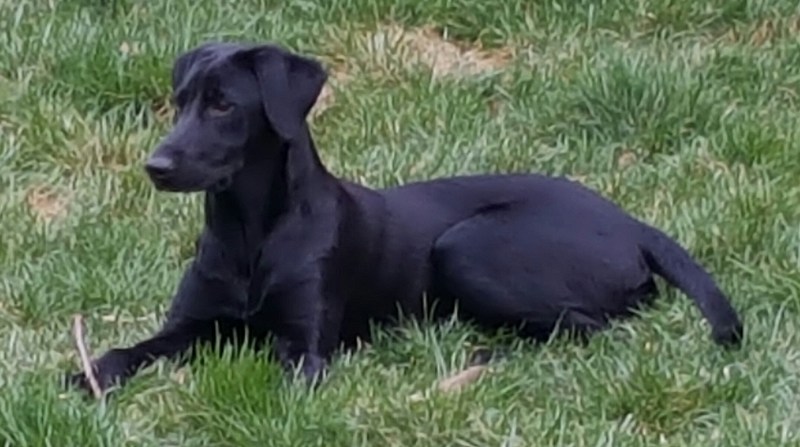
Lightning and I are not precisely at a training milestone at this moment, but today was a gorgeous day for training, with blue skies and temps in the 60s. Tonight’s forecast is for an Arctic blast, so training in the next few days may be less pleasant. On the cusp of that transition in the weather, I thought I might give an intermittent status report on how we’re doing.
By the time we left vacation in the mountains a couple of weeks ago, I was happy with the approach Lightning and I had evolved for pile work, so back home on one of our training fields, we began work on the Single T, bearing in mind that Lightning was trained on this drill years ago before his keep-away habit developed, so to some extent this is a refresher course.
Now that I more or less understand that Lightning’s keep-away is triggered by stress, my goal in coming up with a revised Single T training plan would be to use what I’ve learned to mitigate that difficulty.
We had also addressed Lightning’s tendency to pop during pile work back on vacation by using few whistle stops and almost all freebies. Since Lightning already understands the handling cues, that’s not as much of a disadvantage as it might sound. In the single T work we’ve been doing, Lightning has never refused an Over cue, either silent or with voice cue added. We just need to keep up a high ratio of freebies (that is, straight sends without a Sit cue) to repair the popping.
We did run into one other difficult, though. Lightning apparently believes that a Back cue in a Single T setup, with three lining poles arrayed in front of him, is a guessing game as to which pole I will ultimately handle him to. Therefore, instead of always running the whole way to the center pole, he randomly decides to veer toward one of the side poles instead.
Here again, though, the solution has been lots of freebies to the center pole. So in a typical session over the last few days, we might run a total of ten retrieves, with only one handle to the left pole and one to the right pole.
And we again see the enormous reinforcing power of a successful retrieve for a dog, far beyond anything humans experience. We’ve seen this before with the Walk Out as a negative reinforcer for successful Sits. In the case of Lightning veering to the wrong pole, if he does not sit when I whistle to call him back, and instead completes the retrieve from the wrong pole, not only do I not reinforce the retrieve with a come-in whistle, gunshot, treat, or invitation to keep-away; in addition, I take the delivery, cue Sit, and walk all the way back to the pole where he picked up the bumper and toss it back where it was. Isn’t it amazing that that is a powerful negative reinforcer? That is, having me undo Lightning’s retrieve is something that he so much wants to avoid that even if he does veer off, he Sits when I whistle and comes right back in when I call Here.
That’s actually a double benefit. Not only is Lightning gradually learning that it’s a waste of time to try to guess where I’m going to send him, and so gets increasingly better at running straight to the center pole, but in addition, we get to practice a pattern of “No, Here,” a vital skill for continued handling training.
So with those introductory remarks, here’s a step by step description of our current work with the Single T.
- When we arrive at the field, I give Lightning his keep-away toy and cue Go Play. While I’m busy settng up the course, he runs around the toy. Occasionally he brings it back to me. I take it, and usually give him a treat such as a small piece of hot dog. Then I either hand it to him or tos sit and again say Go Play. We may have half a dozen of these exchanges while I’m setting up, so he gets lots of play time before the drill even starts.
- I place a water bowl and the water jug near our start line. Even in cold weather Lightning will visit that several times during the drill, and of course more so when it’s warmer.
- I walk out and place the four orange lining poles we’ll be using, carrying 15-20 2″ bumpers, mostly orange. One pole is at the start line. One pole (the center pole) is 120y away, and has all but six of the bumpers lying nearby. For now I also have an orange ribbon tied to the top of the center pole. To position the other two poles, first I walk 90y from the starting pole toward the center pole, then turn 90°, walk 30y, and place the side pole with three orange bumpers lying nearby. Of course I place one on the left and one on the right, so they are 60y apart. These are not the only dimensions people use for the Single T but this seems to be a good configuration for Lightning.
- I keep the bumpers in a small cooler for transport, so when I’m done setting up, I place the cooler near the starting pole, a few feet from the water bowl. Then I sit on the cooler and wait.
- Lightning will eventually come to me, sometimes getting some water first. Usually he’ll have his keep-away toy with him when he comes, but sometimes he comes without it. In that case, I cue Go Get Your Toy, and 99% of the time he remembers where he left it and goes to fetch it. As soon as he brings it to me, I take it, hand him or toss him a treat, wait for him to swallow and then instantly hand the toy back to him, and cue Go Play again. We repeat that sequence two, three, or more times. This is the key to training Lightning for handling despite his keep-away tendencies. We defeat the Prisoner’s Dilemma by teaching Lightning thru many reps that it costs him nothing to bring me the toy. I’ll always give it back to him, and he’ll probably get a treat as well.
- After one or more reps, Lightning will take the treat and the toy, but then turn around after a few steps and and bring it right back to me, maybe grabbing a sip of water on the way. With this quick return, Lightning has learned to communicate to me that he’s ready to do some training.
- I stand up, give him a treat in exchange for the toy, put the toy in the cooler so he won’t be able or even tempted to grab it before I’m ready to give it to him again, and move to the starting line, calling Lightning to heel. I have developed a specific posture for setting up to send Lightning on a blind, but I don’t think everyone needs to use that posture. A high level of consistency in your setup routine is beneficial and probably essential, however. Making it different from the way you set up for a mark will also help the advanced dog determine whether he needs to be in marking mode (find the bird yourself) versus handling mode (take direction from me) on each send-out.
- Now I run Lightning on a set of blind retrieves in the Single T course. The set consists of between one and four retrieves, depending on how many the dog can do without a break while maintaining motivation and performance. If your dog can do more, that’s great. Lightning’s limit at this time is four.
- Each retrieve starts off identical to all the others. First I get his back, neck, and head all pointing toward the middle pole. If he misaligns, I say Uh-uh or No and try again to get him lined up, repeating as many times as necessary. As soon as possible after he’s in perfect alignment, I place my hand over his forehead without touching him and cue Back in an excited tone without moving my hand. Sending the dog quickly acts was a reinforcer for getting lined up correctly.
- As mentioned earlier, if he veers toward one of the side poles, I blow a Sit whistle or call out No, then immediately, Here. This in itself is part of the training. If he refuses the Sit and continues to the pole to pick up a bumper, I walk it back, as also mentioned earlier.
- Most or all of the retrieves in the set will be freebies. But every once in a while, I’ll blow a sit whistle and cast him to one of the side poles. I can’t emphasize enough how random this has to be. The dog simply must not be able to guess whether you’re going to let him run all the way to the center pole or stop him on the way out, and he will figure out any non-random algorithm you come up with with distressing acuity.
- Of course an important part of Single T training is what to do if the dog refuses the Sit or the cast. I suppose I’d use a Walk Out, and I’d guess I discussed this in an earlier article from when I trained Lightning on the Single T the first time, lo these many moons past. But I don’t have much to offer on this issue at this time because Lightning never refuses the sit whistle or the cast these days. Yes, this surprises me, also.
- As soon as Lightning arrives at the pole I wanted him to go to, I blow a come-in whistle. Note that this is considered a handle by the judges. You must wait until the dog actually picks up the bird on a mark or you’ll be penalized for a handle. But a blind is all about handling, so blowing a come-in whistle once the dog arrives at the blind is fine.
- Lightning has the commonplace tendency to shop, that is, take some time choosing a bumper from the pile to pick up and bring back. This never happens in a trial because there’s only one bird at the blind, but it’s annoying during training, especially group training. I’ve found a simple solution to it when solo training: fire a blank pistol the instant the dog picks up the bumper and starts back toward the start line. By this time in the dog’s training, the dog has a very positive association with the sound of a pistol going off, classically conditioned by combining the pistol shot with a thrown mark. But you don’t actually need to throw anything. The pistol shot has become a secondary reinforcer, like a clicker in clicker training. The dog’s primary reinforcer is then completing the retrieve. Yes, unsurprisingly, retrieving is a highly self-reinforcing behavior for a retriever. But perhaps guilding the lily, I also praise the dog during the delivery, and it’s not unusual for me to give the dog a treat at that moment as well.
- Now I immediately set him up for another retrieve, or, if that was the last retrieve of the set, I grab his keep-away toy out of the cooler, hand it or toss it to him, and cue Go Play. Off he goes with his toy like a shot.
- I’ll then treat him and give the toy back to him repeatedly whenever he brings it to me, as I sit on the cooler to wait. As I described earlier, he communicates to me when he’s ready to train again.
- We’ve been doing three or four sets per session, taking one to two hours, with Lightning in an almost continuous sprint the entire session. At last he shows some slight signs of tiring and it’s time to pack up and go home.
I’ll just mention an annoying ritual Lightning has trained me to go along with. Once he sees we’re done training, he often runs off with his keep-away toy and lies down in the grass some distance away. At that point he is completely immune to any fetch or recall cue. He requires me to come to him and pick up the toy myself before he will consider walking back with me and getting in the car. He may even tease me a few times, running off again with the toy just as I get close, before he finally deigns to end this miserable game. I’m sure there’s some way to untrain this, but I haven’t found it yet. Waiting for him to just give up and come to me is a fool’s errand. He can lie in that grass a long time. But that’s a different problem, and for now I can only wish you the best of luck in not getting such a mischievous dog for yourself.
In any case, learning something hard like handling means stress to Lightning, and stress used to mean spontaneous eruptions of keep-away that made training impossible. We haven’t gotten rid of keep-away, but we’ve now separated it cleanly from bursts of high quality training within a session. As a result, training has become a lot more fun for me at least, and I’d guess for Lightning as well.
 Lightning's Journal