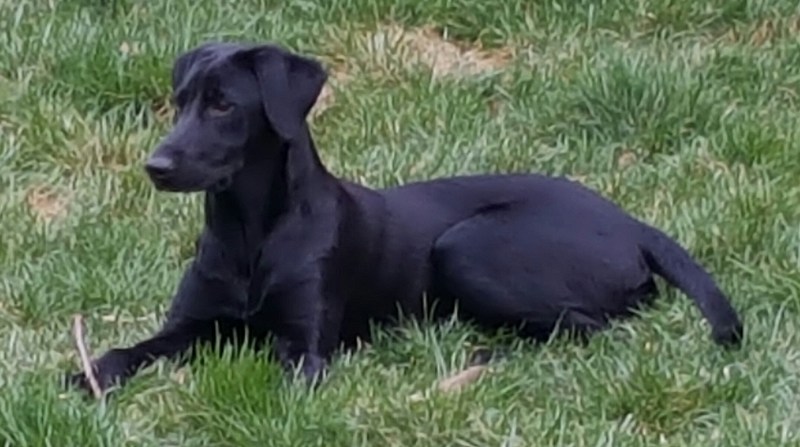
I guess it’s still appropriate for me to call Lightning a keep-away dog. He does have occasional instances where he runs around with an article and won’t return to me with it when called. The instances are becoming far less frequent, but I feel they would still cause serious inconvenience for the other trainers if I tried to bring him to group training, much less any sort of competition.
On the other hand, in contrast to the last two or three years, his keep-away tendency is no longer acting as a barrier to training, for either marks or blinds. I just need to make adjustments in my training plan to allow for that issue.
Once Lightning became proficient at the Single T drill, I graduated him to the Double T, and we’ve now run about half a dozen Double T sessions. Here’s the way we run them:
- As soon as I park my car, when possible at the location where I’m going to set up my start line, I hop out of the car and let Lightning and Lancer out of the back seat. I immediately give Lightning his keep-away toy, currently a chewed-up dokken, and he begins running around to distances of a hundred yards and more in every direction. I make no attempt to practice recall during these jaunts, and I don’t know at this point whether he would come or not.
- Lancer is new to our household, and at seven weeks old, has no chance of keeping up with Lightning. Mostly he bounces about shadowing me as I walk around the field setting up and later taking the setup down, and I practice recall with him at every opportunity when Lightning is off running around with his keep-away toy. Although Lancer does interfere slightly with Lightning’s handling drill, since he repeatedly tries to bite Lightning while he’s setting up for a retrieve, the impact is minor and I won’t say much more about Lancer during this post.
- Next I take out a water bowl and a jug filled with water for regular replenishment of the bowl, and place them about three yards from where I plan to plant the lining pole that will represent our start line. I’ve found that Lightning will drink from the bowl frequently during the session, even in chilly weather. I make no effort to rush him when he’s drinking, much less prevent him from getting water whenever he wishes, even if it interrupts our setup for a retrieve, which occasionally happens. Fortunately he has never made an effort to get to the water bowl when in the midst of a retrieve, though he may rush to it as soon as he has delivered the article at times. Mostly he visits the bowl to drink during his keep-away breaks.
- After putting out the water, I set up the field for the Double T, using six orange lining poles and 24 orange 2″ bumpers. Here’s what the setup looks like:
a. I plant the lining pole that will be our start line.
b. I walk 90y down the centerline of our setup area and temporarily plant a pole there. That is point P, akin to the pitcher’s mound in baseball although there will be five “bases” around it instead of three. Point P is where I will stop Lightning whenever we run a handling retrieve, and it is from that point that I now measure out the five destinations.
c. I place an Over lining pole and two bumpers 30y to the left of P and 30y to the right.
d. I place a Come-in lining pole and two bumpers on a 45° diagonal towards the start line to the left, and another lining pole and two bumpers on a 45° diagonal toward the start line to the right.
e. I then pull out the pole I had planted at P and carry it another 30y further out along the centerline, where I plant it as the Freebie lining pole along with the remaining 16 bumpers.
- With the setup complete, I return to the start line and sit down on the cooler I use to carry the bumpers when they’re not out being used, or I may remain standing and, as I mentioned earlier, take the opportunity to play recall games with Lancer.
- During the time that I have been setting up, Lightning frequently brings his keep-away toy to me. I respond in either of two ways, both of which he clearly finds reinforcing. One option is for me to take delivery of the toy and immediately fling it away for him to chase it, pick it up, and resume running around with it again. The other option is for me to take delivery of the toy, take a treat out of my pocket and give it to him, and then immediately hand him the keep-away toy with the cue Go Play or fling it for him. He has no way of of knowing in advance whether I’m going to give him a treat or not, and I try to make it as random as possible.
- For treats, I use thin hot dog slices that I carry in a plastic baggie. I also use those as treats for Lancer’s recall games. Luckily, both of these dogs consider that to be a high value treat. If that were not so, I would switch to something that does act as a high value reward. I see no point in reinforcing with something that does not provide high value to the dog.
- Generally fairly soon after I complete the setup and await Lightning at the start line, he is ready to do some work. He signals to this to me by bringing me his toy, and when I give him a treat and give the toy back to him, saying Go Play, he just takes a step or two away and then turns back to me, possibly getting some water, too. I take the toy, give him another great, and toss the toy into the cooler.
- Now I run him on two sets of 12 retrieves. In each set, I run him on four handling retrieves and eight freebies. All the retrieves begin with a send toward point P. For the freebies, I just let him continue on to the Freebie lining pole. For the handling retrieves, I stop him with a whistle sit at P, then handle him to one of the Over or Come-in poles. Once he reaches the correct target lining pole, I whistle come-in or sit + come-in, and that cues him to pick up a bumper and run back to me to deliver it to hand. In the early sessions, and whenever needed as a refresher, I fire a blank pistol the instant he picks up the bumper, which produces a nice, high-energy pickup and return rather than a bout of shopping first.
- I utilize the order of retrieves in each set to try to defeat his attempts to anticipate which target is next. If he’s been peeking or popping, I front load with several freebies. If he favors one of the lining poles with a looping sit, I send him to one of the other poles instead, at least if any still have not been used in this set.
- If Lightning veers toward one of the handling poles when I send him, I stop him and either call him in or handle him to the Freebie pole. While that latter action has the disadvantage of somewhat reinforcing his poor line, it practices the single most common handle actually needed in running a blind. But calling him in is also a valuable lesson for him, since it acts as negative reinforcement for holding his line toward P.
- If he repeatedly veers to one of the handling poles when I send him, I move our starting line up along the centerline toward point P until we’re close enough that Lightning can run to the Freebie pole without veering. In that session or later ones, we work our starting line back to its original position.
- Occasionally I give Lightning a treat as he returns with one of the retrieves. I make that as unpredictable as possible. This is in keeping with my recent decision to try to make Lightning always aware that reinforcement comes from me, and is not just the intrinsic reinforcement of doing the work.
- After each set of 12 retrieves, I hand Lightning his keep-away toy and cue Go Play. Each time he brings it back to me, I give him a treat and then hand him the toy and cue Go Play again, until he indicates he has had enough of that game.
- At the end of the last keep-away jaunt, I take delivery of the toy, give Lightning a treat, and open the back door of the car for him to hop in. I let Lancer stay out so he can shadow me while I walk around the field to pick up the lining poles. Once everything is collected, I put the lining poles, the cooler filled with bumpers, the water bowl, and the jug back into the car. Finally I pick Lancer up and put him in the back with Lightning.
These are exhilarating training sessions for me. Lightning does such excellent work, becoming ever more proficient in his handling skills. But more importantly, we work together as a team the entire time, rather than him ever finding the need to take matters into his own hands and play keep-away when I’m trying to work with him. It is night and day from those dark times of the past, before I learned how to address his keep-away issues.
 Lightning's Journal