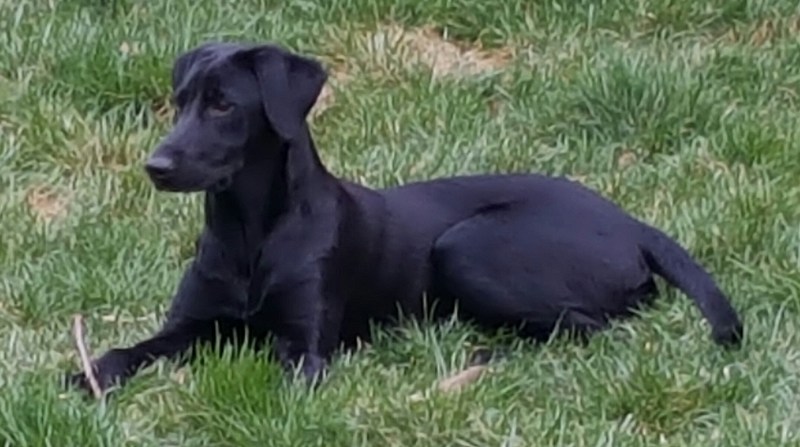
As I described in my previous post, my focus these days with Lightning’s training is to sharpen his land blinds, using pattern blinds with our launcher throwing doubles and triples as diversion. Areas of weakness for Lightning in this work are his whistle sits and his tendency to take detours around terrain changes. These are reasonably easy weaknesses to work on, just requiring incremental increases in difficulty, patience, and operant conditioning to make the correct versions of the behaviors clear. Because of Lightning’s enthusiastic devotion to the work, the training is great fun for both of us.
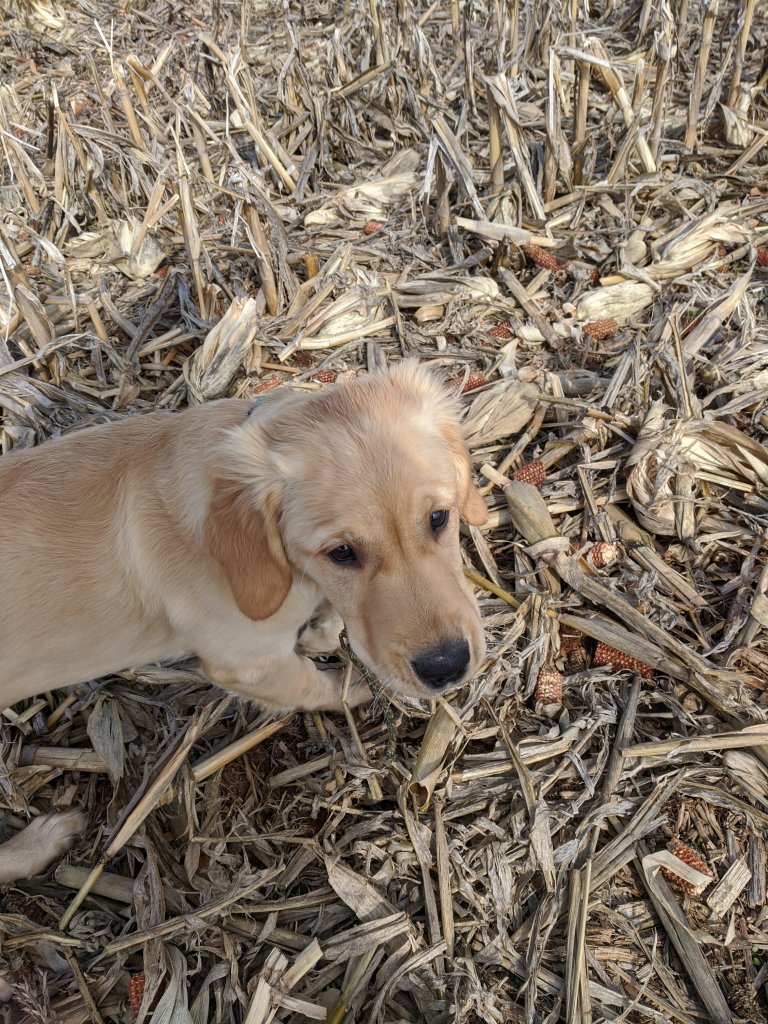
Lancer is three-and-a-half months old now, and of course continues to come out with us on the field when Lightning and I go out to train. Because I had assistants to help with Lightning’s training when he was this age, our training sessions were a bit different than what I’m doing with Lancer. Obviously we’re not using gunner-thrown marks, and I’m also not sure Lancer would do well if I tried to introduce frozen or thawed ducks yet with Lancer, as I had with Lightning by this age.
I think my focus for Lancer may be more about building enthusiasm for the retrieve than particular skills, though really only a slight difference in emphasis from when Lightning was this age.
Here’s a rundown of some of the things Lancer and I are up to:
Indoor tug and retrieve with Lightning as diversion
I think the most exciting activity I currently have with Lancer is an indoor game that I’ve never played with any other dog I’ve trained. Actually I’m not sure any of the others could have done it, though maybe I just never tried it.
Although trying to train two dogs at the same time doesn’t generally work well, this is a game we play with both Lightning and Lancer at once (Ryley, Renee’s gorgeous English Creme Golden, has no interest in it, and tries to keep out of the way, or leaves the room, when we’re playing it). The game works like this:
With Lightning, I’m just throwing his tennis ball for him, over and over countless times. I use every variety of throw I can come up with, from fastball pitches straight at his face to high leaps for lobs into the next room. As far as I know, Lightning is not capable of getting tired of this game.
Simultaneously, I’m playing a more complex game with Lancer. It starts with a vigorous game of tug using any of his many tug toys.
Occasionally he’ll get the toy away from me. When that happens, he steps back toward me, handing me a corner of the toy so we can play some more tug. I believe this alone is an unusually cooperative behavior for a young dog who has not been trained to do it.
In any case, more often I manage to hold on until Lancer accidentally lets go of the toy. Instantly, I throw the toy to a far corner of the room. Lancer tears after it, pounces on it, and immediately runs it back to me, again handing me a corner so we can play some more.
An interesting element of this game is that the two dogs are often in the middle of retrieves simultaneously, sometimes in close trajectoires depending on the direction I threw their toys. Yet neither is confused by the other dog or his toy. Each of them stays laser-focused on his own toy and getting it back to me, even when their paths cross or they even gently collide.
I think this game has several important benefits for Lancer’s training:
- I think tug is a great game of cooperation and thus relationship building.
- I also think tug, when played vigorously and not coddling the pup to try to get him to play and “help” him succeed, builds motivation and self-reliance.
- Since Lancer has an intrinsic drive to bring back a thrown toy, this game exercises and strengthens his retrieve.
- Because Lancer has somehow learned that handing me a corner of the toy is more fun than keeping it entirely for himself, resulting in a highly reinforcing energetic game of tug, we’re building a natural retrieve-to-hand behavior that will hopefully provide a nice foundation when we train a formal retrieve in the future.
The RRT bumper variation
We’ve also been playing the above game using the no-streamer RRT bumper I mentioned in the previous post.
This version isn’t quite the same:
- The bumper is not as good a shape for playing tug
- Lightning sometimes decides to retrieve the bumper instead of his tennis ball, confusing things
- Lancer only brings the bumper back a few times in a row before he settles down to chew on it
To compensate for those disadvantages, I don’t use the bumper for a sustained series of retrieves, but instead occasionally substitute the bumper for the tug toy. Lancer continues the pattern of the game and we still receive a highly reinforced retrieve to hand, this time with an actual field training article.
Hopefully Lancer is becoming increasingly interested in the bumper as a toy for a cooperative retrieve game rather than a chew toy, and that will enable us to begin using it in the field, first hand-thrown, and soon thereafter thrown by the launcher. Now that will really be exciting!
Lancer in the field
Lancer’s retrieving work in the field is not progressing on a clear-cut path, possibly because he may be teething. For whatever reason, his interest in retrieving the no-rope 2″ white bumper we’ve been using has somewhat diminished, so I’ve stopped bringing that out for now.
Instead, I bring out a soft tug toy and throw it for him. When he brings it back, I play a little tug with him, give him a treat, or both. I try to determine on any given day which version of the game produces the best motivation. To keep motivation high, we only do five retrieves at a time, in two series sandwiched around Lightning’s training.
As part of the work with Lancer, I include whistle sits and whistle come-ins, used either alone or in combination with the verbal cues Sit and Here. (By using the whistle cue followed by the verbal cue, the dog learns to anticipate the previously-taught verbal cue when he hears the whistle cue, and the verbal cue gradually becomes superfluous.)
A few days ago, I also fitted Lancer with one of his father’s old collars, with a very short lead, called a tab, attached. This allows us to work on what’s called lead steadiness. That is, the dog is unable to immediately break for a thrown article because the handler is holding the tab. At the instant the dog relaxes, the handler releases the tab and calls the pup’s name, sending him racing to the article to retrieve it. Over time, the dog learns not to break when he sees an article thrown, instead waiting to hear his name called, and the tab becomes unnecessary.
I felt we were making good progress with the lead steadiness training when I first started it, but it only works if the dog is highly motivated to run for the thrown article. Since Lancer is going thru a stage where he’s not always showing maximum motivation, I’m currently not holding the tab when we practice. Hopefully this will be a brief hiatus, perhaps ending when Lancer has finished teething in a few weeks, if that in fact is what’s causing this.
Other adventures
When I open the door from our laundry room to the garage, Lightning and Lancer both rush out. I then open the back door for Lightning to jump in, positioning himself to await my rolling down his driver-side window, where he spends nearly all his time when he’s riding in the car.
Then I open the front passenger door and Lancer hops in to ride shotgun. In the past, I sometimes had to pick him up or herd him into the car because he wanted to explore the garage, but lately he jumps right in. I guess he’s learned that riding in the car probably means going somewhere to have fun.
One of the places we go is to hiking trails. Our PRT retriever training program includes “nature walks” for a pup at this stage, and we have lots of local places to go for off-lead adventures. Although the outdoor experience is probably the most important reason for Mike Lardy’s including this in his TRT program, it’s also an opportunity to work on some training, such as strengthening the dog’s reinforcement history for recall. So I’ll end with a video of Lancer on one of our hikes from a month ago:


 Lightning's Journal