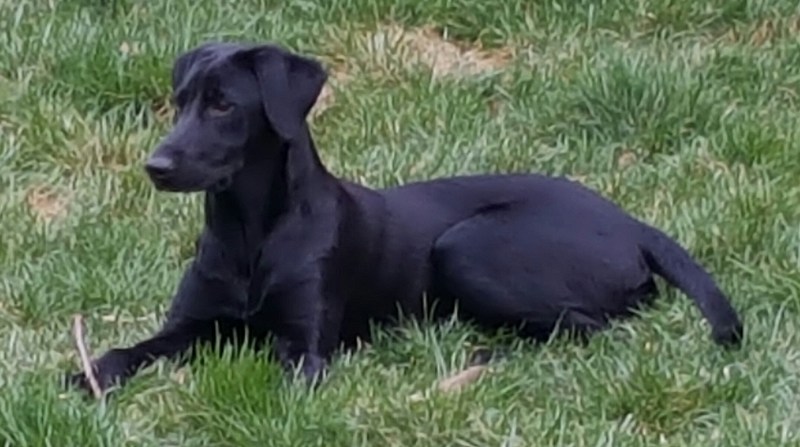
It’s winter here in Maryland. The weather is cold every day, but we’ve had almost no snow this year. As a result, the local fields are in excellent condition for land training, though we have no place to do water training at this time.
We were just given access to a new field by a friendly local farmer. It’ll be used for corn in a few months, but I’m happy to say it’s available for training my pups in the meantime.
I’ve discovered a disadvantage to training on a cornfield, however. The ground is very uneven for walking on, and I have to do a lot of walking when I’m training these guys. Well, it turns out that walking on uneven ground is demanding on the muscles that stabilize your knees and ankles, and after a week of using the new field, I’m half lame. 😟
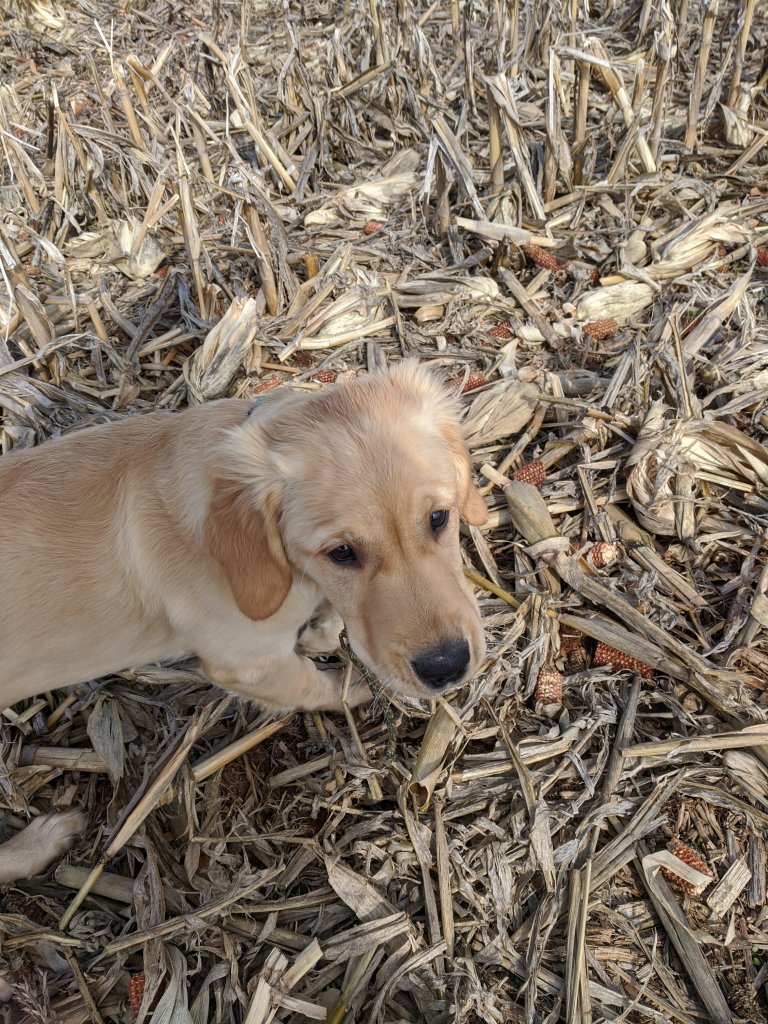
Lightning, at four years of age, and Lancer, at the and a half months, are of course at completely different stages of training. Since this is Lightning’s Journal, Lancer’s training is a little out of scope, but for those interested in it anyway, I think it’s easier to just incorporate that material in this same volume.
Lightning’s pattern blinds with diversions
Lightning’s keep-away tendencies are almost a non-issue now. When I’m setting up the field, and during a couple of breaks in the day’s work, I give him his Mallard dokken as a toy to run around with, and often exchange his toy for a treat whenever he swings by and hands his toy to me. Then, whether I give him a treat or not, I throw the toy for him and he’s off running around again. He covers a lot of ground, hundreds of yards in every direction, all at a full sprint, so actually, I think it’s good conditioning in addition to getting the keep-away game out of his system. Anyway, all of that unstructured play-running goes away when we’re working, and he’s developed a pretty nice field recall in addition to whatever skills we’re focusing on.

Since I don’t feel I can afford paying for assistants to help with our training any more, I’ve invested in a new piece of equipment, a four-shot Versa-Launch made by Retriev-R-Training and sold online by Gun Dog Supply. I was reluctant to spend the money because I had previously invested in a pair of used Bumper Boy Derby Doubles, but they were in disrepair and you can’t get parts or service for them any more.

The Versa-Launch is beautifully engineered, and assembling it when I received it was a pleasure. I had some problems with the firing mechanism at first, but a phone call to the manufacturer got me squared away and now it works like a charm.
As in any solo training session, ours are divided into three phases: setup, training, and takedown. Our setup consists of putting two or more orange bumpers at each of the three lining poles we’re using for pattern blinds, then putting together the launcher so that all four tubes are ready to fire. A bowl of water sits on the ground by the car, and both of the dogs are running around playing, Lightning with his toy, Lancer trying to keep up and also conducting his own explorations.
Since the blinds are at least a couple of hundred yards each and setting up the launcher is a project, the setup phase takes a good bit of time and involves a lot of walking. But when it’s done, I alternately train Lancer, then Lightning, then Lancer again, and finally Lightning again. Each dog waits in the car, my beloved little Nissan Leaf EV with the PUPTAXI license plate, while the other is training.
At the end of the session, takedown of the launcher is also a final play time in the field for the pups, and then we’re ready to strike out on our next adventure of the day. I often leave the lining poles out in the field for our next session rather than taking them down each time.
For Lightning, the current training is pattern blinds with diversions. Please refer to your copy of Mike Lardy’s TRT for a description. Lightning and I do it like this.
I call Lightning to heel, cue Sit, and fire two or three tubes of the launcher. Usually I have him pick them up in reverse order as would be typical in training and competition at the Q level, but sometimes I’ll have him pick up the go-bird first, then run a blind, then the other mark, and then the other two blinds, and sometimes I have him pick up a blind as his very retrieve, or pick up the longer mark first instead of the last one thrown. Not too much of those kinds of things, though. Mostly I want him to learn to run those blinds well.
For that reason, by the way, I use treats to reinforce well-run blinds. Lightning would happily run the retrieves without treats, and would probably learn to run them well because that’s the most efficient way to obtain the intrinsic pleasure of retrieving. But I think the treats nonetheless help with reinforcement and also help emphasize the cooperative element of our work.
Lightning’s second series, after I’ve trained Lancer for a while, is the same as the first, though typically a mirror image in terms of throwing and retrieving sequence. If we’re running triples, I take a moment first to reload the launcher. Of course we can do two series of doubles without reloading.
I haven’t taken much time here to describe these pattern blinds, but this is a joyful part of our day, Lightning and Daddy working together as a team as we hone the skills I hope we’ll someday bring to a real field trial. So literally living the dream. 😃
Lancer’s introduction to lead steady
Most of Lancer’s training is happening at home, but we are also working on completing the outdoor items on the TRT Flow Chart top section, Socialization and Introduction to Field. For our work in the corn field, we’re currently in Introduction to lead steady.
So when it’s one of Lancer’s two turns to train, I let him out of the car rocking an old Laddie collar with a tab attached. I then run him on about five retrieves with a white 2″ bumper. The bumper has no rope because I want him to practice carrying the bumper properly.

For the first retrieve of the series, I just throw the bumper out into the field and call “Lancer”. He races to it, picks it up, and brings it back to me on the run. He drops it just as he gets back to me, actually seeming to throw it on the ground at my feet. In a split second, no longer, I toss him a treat, thus serendipitously working on his eye-mouth coordination along the way. As he savors and swallows it, I take hold of the little tab attached to his collar.
For the remaining throws of the series, I hold onto the tab with one hand while throwing the bumper with the other. If he tries to break before I cue “Lancer”, I just hold him in place. Once he resigns himself to waiting, I drop the tab and call “Lancer”. He is learning quickly not to break until I call his name.
Soon I hope to use the launcher with Lancer, but I’m postponing that until he is able to carry the special launcher bumpers correctly. Currently he tries to carry them by the streamer rather than by the body. I’ve purchased a bumper made for the launcher without a streamer and we’re practicing with it indoors. When Lancer is ready, we’ll start using it with launcher. I expect that will take his excitement to a whole new level, since Lightning is wild about training with the launcher.
 Lightning's Journal