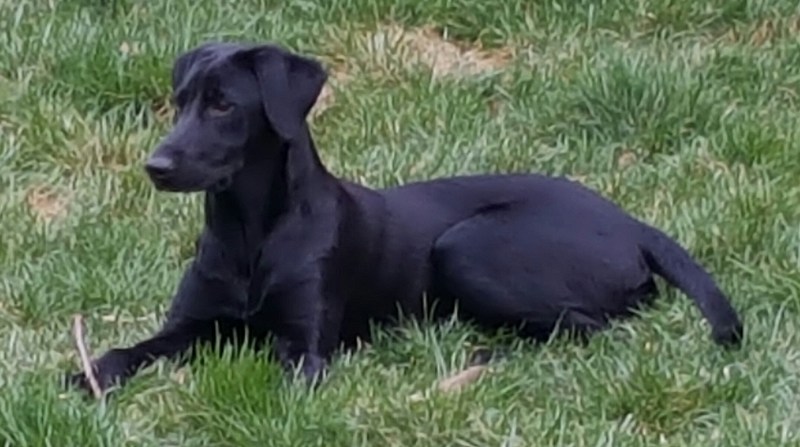
Lancer at three-and-a-half months (with video)

As I described in my previous post, my focus these days with Lightning’s training is to sharpen his land blinds, using pattern blinds with our launcher throwing doubles and triples as diversion. Areas of weakness for Lightning in this work are his whistle sits and his tendency to take detours around terrain changes. These are reasonably easy weaknesses to work on, just requiring incremental increases in difficulty, patience, and operant conditioning to make the correct versions of the behaviors clear. Because of Lightning’s enthusiastic devotion to the work, the training is great fun for both of us.

Lancer is three-and-a-half months old now, and of course continues to come out with us on the field when Lightning and I go out to train. Because I had assistants to help with Lightning’s training when he was this age, our training sessions were a bit different than what I’m doing with Lancer. Obviously we’re not using gunner-thrown marks, and I’m also not sure Lancer would do well if I tried to introduce frozen or thawed ducks yet with Lancer, as I had with Lightning by this age.

I think my focus for Lancer may be more about building enthusiasm for the retrieve than particular skills, though really only a slight difference in emphasis from when Lightning was this age.

Here’s a rundown of some of the things Lancer and I are up to:

Indoor tug and retrieve with Lightning as diversion

I think the most exciting activity I currently have with Lancer is an indoor game that I’ve never played with any other dog I’ve trained. Actually I’m not sure any of the others could have done it, though maybe I just never tried it.

Although trying to train two dogs at the same time doesn’t generally work well, this is a game we play with both Lightning and Lancer at once (Ryley, Renee’s gorgeous English Creme Golden, has no interest in it, and tries to keep out of the way, or leaves the room, when we’re playing it). The game works like this:

With Lightning, I’m just throwing his tennis ball for him, over and over countless times. I use every variety of throw I can come up with, from fastball pitches straight at his face to high leaps for lobs into the next room. As far as I know, Lightning is not capable of getting tired of this game.

Simultaneously, I’m playing a more complex game with Lancer. It starts with a vigorous game of tug using any of his many tug toys.

Occasionally he’ll get the toy away from me. When that happens, he steps back toward me, handing me a corner of the toy so we can play some more tug. I believe this alone is an unusually cooperative behavior for a young dog who has not been trained to do it.

In any case, more often I manage to hold on until Lancer accidentally lets go of the toy. Instantly, I throw the toy to a far corner of the room. Lancer tears after it, pounces on it, and immediately runs it back to me, again handing me a corner so we can play some more.

An interesting element of this game is that the two dogs are often in the middle of retrieves simultaneously, sometimes in close trajectoires depending on the direction I threw their toys. Yet neither is confused by the other dog or his toy. Each of them stays laser-focused on his own toy and getting it back to me, even when their paths cross or they even gently collide.

I think this game has several important benefits for Lancer’s training:

  • I think tug is a great game of cooperation and thus relationship building.
  • I also think tug, when played vigorously and not coddling the pup to try to get him to play and “help” him succeed, builds motivation and self-reliance.
  • Since Lancer has an intrinsic drive to bring back a thrown toy, this game exercises and strengthens his retrieve.
  • Because Lancer has somehow learned that handing me a corner of the toy is more fun than keeping it entirely for himself, resulting in a highly reinforcing energetic game of tug, we’re building a natural retrieve-to-hand behavior that will hopefully provide a nice foundation when we train a formal retrieve in the future.

The RRT bumper variation

We’ve also been playing the above game using the no-streamer RRT bumper I mentioned in the previous post.

This version isn’t quite the same:

  • The bumper is not as good a shape for playing tug
  • Lightning sometimes decides to retrieve the bumper instead of his tennis ball, confusing things
  • Lancer only brings the bumper back a few times in a row before he settles down to chew on it

To compensate for those disadvantages, I don’t use the bumper for a sustained series of retrieves, but instead occasionally substitute the bumper for the tug toy. Lancer continues the pattern of the game and we still receive a highly reinforced retrieve to hand, this time with an actual field training article.

Hopefully Lancer is becoming increasingly interested in the bumper as a toy for a cooperative retrieve game rather than a chew toy, and that will enable us to begin using it in the field, first hand-thrown, and soon thereafter thrown by the launcher. Now that will really be exciting!

Lancer in the field

Lancer’s retrieving work in the field is not progressing on a clear-cut path, possibly because he may be teething. For whatever reason, his interest in retrieving the no-rope 2″ white bumper we’ve been using has somewhat diminished, so I’ve stopped bringing that out for now.

Instead, I bring out a soft tug toy and throw it for him. When he brings it back, I play a little tug with him, give him a treat, or both. I try to determine on any given day which version of the game produces the best motivation. To keep motivation high, we only do five retrieves at a time, in two series sandwiched around Lightning’s training.

As part of the work with Lancer, I include whistle sits and whistle come-ins, used either alone or in combination with the verbal cues Sit and Here. (By using the whistle cue followed by the verbal cue, the dog learns to anticipate the previously-taught verbal cue when he hears the whistle cue, and the verbal cue gradually becomes superfluous.)

A few days ago, I also fitted Lancer with one of his father’s old collars, with a very short lead, called a tab, attached. This allows us to work on what’s called lead steadiness. That is, the dog is unable to immediately break for a thrown article because the handler is holding the tab. At the instant the dog relaxes, the handler releases the tab and calls the pup’s name, sending him racing to the article to retrieve it. Over time, the dog learns not to break when he sees an article thrown, instead waiting to hear his name called, and the tab becomes unnecessary.

I felt we were making good progress with the lead steadiness training when I first started it, but it only works if the dog is highly motivated to run for the thrown article. Since Lancer is going thru a stage where he’s not always showing maximum motivation, I’m currently not holding the tab when we practice. Hopefully this will be a brief hiatus, perhaps ending when Lancer has finished teething in a few weeks, if that in fact is what’s causing this.

Other adventures

When I open the door from our laundry room to the garage, Lightning and Lancer both rush out. I then open the back door for Lightning to jump in, positioning himself to await my rolling down his driver-side window, where he spends nearly all his time when he’s riding in the car.

Then I open the front passenger door and Lancer hops in to ride shotgun. In the past, I sometimes had to pick him up or herd him into the car because he wanted to explore the garage, but lately he jumps right in. I guess he’s learned that riding in the car probably means going somewhere to have fun.

One of the places we go is to hiking trails. Our PRT retriever training program includes “nature walks” for a pup at this stage, and we have lots of local places to go for off-lead adventures. Although the outdoor experience is probably the most important reason for Mike Lardy’s including this in his TRT program, it’s also an opportunity to work on some training, such as strengthening the dog’s reinforcement history for recall. So I’ll end with a video of Lancer on one of our hikes from a month ago:
Lancer exploring off-trail on a winter hike and responding to Daddy’s call

A winter training session (with photos)

It’s winter here in Maryland. The weather is cold every day, but we’ve had almost no snow this year. As a result, the local fields are in excellent condition for land training, though we have no place to do water training at this time.

We were just given access to a new field by a friendly local farmer. It’ll be used for corn in a few months, but I’m happy to say it’s available for training my pups in the meantime.

I’ve discovered a disadvantage to training on a cornfield, however. The ground is very uneven for walking on, and I have to do a lot of walking when I’m training these guys. Well, it turns out that walking on uneven ground is demanding on the muscles that stabilize your knees and ankles, and after a week of using the new field, I’m half lame. 😟

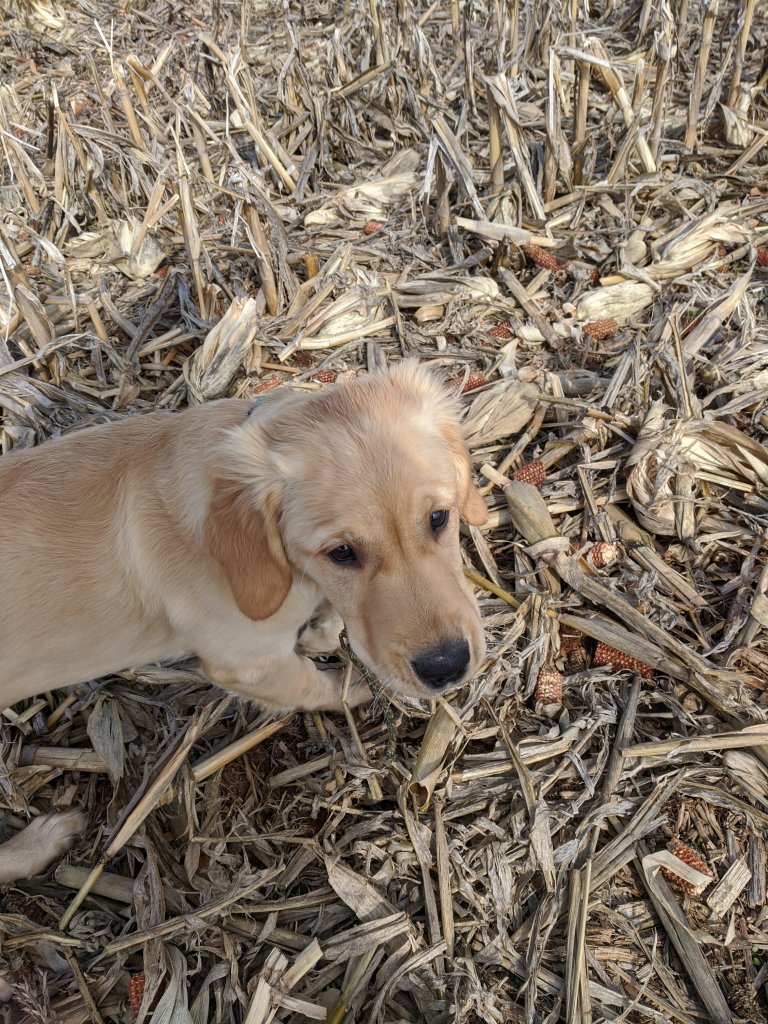
Lancer showing the uneven surface of a winter corn field

Lightning, at four years of age, and Lancer, at the and a half months, are of course at completely different stages of training. Since this is Lightning’s Journal, Lancer’s training is a little out of scope, but for those interested in it anyway, I think it’s easier to just incorporate that material in this same volume.

Lightning’s pattern blinds with diversions

Lightning’s keep-away tendencies are almost a non-issue now. When I’m setting up the field, and during a couple of breaks in the day’s work, I give him his Mallard dokken as a toy to run around with, and often exchange his toy for a treat whenever he swings by and hands his toy to me. Then, whether I give him a treat or not, I throw the toy for him and he’s off running around again. He covers a lot of ground, hundreds of yards in every direction, all at a full sprint, so actually, I think it’s good conditioning in addition to getting the keep-away game out of his system. Anyway, all of that unstructured play-running goes away when we’re working, and he’s developed a pretty nice field recall in addition to whatever skills we’re focusing on.

Lightning with his keep-away toy, a Mallard dokken

Since I don’t feel I can afford paying for assistants to help with our training any more, I’ve invested in a new piece of equipment, a four-shot Versa-Launch made by Retriev-R-Training and sold online by Gun Dog Supply. I was reluctant to spend the money because I had previously invested in a pair of used Bumper Boy Derby Doubles, but they were in disrepair and you can’t get parts or service for them any more.

Our four-shot Retriev-R-Training Versa-Launch

The Versa-Launch is beautifully engineered, and assembling it when I received it was a pleasure. I had some problems with the firing mechanism at first, but a phone call to the manufacturer got me squared away and now it works like a charm.

As in any solo training session, ours are divided into three phases: setup, training, and takedown. Our setup consists of putting two or more orange bumpers at each of the three lining poles we’re using for pattern blinds, then putting together the launcher so that all four tubes are ready to fire. A bowl of water sits on the ground by the car, and both of the dogs are running around playing, Lightning with his toy, Lancer trying to keep up and also conducting his own explorations.

Since the blinds are at least a couple of hundred yards each and setting up the launcher is a project, the setup phase takes a good bit of time and involves a lot of walking. But when it’s done, I alternately train Lancer, then Lightning, then Lancer again, and finally Lightning again. Each dog waits in the car, my beloved little Nissan Leaf EV with the PUPTAXI license plate, while the other is training.

At the end of the session, takedown of the launcher is also a final play time in the field for the pups, and then we’re ready to strike out on our next adventure of the day. I often leave the lining poles out in the field for our next session rather than taking them down each time.

For Lightning, the current training is pattern blinds with diversions. Please refer to your copy of Mike Lardy’s TRT for a description. Lightning and I do it like this.

I call Lightning to heel, cue Sit, and fire two or three tubes of the launcher. Usually I have him pick them up in reverse order as would be typical in training and competition at the Q level, but sometimes I’ll have him pick up the go-bird first, then run a blind, then the other mark, and then the other two blinds, and sometimes I have him pick up a blind as his very retrieve, or pick up the longer mark first instead of the last one thrown. Not too much of those kinds of things, though. Mostly I want him to learn to run those blinds well.

For that reason, by the way, I use treats to reinforce well-run blinds. Lightning would happily run the retrieves without treats, and would probably learn to run them well because that’s the most efficient way to obtain the intrinsic pleasure of retrieving. But I think the treats nonetheless help with reinforcement and also help emphasize the cooperative element of our work.

Lightning’s second series, after I’ve trained Lancer for a while, is the same as the first, though typically a mirror image in terms of throwing and retrieving sequence. If we’re running triples, I take a moment first to reload the launcher. Of course we can do two series of doubles without reloading.

I haven’t taken much time here to describe these pattern blinds, but this is a joyful part of our day, Lightning and Daddy working together as a team as we hone the skills I hope we’ll someday bring to a real field trial. So literally living the dream. 😃

Lancer’s introduction to lead steady

Most of Lancer’s training is happening at home, but we are also working on completing the outdoor items on the TRT Flow Chart top section, Socialization and Introduction to Field. For our work in the corn field, we’re currently in Introduction to lead steady.

So when it’s one of Lancer’s two turns to train, I let him out of the car rocking an old Laddie collar with a tab attached. I then run him on about five retrieves with a white 2″ bumper. The bumper has no rope because I want him to practice carrying the bumper properly.

Lancer contemplating his next attack victim, wearing his father’s old collar with a tab attached for practicing lead steady

For the first retrieve of the series, I just throw the bumper out into the field and call “Lancer”. He races to it, picks it up, and brings it back to me on the run. He drops it just as he gets back to me, actually seeming to throw it on the ground at my feet. In a split second, no longer, I toss him a treat, thus serendipitously working on his eye-mouth coordination along the way. As he savors and swallows it, I take hold of the little tab attached to his collar.

For the remaining throws of the series, I hold onto the tab with one hand while throwing the bumper with the other. If he tries to break before I cue “Lancer”, I just hold him in place. Once he resigns himself to waiting, I drop the tab and call “Lancer”. He is learning quickly not to break until I call his name.

Soon I hope to use the launcher with Lancer, but I’m postponing that until he is able to carry the special launcher bumpers correctly. Currently he tries to carry them by the streamer rather than by the body. I’ve purchased a bumper made for the launcher without a streamer and we’re practicing with it indoors. When Lancer is ready, we’ll start using it with launcher. I expect that will take his excitement to a whole new level, since Lightning is wild about training with the launcher.

Early days with Lancer

As mentioned in my previous post, we’ve added another puppy to our pack. We’re all very excited, in part because this is Laddie pup! Here’s a picture:

The new puppy’s registered name is Turbo Lancelot Bold and True, and his call name is Lancer. Born 10-16-2019, he’s now 18 lbs and just over nine weeks old. I’ve had him since the day he turned seven weeks old.

Over the past four years, this journal has had two purposes: to tell Lightning’s story, and to explain the Positive Retriever Training (PRT) program I’ve been developing with two dogs before Lightning, namely Lumi and Laddie, as well of course as with Lightning himself. Of all of them, Lightning is the only Labrador Retriever. Lumi and Laddie were both Golden Retrievers, as is Lancer.

For now, at least, I don’t plan to change the focus of this journal as being about Lightning and his training. Hopefully he still has many years of exciting development ahead of him, and I expect that to form the core framework for describing PRT.But where I feel my new experiences with Lancer might be a useful adjunct to the previously provided information, I’ll try to include that information in separate posts like this one.
In addition, I’ll go back and update relevant older posts from Lightning’s earlier days with forward references to Lancer posts like this one so that readers can, if they wish, consolidate the information about the two different dogs in their minds as they work thru the program.

Here then, in no particular order, is a breakdown of the work I’ve been doing with Lancer in his first two and a half weeks in his new home;

  • Here. I generally carry around treats such as string cheese or hot dog slices. At every opportunity, indoors or out, I lower my hand so my palm is facing Lancer and call Here. As soon as he comes running, I take a treat out of my pocket and try to have it ready to put in his mouth the instant he arrives. Within less than a day, he began alerting to the cue and looking around to see where I was so he could come running.
  • Field recall. No different from Here. I just wanted to emphasize that I also work with Lancer on this when we take Lightning out to train. The field has many scents and other distractions that don’t occur indoors. A rock solid field recall is far and away the single most important skill for a field retriever to have.
  • Retrieving. As often as possible, at least once a day, I clear the breakfast room floor of distractions and throw a paint roller for Lancer over and over again, typically five times per session. He runs to it, and as soon as he picks it up, I cue Here and he races back with it, then drops it as I give him a treat. As I’ve discussed elsewhere, I don’t believe in delivery to hand for puppies, because I believe it effectively punishes the pup for bringing you the article, which he regards as his own prize that he just brings to show you, not for you to take it away. We’ll work on building a formal retrieve with reverse chaining, that is, starting with the delivery, when Lancer is a bit older.
  • Socialization. Lancer is in the company of, and plays with, other dogs, both family dogs and others, as well as a variety of humans, every day. Socialization is of course hugely important for any dog.
  • Feeding. Under guidance of our holistic vet, Lancer eats a raw diet. It’s the same diet our adult dogs eat. We began him on his new diet from the first day he came home.
  • Sleeping. Of course Lancer takes naps throughout the day like any puppy. For my bedtime, he sleeps in my bed. I created some “stairs” for him out of dog beds and pillows next to the bad so he can climb up down from the floor. However, after the first three or four nights, he just stays on the bed with me all night. I bunch up my bathrobe and put it on the bed also, and he seems to like curling up next to that. He was very bitey the first few nights. I would let him bite my hand as long as I could take it, then hide it under the covers. Meanwhile he had chew toys on the bed I would try with varying success to divert his biting to. All thru the night, I repeatedly set my alarm so that I can get up in the middle of the night, put on my robe and slippers, and carry him outside to give him a chance to air, which he almost always does. Often, Lightning goes out with him so it takes several minutes for them to wander and play outside before they come to the door to come back in, even in subfreezing weather. I don’t let Lancer have any food or water during our eight hours of sleeping time. When we go back to bed, sometimes after another short session of biting, I set my alarm again and we sleep for another few hours. Typically I set the alarm for two hours when we first go to bed, then three hours at a time after that. I don’t know if that’s optimal for all pups, it just works for Lancer so that he doesn’t pee in the bedroom.
  • House training. I take Lancer outside many times every day, with trips often as close as 15 minutes apart. In his first 2-1/2 weeks here, he has never pooped in the house, thank goodness. We have not been so lucky with his peeing despite all the trips outside. We do not treat him any differently after a mistake, though if I can catch him just as he’s crouching down to pee, I pick him up and whisk him outside. We immediately clean and sanitize every wet spot.
  • Tug. Tug-of-war with a toy is an excellent game for retriever puppies. It’s an opportunity for energetic play and an outlet for biting, and it builds confidence and enhances the relationships of the players, whether me, another human, or another dog. If you don’t make it too easy for the puppy to grab the toy, but pull it away if he’s not fast enough, it builds drive, a desirable trait in a field retriever. I don’t think it matters whether you or the puppy “wins” each round. The benefits come from that first, drive-building grab and then playing the game. I usually do let my dogs win though. Here’s a video of Lightning training Lancer to play tug:
  • Sit. My darling wife Renée gives all the dogs various kinds of treats throughout the day, and she requires each one to sit before getting the treat. I also do more formal Sit training with Lancer every day. I say Sit, and if necessary hold my open hand with the back of my hand toward his face over his head, as if holding something in my hand, to lure him into a sit, then instantly give him a treat. He seems to be learning to sit from the verbal cue, without the visual cue, already. Sit is another important cue for a field retriever. I avoid having him sit in any particular orientation with respect to me since soon I’ll want him to be able to do a remote sit and not just sit right in front of me.
  • Touch. Renée and I often offer an open hand to pups, including Lancer, and when the dog touches our hands we instantly give them a treat. Renée also cues with a verbal “Touch” and makes a clicker sound, which is probably good, but I don’t bother with that these days. In any case, this open hand cue, later without the pup necessarily actually touching the hand, will be used as a primary method of communication throughout the dog’s life to draw him from one place or position to another, such as gesturing for him to jump in the car, bringing him to heel, and so forth.
  • Stairs. If I think Lancer is about to pee, I carry him. But the rest of the time, he’s quickly learned to climb stairs, first climbing up, a few days later climbing down as well. He now chases Lightning up and down stairs both in the house and in the backyard on the run.
  • Wearing the dog. One of the most useful tools for strengthening a pup’s relationship with you is tethering, what my friend and expert dog trainer Jody Baker calls “wearing the dog.” I’ve read that it also helps shy dogs gain confidence and helps tame more aggressive pups, though none of my dogs happen to have had either of those traits. In any case, it’s not really leash walking. Instead, you attach yourself to the dog with a short lead and go about your business, walking around the house as normal. The pup quickly learns to pay attention and stay close. You can dispense with the tether during times the pup is following you around on his own, then attach it again when he begins to get distracted. Eventually we’ll formalize this behavior as Heel.
  • Nail grinding. Once a day, I set my Dremel on the lowest setting and pick up Lancer in my lap. I take each of his four paws one by one and gently press the vibrating handle against the top of his paw, which I guess feels like a gentle massage. Then I touch the spinning grinder wheel to each of his nails of that paw for a split second. I’m not holding it long enough to keep his nails as short as they should be yet, but Carol had no difficulty grinding his nails to the correct length when he had his 9-week veterinary visit thanks to the early conditioning. I’ve always given my other dogs treats after a nail grinding session, but I haven’t bothered doing that with Lancer.
  • Crate training. My circumstances have not required me to do much crate training in the house, and my Nissan Leaf doesn’t have room for a crate, much less two for both Lightning and Lancer. As a result, I’ve done relatively little crate training with Lancer. He does, however, occasionally spend hours at a time alone in my puppy-proof bedroom with the door closed. Sometimes I can hear him screaming a little at first, but it doesn’t last long. He’s pretty much over that. He’ll probably need to spend some time in crates when he’s older, for example at group training or a competition, and we may need to do more crate conditioning at some point for him to be able to do that.
  • Riding in a car. I take Lightning and Lancer with me on most of my excursions, often leaving them in the car alone for up to an hour or so when I go to the gym, shopping, etc. I leave the car running with a little heat on (it’s winter here) and the windows cracked but the doors locked, since my car’s smart key lets me do that and it’s an EV so zero emissions. Your approach may well be different, but in any case, he’s comfortable riding in cars, which will be essential for group training and competition.
  • Hand feeding. I often feed Lancer by hand, and I also occasionally take food, bones, or toys away from him. He’s a gentle little pup and it’s no problem for him at this age. I intend to continue doing those things as he gets older. I don’t want him ever learning to resource guard.
  • Gunfire. When I’m training Lightning out in the field each day, I sometimes use a blank pistol as part of the training. I am very conscious of Lancer when I make the shot. I do not fire when he’s in the middle of play because I don’t want him to accidentally learn that play predicts something scary. I keep my distance from him so it won’t seem so loud to him, and the instant I fire, I reach down with my open hand and call Here, then give him a treat as soon as he runs to my hand. My first retriever, Lumi, was gun-shy at first and it took me weeks to counter-condition. I don’t want any of my other dogs to have to suffer thru that.

It’s too cold to go swimming unfortunately, and I’ve probably forgotten a few other items, but that’s a fairly complete list of the initial training I feel is good for a young retriever.

Running the Double T with a keep-away dog

I guess it’s still appropriate for me to call Lightning a keep-away dog. He does have occasional instances where he runs around with an article and won’t return to me with it when called. The instances are becoming far less frequent, but I feel they would still cause serious inconvenience for the other trainers if I tried to bring him to group training, much less any sort of competition.

On the other hand, in contrast to the last two or three years, his keep-away tendency is no longer acting as a barrier to training, for either marks or blinds. I just need to make adjustments in my training plan to allow for that issue.

Once Lightning became proficient at the Single T drill, I graduated him to the Double T, and we’ve now run about half a dozen Double T sessions. Here’s the way we run them:

  • As soon as I park my car, when possible at the location where I’m going to set up my start line, I hop out of the car and let Lightning and Lancer out of the back seat. I immediately give Lightning his keep-away toy, currently a chewed-up dokken, and he begins running around to distances of a hundred yards and more in every direction. I make no attempt to practice recall during these jaunts, and I don’t know at this point whether he would come or not.
  • Lancer is new to our household, and at seven weeks old, has no chance of keeping up with Lightning. Mostly he bounces about shadowing me as I walk around the field setting up and later taking the setup down, and I practice recall with him at every opportunity when Lightning is off running around with his keep-away toy. Although Lancer does interfere slightly with Lightning’s handling drill, since he repeatedly tries to bite Lightning while he’s setting up for a retrieve, the impact is minor and I won’t say much more about Lancer during this post.
  • Next I take out a water bowl and a jug filled with water for regular replenishment of the bowl, and place them about three yards from where I plan to plant the lining pole that will represent our start line. I’ve found that Lightning will drink from the bowl frequently during the session, even in chilly weather. I make no effort to rush him when he’s drinking, much less prevent him from getting water whenever he wishes, even if it interrupts our setup for a retrieve, which occasionally happens. Fortunately he has never made an effort to get to the water bowl when in the midst of a retrieve, though he may rush to it as soon as he has delivered the article at times. Mostly he visits the bowl to drink during his keep-away breaks.
  • After putting out the water, I set up the field for the Double T, using six orange lining poles and 24 orange 2″ bumpers. Here’s what the setup looks like:

a. I plant the lining pole that will be our start line.

b. I walk 90y down the centerline of our setup area and temporarily plant a pole there. That is point P, akin to the pitcher’s mound in baseball although there will be five “bases” around it instead of three. Point P is where I will stop Lightning whenever we run a handling retrieve, and it is from that point that I now measure out the five destinations.

c. I place an Over lining pole and two bumpers 30y to the left of P and 30y to the right.

d. I place a Come-in lining pole and two bumpers on a 45° diagonal towards the start line to the left, and another lining pole and two bumpers on a 45° diagonal toward the start line to the right.

e. I then pull out the pole I had planted at P and carry it another 30y further out along the centerline, where I plant it as the Freebie lining pole along with the remaining 16 bumpers.

  • With the setup complete, I return to the start line and sit down on the cooler I use to carry the bumpers when they’re not out being used, or I may remain standing and, as I mentioned earlier, take the opportunity to play recall games with Lancer.
  • During the time that I have been setting up, Lightning frequently brings his keep-away toy to me. I respond in either of two ways, both of which he clearly finds reinforcing. One option is for me to take delivery of the toy and immediately fling it away for him to chase it, pick it up, and resume running around with it again. The other option is for me to take delivery of the toy, take a treat out of my pocket and give it to him, and then immediately hand him the keep-away toy with the cue Go Play or fling it for him. He has no way of of knowing in advance whether I’m going to give him a treat or not, and I try to make it as random as possible.
  • For treats, I use thin hot dog slices that I carry in a plastic baggie. I also use those as treats for Lancer’s recall games. Luckily, both of these dogs consider that to be a high value treat. If that were not so, I would switch to something that does act as a high value reward. I see no point in reinforcing with something that does not provide high value to the dog.
  • Generally fairly soon after I complete the setup and await Lightning at the start line, he is ready to do some work. He signals to this to me by bringing me his toy, and when I give him a treat and give the toy back to him, saying Go Play, he just takes a step or two away and then turns back to me, possibly getting some water, too. I take the toy, give him another great, and toss the toy into the cooler.
  • Now I run him on two sets of 12 retrieves. In each set, I run him on four handling retrieves and eight freebies. All the retrieves begin with a send toward point P. For the freebies, I just let him continue on to the Freebie lining pole. For the handling retrieves, I stop him with a whistle sit at P, then handle him to one of the Over or Come-in poles. Once he reaches the correct target lining pole, I whistle come-in or sit + come-in, and that cues him to pick up a bumper and run back to me to deliver it to hand. In the early sessions, and whenever needed as a refresher, I fire a blank pistol the instant he picks up the bumper, which produces a nice, high-energy pickup and return rather than a bout of shopping first.
  • I utilize the order of retrieves in each set to try to defeat his attempts to anticipate which target is next. If he’s been peeking or popping, I front load with several freebies. If he favors one of the lining poles with a looping sit, I send him to one of the other poles instead, at least if any still have not been used in this set.
  • If Lightning veers toward one of the handling poles when I send him, I stop him and either call him in or handle him to the Freebie pole. While that latter action has the disadvantage of somewhat reinforcing his poor line, it practices the single most common handle actually needed in running a blind. But calling him in is also a valuable lesson for him, since it acts as negative reinforcement for holding his line toward P.
  • If he repeatedly veers to one of the handling poles when I send him, I move our starting line up along the centerline toward point P until we’re close enough that Lightning can run to the Freebie pole without veering. In that session or later ones, we work our starting line back to its original position.
  • Occasionally I give Lightning a treat as he returns with one of the retrieves. I make that as unpredictable as possible. This is in keeping with my recent decision to try to make Lightning always aware that reinforcement comes from me, and is not just the intrinsic reinforcement of doing the work.
  • After each set of 12 retrieves, I hand Lightning his keep-away toy and cue Go Play. Each time he brings it back to me, I give him a treat and then hand him the toy and cue Go Play again, until he indicates he has had enough of that game.
  • At the end of the last keep-away jaunt, I take delivery of the toy, give Lightning a treat, and open the back door of the car for him to hop in. I let Lancer stay out so he can shadow me while I walk around the field to pick up the lining poles. Once everything is collected, I put the lining poles, the cooler filled with bumpers, the water bowl, and the jug back into the car. Finally I pick Lancer up and put him in the back with Lightning.

These are exhilarating training sessions for me. Lightning does such excellent work, becoming ever more proficient in his handling skills. But more importantly, we work together as a team the entire time, rather than him ever finding the need to take matters into his own hands and play keep-away when I’m trying to work with him. It is night and day from those dark times of the past, before I learned how to address his keep-away issues.

The demise of discovery training

In “Slipper retrieve,” a post from four years ago, I introduced the concept of “discovery training.”

The idea is that some of the behaviors we want our dogs to learn are self-reinforcing, to the extent that an extrinsic reinforcer such as treats is not only unnecessary but may even detract from the natural discovery process of the dog learning the pleasure of the behavior itself. Examples of behaviors well suited to discover training are house-training, wherein the pleasure of the dog relieving himself is an intrinsic reinforcer for the act being performed outside, and wherein, for a dog with an innate instinct to retrieve, the act of retrieving is a powerful reinforcer for the act itself.

Because I dislike being on the receiving side or the sending side of coercion and manipulation in human interaction, and perhaps for other philosophical and psychological reasons, such as an attraction to simplicity and efficiency, the notion of discovery training appealed and I guess still appeals to me, and I believe I’ve often Incorporated it into my efforts at dog training.

But as I was rethinking the concept of discovery training recently, I suddenly had one of those Eureka! moments. Wait! Perhaps my use of discovery training with Lightning has caused or exacerbated his keep-away habits!

Well, it’s probably more complicated than that. For example, in “The Prisoner’s Dilemma, keep-away, and patience,” I described another mechanism that is also likely in play. And growing up with Ryley, DW Renée’s Golden Retriever, who is almost the same age as Lightning, may have also been an important factor. In TRT, Mike Lardy says something along the lines that he has never seen a successful field retriever who grew up with a sibling as a companion.

Nonetheless, discovery training means that the dog looks to himself for the rewards of his behavior. I would think that’s desirable in human development, but I have now begun to think it’s counterproductive in dog training.

My reasoning is this. Dog training is about engaging in the bargain that the dog gives you what you want, and in exchange you give him what he wants. For the dog, that takes place unconsciously, as the behavioral mechanism called operant conditioning. But that mechanism nonetheless loses its power to the extent that the dog doesn’t depend on you for reinforcement.

Instead, I now think that to maximize the effectiveness of operant conditioning, we want to maximize the give and take in our relationship with the dog. Thus treats and other extrinsic rewards that are available only from the trainer are preferable to intrinsic rewards for the vital goal of engendering cooperative interaction.

For Lightning, I think the most prominent example of this principle is his tendency to go into keep-away mode rather than complete a retrieve, a tendency I’ve been battling, and finally, gradually defeating, literally for years now. Keep-away is a game he can play without my cooperation. In fact, it seems likely to be more pleasurable, as a game for the dog, the more the behavior annoys and animates the other party. It may be a healthy game for dogs to play with one another, and in any case probably is inevitable in doggy interaction, but it is destructive when you’re training a dog for a team sports activity.

So this is the new plan: I won’t be reluctant to incorporate intrinsic reinforcement into my interaction with my dogs, but in the first place I won’t be shy to also use extrinsic reinforcers, and in the second place, I’ll make an effort to pair intrinsic reinforcement, when it occurs, with rewards that the dog associates with our relationship rather than just pleasure the dog obtains without my participation.

Progress on the Single T

Lightning and I are not precisely at a training milestone at this moment, but today was a gorgeous day for training, with blue skies and temps in the 60s. Tonight’s forecast is for an Arctic blast, so training in the next few days may be less pleasant. On the cusp of that transition in the weather, I thought I might give an intermittent status report on how we’re doing.

By the time we left vacation in the mountains a couple of weeks ago, I was happy with the approach Lightning and I had evolved for pile work, so back home on one of our training fields, we began work on the Single T, bearing in mind that Lightning was trained on this drill years ago before his keep-away habit developed, so to some extent this is a refresher course.

Now that I more or less understand that Lightning’s keep-away is triggered by stress, my goal in coming up with a revised Single T training plan would be to use what I’ve learned to mitigate that difficulty.

We had also addressed Lightning’s tendency to pop during pile work back on vacation by using few whistle stops and almost all freebies. Since Lightning already understands the handling cues, that’s not as much of a disadvantage as it might sound. In the single T work we’ve been doing, Lightning has never refused an Over cue, either silent or with voice cue added. We just need to keep up a high ratio of freebies (that is, straight sends without a Sit cue) to repair the popping.

We did run into one other difficult, though. Lightning apparently believes that a Back cue in a Single T setup, with three lining poles arrayed in front of him, is a guessing game as to which pole I will ultimately handle him to. Therefore, instead of always running the whole way to the center pole, he randomly decides to veer toward one of the side poles instead.

Here again, though, the solution has been lots of freebies to the center pole. So in a typical session over the last few days, we might run a total of ten retrieves, with only one handle to the left pole and one to the right pole.

And we again see the enormous reinforcing power of a successful retrieve for a dog, far beyond anything humans experience. We’ve seen this before with the Walk Out as a negative reinforcer for successful Sits. In the case of Lightning veering to the wrong pole, if he does not sit when I whistle to call him back, and instead completes the retrieve from the wrong pole, not only do I not reinforce the retrieve with a come-in whistle, gunshot, treat, or invitation to keep-away; in addition, I take the delivery, cue Sit, and walk all the way back to the pole where he picked up the bumper and toss it back where it was. Isn’t it amazing that that is a powerful negative reinforcer? That is, having me undo Lightning’s retrieve is something that he so much wants to avoid that even if he does veer off, he Sits when I whistle and comes right back in when I call Here.

That’s actually a double benefit. Not only is Lightning gradually learning that it’s a waste of time to try to guess where I’m going to send him, and so gets increasingly better at running straight to the center pole, but in addition, we get to practice a pattern of “No, Here,” a vital skill for continued handling training.

So with those introductory remarks, here’s a step by step description of our current work with the Single T.

  1. When we arrive at the field, I give Lightning his keep-away toy and cue Go Play. While I’m busy settng up the course, he runs around the toy. Occasionally he brings it back to me. I take it, and usually give him a treat such as a small piece of hot dog. Then I either hand it to him or tos sit and again say Go Play. We may have half a dozen of these exchanges while I’m setting up, so he gets lots of play time before the drill even starts.
  2. I place a water bowl and the water jug near our start line. Even in cold weather Lightning will visit that several times during the drill, and of course more so when it’s warmer.
  3. I walk out and place the four orange lining poles we’ll be using, carrying 15-20 2″ bumpers, mostly orange. One pole is at the start line. One pole (the center pole) is 120y away, and has all but six of the bumpers lying nearby. For now I also have an orange ribbon tied to the top of the center pole. To position the other two poles, first I walk 90y from the starting pole toward the center pole, then turn 90°, walk 30y, and place the side pole with three orange bumpers lying nearby. Of course I place one on the left and one on the right, so they are 60y apart. These are not the only dimensions people use for the Single T but this seems to be a good configuration for Lightning.
  4. I keep the bumpers in a small cooler for transport, so when I’m done setting up, I place the cooler near the starting pole, a few feet from the water bowl. Then I sit on the cooler and wait.
  5. Lightning will eventually come to me, sometimes getting some water first. Usually he’ll have his keep-away toy with him when he comes, but sometimes he comes without it. In that case, I cue Go Get Your Toy, and 99% of the time he remembers where he left it and goes to fetch it. As soon as he brings it to me, I take it, hand him or toss him a treat, wait for him to swallow and then instantly hand the toy back to him, and cue Go Play again. We repeat that sequence two, three, or more times. This is the key to training Lightning for handling despite his keep-away tendencies. We defeat the Prisoner’s Dilemma by teaching Lightning thru many reps that it costs him nothing to bring me the toy. I’ll always give it back to him, and he’ll probably get a treat as well.
  6. After one or more reps, Lightning will take the treat and the toy, but then turn around after a few steps and and bring it right back to me, maybe grabbing a sip of water on the way. With this quick return, Lightning has learned to communicate to me that he’s ready to do some training.
  7. I stand up, give him a treat in exchange for the toy, put the toy in the cooler so he won’t be able or even tempted to grab it before I’m ready to give it to him again, and move to the starting line, calling Lightning to heel. I have developed a specific posture for setting up to send Lightning on a blind, but I don’t think everyone needs to use that posture. A high level of consistency in your setup routine is beneficial and probably essential, however. Making it different from the way you set up for a mark will also help the advanced dog determine whether he needs to be in marking mode (find the bird yourself) versus handling mode (take direction from me) on each send-out.
  8. Now I run Lightning on a set of blind retrieves in the Single T course. The set consists of between one and four retrieves, depending on how many the dog can do without a break while maintaining motivation and performance. If your dog can do more, that’s great. Lightning’s limit at this time is four.
  9. Each retrieve starts off identical to all the others. First I get his back, neck, and head all pointing toward the middle pole. If he misaligns, I say Uh-uh or No and try again to get him lined up, repeating as many times as necessary. As soon as possible after he’s in perfect alignment, I place my hand over his forehead without touching him and cue Back in an excited tone without moving my hand. Sending the dog quickly acts was a reinforcer for getting lined up correctly.
  10. As mentioned earlier, if he veers toward one of the side poles, I blow a Sit whistle or call out No, then immediately, Here. This in itself is part of the training. If he refuses the Sit and continues to the pole to pick up a bumper, I walk it back, as also mentioned earlier.
  11. Most or all of the retrieves in the set will be freebies. But every once in a while, I’ll blow a sit whistle and cast him to one of the side poles. I can’t emphasize enough how random this has to be. The dog simply must not be able to guess whether you’re going to let him run all the way to the center pole or stop him on the way out, and he will figure out any non-random algorithm you come up with with distressing acuity.
  12. Of course an important part of Single T training is what to do if the dog refuses the Sit or the cast. I suppose I’d use a Walk Out, and I’d guess I discussed this in an earlier article from when I trained Lightning on the Single T the first time, lo these many moons past. But I don’t have much to offer on this issue at this time because Lightning never refuses the sit whistle or the cast these days. Yes, this surprises me, also.
  13. As soon as Lightning arrives at the pole I wanted him to go to, I blow a come-in whistle. Note that this is considered a handle by the judges. You must wait until the dog actually picks up the bird on a mark or you’ll be penalized for a handle. But a blind is all about handling, so blowing a come-in whistle once the dog arrives at the blind is fine.
  14. Lightning has the commonplace tendency to shop, that is, take some time choosing a bumper from the pile to pick up and bring back. This never happens in a trial because there’s only one bird at the blind, but it’s annoying during training, especially group training. I’ve found a simple solution to it when solo training: fire a blank pistol the instant the dog picks up the bumper and starts back toward the start line. By this time in the dog’s training, the dog has a very positive association with the sound of a pistol going off, classically conditioned by combining the pistol shot with a thrown mark. But you don’t actually need to throw anything. The pistol shot has become a secondary reinforcer, like a clicker in clicker training. The dog’s primary reinforcer is then completing the retrieve. Yes, unsurprisingly, retrieving is a highly self-reinforcing behavior for a retriever. But perhaps guilding the lily, I also praise the dog during the delivery, and it’s not unusual for me to give the dog a treat at that moment as well.
  15. Now I immediately set him up for another retrieve, or, if that was the last retrieve of the set, I grab his keep-away toy out of the cooler, hand it or toss it to him, and cue Go Play. Off he goes with his toy like a shot.
  16. I’ll then treat him and give the toy back to him repeatedly whenever he brings it to me, as I sit on the cooler to wait. As I described earlier, he communicates to me when he’s ready to train again.
  17. We’ve been doing three or four sets per session, taking one to two hours, with Lightning in an almost continuous sprint the entire session. At last he shows some slight signs of tiring and it’s time to pack up and go home.

I’ll just mention an annoying ritual Lightning has trained me to go along with. Once he sees we’re done training, he often runs off with his keep-away toy and lies down in the grass some distance away. At that point he is completely immune to any fetch or recall cue. He requires me to come to him and pick up the toy myself before he will consider walking back with me and getting in the car. He may even tease me a few times, running off again with the toy just as I get close, before he finally deigns to end this miserable game. I’m sure there’s some way to untrain this, but I haven’t found it yet. Waiting for him to just give up and come to me is a fool’s errand. He can lie in that grass a long time. But that’s a different problem, and for now I can only wish you the best of luck in not getting such a mischievous dog for yourself.

In any case, learning something hard like handling means stress to Lightning, and stress used to mean spontaneous eruptions of keep-away that made training impossible. We haven’t gotten rid of keep-away, but we’ve now separated it cleanly from bursts of high quality training within a session. As a result, training has become a lot more fun for me at least, and I’d guess for Lightning as well.

Preparation for handling with a keep-away dog

The Three Toy Game is somewhat complex, and it took me many months to discover a sequence of events for incorporation into the PRT program that would enable Lightning to run single, double, and triple marks, even with throws into or across water, and even using thawed ducks as retrieve articles, without breaking into a game of keep-away during the work.

Yet despite the game’s complexity, it really just remains analogous to using an ecollar for negative reinforcement, but instead using high value rewards for positive reinforcement.

I guess the key was coming to understand that for Lightning at this stage in his development, the only reward with sufficiently high value to reinforce correct retrieves was the opportunity to play keep-away immediately after those retrieves, and thus enable such an opportunity to become understood as an outcome of correct performance. Adding food to the mix further strengthened the reinforcement but added more complexity and thus took even longer to figure out as a training plan.

Now that the keep-away version of Lightning has reached this stage in his marking, I felt it was time to resume his handling training. But since he was now handicapped, you might say, by being unable to perform a good retrieve without me as his trainer addressing his keep-away tendency, I saw the handling training as needing to go all the way back to pile work and retracing our progress from there, making the necessary adjustments this time thru the training sequence to deal with keep-away.

I didn’t actually know if that would be possible, and I still have only limited data. But after a few days of some preliminary work, I’m encouraged enough with Lightning’s progress that I felt it was time to record our method so far, lest it get lost as we go on to the formal four steps of pile training as described in earlier posts to this journal from, amazingly and sadly, years ago.

Here’s my guide to preparatory work for pile training for a keep-away dog already skillful with the Three Toy Game:

  1. Use an isolated field, where your dog will not be distracted by other people and other dogs.
  2. Place two lining poles 100y apart. The field we’re using has a long, straight path of low growth with higher shrubbery on either side, but I don’t think it’s necessary for the path between the two lining poles to be cut or worn shorter than the rest of the field. [Note: Based on a re-viewing of the TRT video on pile work after we ran this session, I would now not use lining poles, and I would plan the distance at about 50y, not 100y. In a later note I’ll mention another change also based on the video.]
  3. Place a bowl of water somewhere within 20y of the starting-line pole you’ll be running from so that the dog can take breaks for water as he deems necessary.
  4. Place several bumpers near the far pole. Dog trainers call this a “pile” but the bumpers are actually scattered so that they don’t touch, rather than being piled atop one another. We’re on vacation and I brought three white and three orange 2″ bumpers, so our pile has six bumpers. When we get home I’ll probably use more, and may switch to all orange, since I believe that’s more common for handling drills. [Now I would not place the bumpers as a set-up step while the dog was playing, but would put the dog in a sit at the start line and let him watch me toss the bumpers onto the ground to make the pile.]
  5. Keep the dog’s preferred keep-away (K) toy handy. I tried retraining pile work without the K toy a few days ago, before developing the present drill, and it didn’t work because Lightning, despite his months of experience with the Three Toy Game, kept breaking into keep-away on his pile-work retrieves. So I developed this drill so that he can perform high quality pile work while using his own keep-away games as reinforcement.
  6. I let Lightning chase around with the K toy while I was setting up. Any time he brought it to me, I gave him a small, high-value treat (a piece of hot dog) and then threw the K toy into the field so he could continue playing while I finished setting up.
  7. When everything was in place, I stood near the starting-line pole and waited for Lightning to bring me the K toy. I tossed the toy on the ground behind me, lined Lightning up in a sit to run a retrieve to the far pole, placed my hand as a guide over his forehead, and cued an enthusiastic Back.
  8. Since Lightning has been running this sort of retrieve throughout his life, he knew exactly what to do. He raced to the far pole, grabbed one of the bumpers, and raced back with it, delivering enthusiastically to hand. I had his K toy ready in my other hand and immediately tossed it for him to chase and play with, without any further interaction from me. When he eventually brought the K toy back to me unsolicited, I took it and handed him a piece of hot dog. That was one rep.

We repeated that sequence six times the first day. The primary variation, when it occurred, was that Lightning was not always satisfied with a single game of keep-away after a successful retrieve. He showed this by refusing to lock in on the far pole when I tried to set him up for the next retrieve. So I would gesture toward the K toy lying on the ground and cue Go Play. I’d give him a treat each time he brought the toy back and tossed it away for him again until he stayed close and brought the toy back immediately. Then I knew he was ready for another rep.

Over the next three days, I gradually introduced double retrieves. That is, after he brought back one of the bumpers, I’d immediately line him up and send him back for another.

The first day I tried that, he only accomplished it correctly the first time I tried it. From then on, he’s do the first retrieve and then drift offline and out of control when I sent him again. But we still completed all six retrieves, mostly as singles as in the original drill.

The next session, he completed doubles successfully the first time and the third time I tried them, but in between drifting off when I sent him for the second bumper. This time I called him and gave him a treat for the nice recall, then sent him out with his K toy before running another single. After that single and his keep-away game, he ran another nice double.

Around the fifth session, which was yesterday, I had Lightning run his first triple with this drill, then a single and a double. That went so quickly, even with the intermediate games of keep-away, that I decided to put the three orange bumpers back out at the far pole and run another triple.

Although Lightning will play games of fetch all day indoors and out, pile work is a bit tedious for him, as it was for Lumi and Laddie before him. I may try to add longer combinations, even as many as six in a row, to this preliminary work, but soon, I plan to begin the formal pile work drills outlined in Mike Lardy’s TRT and their PRT equivalents, which I described in earlier posts to this journal. I’m optimistic that with judicious use of the K toy and treats, we’ll be able to again accomplish that vital first handling drill, but this time compensating for Lightning’s keep-away “handicap”.

A bright spot

In our region, we’ve had a prolonged stretch of summer weather that has given Lightning and me an opportunity to utilize the Three Toy Game, which I wrote about previously, nearly every day for months on end, gradually addressing Lightning’s crippling keep-away tendencies. Yesterday was one of the high points so far on that trajectory.

We trained for nearly an hour, using no bumpers, but instead just a dokken and two small, thawing birds. I started the session by giving Lightning ample time to run around uncontrolled with the dokken, tossing him a slice of hot dog each time he brought the dokken to me. Combating the Prisoner’s Dilemma, which I also discussed in another article in this journal, I would then immediately return the dokken to him with the verbal cue, a cheerful Go Play.

Once I felt he was losing enthusiasm for playing by himself, I brought out one of the birds from our cooler and tried a small, simple double. After calling Lightning to heel and cueing Sit, I tossed the dokken about thirty yards and the bird just a few feet away from him, calling Hey Hey Hey with each throw. When I sent Lightning on his name to the bird, he ran to it, picked it up, and brought it back to me, with not the slightest trace of seeming to grapple with the temptation to play keep-away. Then I sent him for the dokken and again he brought it straight back, despite the fact that only a few moments later he’d been playing keep-away with it.

That was an encouraging start to what turned out to be a long, unbroken string of increasingly difficult doubles and then triples, adding a second bird to the game. Besides increasing the distance of the poorman marks significantly, I also began to tossing the birds into cover, necessitating a delay in the retrieve as Lightning would have to carry out a search. All of this was intended to test and strengthen his ability to resist switching into keep-away mode, since stress and frustration often seem to be precursors of those switches. But it never happened. Lightning did not attempt a keep-away game a single time once we started running our marks.

I’m telling this story not primarily because it contains any important training revelations, but as a memorial of one day, at least, when training Lightning was completely free of the keep-away issue that has plagued so much of our training these last few years.

I’m under no delusion that we won’t have more difficulties with keep-away in future sessions, especially if water retrieves and wet birds are involved. But yesterday’s session was a welcome reprieve.

Repairing keep-away: the Three Toy Game

Why now?

In this post, I’m going to describe the Three Toy Game, a training method unlike any I have seen before, not in traditional nor positive retriever training, agility training, musical freestyle training, or general clicker training.

Since I believe the method could have value to others, I want to share it and include it in the Positive Retriever Training (PRT) system being developed here in Lightning’s Journal.

Yet I have only used this method with a single dog, Lightning, my black Labrador Retriever. And I am still in the proofing stages of the training’s water version. It’s always possible that something will go wrong, either a failure of the method ultimately to deliver the desired results — preparing Lightning’s retrieve for competition — or some unintended side effect.

Still, for me, the Three Toy Game seems to hold the solution to one of the most difficult training challenges I have ever encountered: repairing a retriever’s tendency to go into a game of keep-away at times instead of completing a retrieve. And I know Lightning is not the only retriever ever to display this tendency, although I do not know what factors — nature or nurture — trigger it in particular dogs.

I wish I could publish the Three Toy Game as a rigorously proven method. But we never know what lies ahead. If I try to wait until the circumstances for publishing it are ideal, that time may never come and I may never have the opportunity to share what I have learned.

So with apologies for the method’s lack of proof at this time for effectiveness with a large number of dogs, and the refinements (or even abandonment) of the method if and when such proof is attempted, here is the Three Toy Game as currently developed for Lightning.

Who Is This For?

I cannot say with certainty what the prerequisites are for having success with this game. This journal has described pretty much all of Lightning’s previous training, but I doubt all of it would need to be completed in order to begin using the Three Toy Game. I think you could use this game once the dog can run marks on land and water, that is, when the dog is ready to begin pile work or any time thereafter.

I also cannot say whether this game would be of any value to someone whose dog does not have a tendency to play keep-away. For all I know, it would teach keep-away to a dog who didn’t previously show that tendency! But all of my retrievers have had a problem with keep-away at some point in their development, generally starting at around a year old. I eventually solved it with Lumi and Laddie using combinations of other approaches, but I wish I had known about the Three Toy Game with them. It might have saved a lot of time.

Finally, the dog cannot be a runaway risk. Lightning may disappear for as much as 20 minutes at a time when we’re playing or training outside, but he always comes back. If you feel there is any risk that your dog could get lost or choose to run away, please don’t try the Three Toy Game as described here. Perhaps some variation could be developed that would work for your dog.

The Three Toy Game

Here’s a bullet list describing the Three Toy Game:

  • The three toys are: the keep away (K) toy, the hard (H) toy, and the easy (E) toy. Let me explain each of them, and then go over the training chains, or sequences, with which they are combined to create the desired reinforcement history in the dog.
  • Every second or third throw is with the K toy, using a consistent cue such as Go Play. The article should be something the dog has shown he likes to play keep-away with, but preferably not something that would be used in a training group or competition, such as a bumper or dead bird. I use an old, half-chewed dokken for Lightning’s K toy. Hand or toss the toy to the dog, cue Go Play, and just let him play keep-away with it as long as he wants. Perhaps counterintuitively, using the K toy for reinforcement in each training chain is the key to training the dog not to play keep-away when the retrieve counts.
  • Don’t lunge for the K toy when the dog approaches you with it while playing. Instead, wait for a cheerful, motivated delivery. Make sure he has really decided he wants to deliver it.
  • Important and difficult: Don’t attempt recall or any other curtailment during the keep-away retrieve. It just trains the dog to ignore or even be repelled by your recall cue, and reinforces keep-away by making the keep-away game more interesting for the dog.
  • If the dog is fairly hungry and you’re using really high-value treats, you may be able to significantly reduce your wait time on the K returns by reinforcing delivery with a treat. As always with treats, don’t use them as a lure. Keep the treat out of sight until the delivery, then instantly hand or toss the treat to the dog.
  • The H toy represents your training objective. I like using a dokken that’s in good condition for the H toy. It’s “hard” in the sense that I have found it extremely difficult to train Lightning not to go into a game of keep-away with dokkens.
  • Set the H retrieve up consistently as a competition-like mark, not a fun throw. As with a poorman mark, the cueing sequence is Heel, Sit (I don’t use Stay), then walk out to place the toy, return to the dog, Sit, send on the dog’s call name, and finally, Here. Unless it’s obvious the dog is going to fail the retrieve when he picks up the H toy, I would suggest that you not omit the recall cue (“Here,” or later, a whistle). This is a good time to help it become solidly associated with successful retrieves.
  • Start with very short distances for the H toy. Reinforce delivery of the H toy instantly by handing or tossing the dog the K toy and cueing Go Play.
  • The dog eventually needs to be able to do the H retrieve without seeing that you have the K toy waiting to give him, since you can’t bring training equipment to the line in competition. But you might want to hold the K toy in your hand for the pup to catch a glimpse of while setting up the H retrieve in the early training.
  • If you’re using treats for the K retrieves, you also need to use treats for the H retrieves, because otherwise the dog is likely to start failing the H retrieve in anticipation of the K retrieve’s treat. This is the same behavioral mechanism that causes false starts in races and looking up instead of keeping your eye on the ball in sports. So if you are using treats, give the treat upon delivery of the H toy, then immediately hand or toss the K toy and cue Go Play, and then use another treat for delivery of the K toy. I suppose you could use treats for the H toy and not the K toy, but then you’d lose the benefit of slashing the amount of time your dog will play keep-away with the K toy.
  • The E toy is retrieved as a big fun throw, that is, allowing the dog to run out ahead of you while you’re throwing, and is run in a way that the dog has a high probability of completing the retrieve. The importance of the E toy in the Three Toy Game is that it injects low stress yet successful, no keep-away, retrieves into the training chains, enabling the dog to practice that behavior in every sequence. I like to use a 2″ white bumper for the E toy because I can throw it a long way, which motivates Lightning, and he has a long history of returning 2″ bumpers without playing keep-away, at least in certain locations. Reinforce delivery of the E toy by instantly handing or tossing the dog the K toy and cueing Go Play. Even if you’re using treats for the H and K deliveries, I don’t see any advantage in treating after the E retrieve. It is already self-reinforcing to a high degree, plus the K toy is coming.
  • Running these three kinds of retrieves in haphazard fashion has never let me decrease Lightning’s keep-away tendencies on competition-style retrieves. But I finally learned how to chain them so that the reinforcement factors at play would produce that result. That is the basis for the Three Toy Game.
  • Now here’s the training sequence for the first few sessions:
  • — K (“Yay, I get to play keep-away today.”)
  • — E/K (“That was easy, and I see that I get to play keep-away when I bring back the E toy.”) Repeat one or more times.
  • — E/K/H/K (“This time I had to complete a retrieve with one of my favorite toys without playing keep-away, but I see that I still get to play keep-away afterwards.”) Repeat one or more times until totally confident on the H retrieves with no keep-away.
  • — Finally, sets of E/H/K and H/E/K randomly intermixed (“I get so many fun throws and I get to play so much keep-away. NBD, I can do all of these chains.”) These are the first chains where the dog must perform more than one E or H retrieve before getting to play keep-away. This is a tremendous confidence booster for the trainer. When the dog can do these, you can know you’re on your way to having a dog who can run marks without going into a spontaneous game of keep-away, though there’s still a lot more work to complete this training.
  • After several sessions and you have high confidence in all the patterns, you can incrementally refine the training in many ways: Use doubles for H, then triples; increase distances for H; use a tweet-tweet-tweet whistle instead of Here for the H recall; toss H instead of placing it; call Hey-Hey-Hey when placing or tossing H; use assistants to throw H; use a holding blind when running H; use a gunshot for H; use a dead bird for H; use a flyer for H.
  • As with any training, you need to do location proofing. Important and frustrating: you may need to start almost from scratch in new locations.
  • Also as with any training, you need to do distraction proofing: introduce the work to environments with people, wild birds, crated birds, etc.
  • For land training, Lightning and I went on hikes while playing the Three Toy Game.
  • For water training, because of the long waits while Lightning was playing keep-away, I sat in a folding chair placed at various locations near the water while waiting for Lightning to finish his keep-away retrieves. I would stand up and remain standing for the other retrieves. When I trained with treats, the chair was unnecessary because the time of the keep-away waits was slashed.
  • For failed retrieve with E or H: rerun the identical E or H once the dog brings the article back, then continue the chain. If using treats, do not reinforce the failed retrieve.
  • Unlike early training where short sessions work so effectively, I played the Three Toy Game in long sessions, as long as Lightning remained motivated by all elements of the game. For example, we were able to continue playing this game continuously on two-hour hikes for land training. For summer water training, in 90s temps with 105° heat index, Lightning only began failing H retrieves after about 90 minutes. Don’t continue the session once the dog begins repeatedly failing H retrieves, assuming you’re pretty sure you haven’t made them too hard too soon. At some point the dog is no longer learning effectively. Try to quit before that happens if possible.
  • Using a long line for the H retrieves might accelerate the training, or might destroy it. It’s possible that the dog just learns not to play keep-away when on a long line. I have tried fixing Lightning’s keep-away with a long line many times in various ways without good results.
  • I would greatly welcome feedback from other positive trainers who try the Three Toy Game with their pups.

The Prisoner’s Dilemma, keep-away, and patience

I have thought for some time that Lightning’s continued tendency to play keep-away instead of bringing me the retrieval article has to mean that Lightning actually prefers his keep-away game to retrieving.

But that conclusion raised questions for me despite seeming apparent in his behavior: Why was this true for Lightning but had not been true for Lumi and Laddie, the two Goldens I trained previously, who learned a reliable retrieve under field conditions earlier in their training than Lightning has? Why doesn’t preferring keep-away apply to playing with the tennis ball in the house, where Lightning always brings me the ball and has pretty much never played keep-away? Perhaps most important, why would a preference for the keep-away game occur in a dog like Lightning, bred specifically for success in field trials, where keep-away during a competition would be disastrous?

And also, why am I making progress — slow but unmistakeable — in training him to complete his retrieve rather than switch to keep-away? That is, if he prefers retrieving, why did he ever play keep-away? And if he prefers keep-away, why is he learning, albeit slowly, not to do it?

Meanwhile, I recently began thinking about a scenario from game theory called the Prisoner’s Dilemma. You can read about on the web if you like, but basically it creates a situation where each of two parties will take one action, which they reason to be in their own best interest, if they are not cooperating, and an opposite action, which objectively actually is in their own best interest, if they are cooperating.

An example of the concept applied to international relations is disarmament: If one party does not know whether the other party will disarm, then it would arguably be against their best interest to unilaterally disarm and risk subjugation or annihilation. Therefore both parties come to the same conclusion not to disarm and instead engage in an expensive and dangerous arms race. But if both parties believed the other would cooperate, the best solution would be for both to disarm, saving money for each of them and reducing the risk of war.

Other examples of the Prisoner’s Dilemma come up in other fields. And an extended case of it comes up in behaviorism. It turns out that with an Iterative Prisoner’s Dilemma, if the number of iterations is not predetermined, both subjects will eventually learn via operant conditioning to select the optimum solution and begin cooperating.

So following that line of thought, it occurred to me that Lightning’s keep-away games look like a classical Prisoner’s Dilemma. That is, he plays keep-away even though, due to his breeding, retrieving should be preferred. Why? Because at least with keep-away, he gets to keep his toy. Sure, if he delivers it to me and I throw it for him again, that would be more fun. But only if I throw it again.

As in the classical Prisoner’s Dilemma, not being telepathic, he doesn’t have a way of knowing what I’ll do — that is, whether I’ll throw it again — so he takes the suboptimal solution of playing keep-away, in which he deems he is still better off than the worse outcome of giving up the toy and not getting it back again.

But that does not mean that he actually prefers keep-away to retrieving. It just means that he doesn’t know whether I’ll throw the article again if he gives it up.

Further, as Lightning and I work through our version of the Iterative Prisoner’s Dilemma, he is gradually learning via operant conditioning that I almost invariably will throw the article again, or offer some other enjoyable activity, a preferable outcome to being stuck playing keep-away alone.

I think this reasoning explains Lightning’s behavior in a way I’ve never understood before. And I think it also suggests that the key ingredient to eventual success will be patience on my part.

We haven’t done enough iterations yet. I just need to continue the training, and can reasonably expect that eventually, through operant conditioning, Lightning’s keep-away behavior will extinguish from lack of reinforcement.