Whistle sit

Since Lightning is not yet being trained to handle, he has no need for a whistle Sit cue, and we can only use a verbal Sit in most situations outside of field training. Whistles don’t go well in our house or in most public settings.

But the whistle Sit will play a vital role in approximately half of the retrieves Lightning will someday run in competition, namely the land and water  blinds, as well as occasional other use. So before running Laddie and Lightning on retrieves in yesterday’s session, I took a few minutes to train a whistle Sit to Lightning.

I had planned to use a mechanism called anticipatory response as the basis for transferring Lightning’s understanding of a verbal Sit to an alternate cue, a single whistle tweet, for the same behavior. To use that method, you give the new cue, and when the subject doesn’t respond, you give the known cue and reinforce when the subject responds. After s few trials, the subject begins to anticipate the known cue and responds to the earlier cue in order to receive the reinforcement sooner. Within anther trial or two, it’s no longer necessary to prompt with the older cue, and you can just practice with and reinforce responses to the new cue

So I had brought along sliced ham to use for reinforcement, but it turned out I didn’t need to prompt with a verbal Sit more than once or twice. Lightning seemed to have a natural Sit response to the single tweet, so all I needed to do was give him a bit of ham each time he responded correctly.

I didn’t want Lightning to learn the incorrect concept that he should always come in front of me to sit, so as soon as he was responding to the whistle, I moved about and used hand gestures to guide Lightning so that we could practice a wide variety of othec contexts for him to hear the whistle and respond, such as beside me at heel or at distance from me, trusting me to rush to him with his treat when he responded correctly.

Later I tried a sit whistle while Lightning was waiting for a mark to be thrown during retrieval practice, and he instantly sat without taking his eye off the gunner. I was pleased. That’s the kind of reflexive response I was aiming for. From now on, we’ll continue to practice and reinforce Lightning’s whistle Sit so it will already be available when we begin training handling in the next phase of our program.

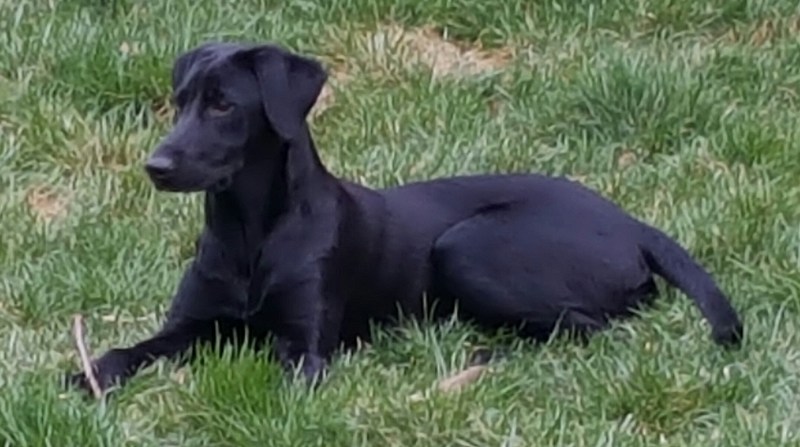
Lightning at five months

Lightning has now been with me nearly four months. That included an initial six weeks of virtually no training as I dealt with the most acute phase of my back injury, another six weeks of the kind of early retriever training I had planned for Lightning, and then a prolonged winter period when weather conditions, including the historic blizzard known locally as Snowzilla, limited us exclusively at times to indoor training. Even that training was limited further by Lightning going thru teething and showing discomfort carrying even 2″ bumpers, so that he would carry them by their ropes instead.

As a result, I’ve decided to extend our schedule for the initial phase of Lightning’s training, rather than my original plan of moving into the next phase after teething.

As I mentioned previously, that’s not because we’re missing many checkmarks in our planned activities, based on Mike Lardy’s Socialization and Introduction to Field training phase. In fact, the only missing item I’m concerned about is introduction to water retrieves, and for that we’ll have to wait till the weather is warmer in our region regardless of our other training activities.

But just because Lightning has some experience with various skills doesn’t necessarily mean it’s time to go onto the next phase. Instead, I want him to have as deep and rich an experience with foundation skills as if we had been able to train outdoors this entire time. Hence the decision to extend this phase.

I think Lightning has pretty much finished teething, since he’s carrying 2″ bumpers by the bumper again instead of by the rope. And now the weather has been better for a few days, so we’ve had training sessions most days, though it snowed again last night. 

Here then are the things we’re continuing to work on:

  • Heeling. This involves practicing a number of maneuvers, including walking beside me and then sitting when I stop, coming toward me and then looping around at my side to sit facing the same way I am, and swinging from heel at one side to heel at the other. We practice all of those equally on both sides. I use high-value treats to reinforce every sit. I usually do not have to cue the sit. 
  • Self-control. For example, although Lightning loves to rough house with Ryley,  DW Renee’s 8mo Golden, he has also learned to stop and come to me when I cue Stop and Here, and then sit quietly at my feet or on the couch next to me for long durations while Ryley continues attempting to entice him to resume playing. 
  • Hippity-hop. My cue for what most trainers call “kennel”, cueing Lightning to jump up into his crate in the back of our van, accompanied if necessary by a sweeping hand gesture. I always reinforce with treats. Lightning is still quite small, but he’s big enough to jump into the back of our van. 
  • Leave it. We haven’t proofed this outdoors yet, but we often practice it in the house, typically with a treat in my hand or on the floor. This also gives Lightning an opportunity to learn “OK” as a release cue. 
  • Leash walking. This remains a challenge for me because of my back injury as well as because of the weather, but we practice it regularly. I’ve made no effort to merge it with Lightning’s heeling skills, which I regard as for shorter distances. For leash walking, I’m just looking for Lightning not to pull forward. It took years to get there with Lumi and Laddie, and Laddie still often pulls on lead, so I’m not expecting Lightning to become good at walking on a loose lead overnight. But it’s coming.
  • Catch. Lightning often brings me a tennis ball to throw to him so he can rise up on his hind legs and catch the ball in the air, over and over again. I haven’t worked on it outdoors yet. I’m a little worried that he could injure himself jumping, either landing the wrong way, or from the impact of repeated landings. So we just play catch in the house for now. After he’s 14mo and his plates have closed, jumping will be safer, though I’ll still need to be cautious to avoid a ligament tear.  
  • Retrieving. This, of course, is both our favorite activity. Whenever possible I get one or more assistants. I always ask for one bumper retrieve first, and then we train either with bumpers or ducks. We go a variety of different places to train, and I vary the terrain on the lines Lightning runs as much as possible: up, down, and across hillsides, running thru cover, changes of surface, and always avoiding running in mow lines, ditches, or other channels but always running across them on diagonals. Lightning still wears a 15′ check cord attached to his harness when we run retrieves, but he’s extremely reliable on his returns with bumpers and almost as reliable with ducks. We mostly run singles, but occasionally we throw in a double. I don’t require steadiness from Lightning and allow him to race out in the field as soon as the gun fires, and I have my assistants do the same when they’re handling him. I sometimes let him hunt if he misses the mark on his send-out, but I also often call for help from the gunner in those situations to instill in Lightning that looking for the gunner is a good Plan B.
  • Poorman retrieves. This is how Lightning and I, or Laddie and I, practice without an assistant. Lightning has become reliable at waiting in place at least till I throw, and most of the time also waits till I return to his side to send him. This self-control is related to steadiness, but has not and probably will not automatically transfer to steadiness during ordinary marking. I think that for most high energy, high prey-drive dogs, training for steadiness will be a separate and distinct activity in a later stage of training. I feel that too much emphasis on steadiness training in the early stages risks permanently impairing motivation, and that’s not a risk I want to take.

Despite the fact that Lightning seems to be past teething and has worked on nearly all of the items planned for this stage of training, he’s had no experience with flyers or water, and as I mentioned, he’s had far fewer training days than if we had been able to train as I would have wished by now. Since I don’t plan to run him in Derby, the only stake restricted to younger dogs, we have is no urgency to move on to the next stage of training. Instead, we’ll continue in the current stage, taking the time to lay a solid foundation for Lightning’s future career in field trial competition.

A word of caution about multiples

For best chance to succeed on marking series in competition, we want the dog to give every ounce of attention to each throw, then fully commit to retrieving that bird. Ideally, the dog watches the throw and then locks onto his or her line, allowing nothing to distract him unless and until the gunshot or duck call for the next mark sounds. The dog then gives that mark the same dedication, and perhaps then another, or even a fourth. Ultimately, the dog is sent to the go-bird (the last bird thrown), which he has been locked onto since the moment he turned to it. But meanwhile, pictures and thoughts of the earlier throws are also burned into his memory from the concentration he devoted to each of them.

A dog exhibiting that style of line work is to some extent a matter of breeding and of individual drive and focus. The handler also has a role to play that day, by not intentionally or inadvertently distracting the dog from each mark. But some of that commitment to each mark is learned behavior, and early learning is especially important. A habit of poor focus learned as a puppy could persist the rest of the dog’s life regardless of attempts at retraining.

In fact, even for advanced dogs who already run marks with that kind of mark-by-mark focus, many experienced trainers will often set up a series with three or four visible gun stations for practice and then have the dog run each mark as a single. Even if the trainer originally called for a multiple, if the dog swings his head on a particular mark without at least watching the bird to the ground, the trainer may send the dog to that mark instantly as a way to help the dog learn not to head-swing.

All of this pertains to the first stage of the PRT program I’m developing and using for Lightning. Because PRT is modeled on Mike Lardy’s TRT, and because Mike lists introduction to yard multiples as one of the items in the socialization and introduction to field section of his TRT Flow Chart, I have been giving Lightning a bit of practice running short doubles, first in the house, then in our yard, and lately at practice with an assistant. The same person makes both throws, and the throws are widely separated so that the handler can intercept Lightning if he tries to pick up the go-bird and then run, carrying it, directly to the memory bird without returning to the handler first.

But, because of my concern that Lightning could develop a behavior of looking for another throw rather than giving all of his focus and commitment to the first one, I always start and the end the session with singles, and most of the marks are singles. Also, while we run singles at distances up to 200y, the doubles are much shorter, in keeping with Mike’s term, “yard multiples”.

Lightning will learn to run doubles and triples during this first stage of his training, but far more of his experience will be with singles. We have plenty of time to work on multiples when his marking habits are more thoroughly established.

Poorman marks

A poorman mark is a mark you go out to throw while leaving your dog in a sit at the start line. After you throw, you return to the line and send the dog.

I learned the term “poorman mark” from my mentor, Alice Woodyard, so I guess it’s in common usage at least in some regions, though I’ve never heard anyone else use the term. In fact, I suspect many trainers never use this skill, or even train it, either because they never run marks alone or because they use launchers.

Though launchers are valuable, I think poorman marks also have their place. They’re a lot faster than setting up launchers, and the dog can learn some steadiness even before you begin to explicitly work on that skill. Poorman marks also give you an opportunity to practice the verbal Sit cue, and a way for the dog to get a solid understanding of his or her name as the release cue on a send out. More generally, poorman marks require the dog to exercise self control, since you are not there to physically restrain the dog while throwing. 

I’m not sure how early you can comfortably train poorman marks to a puppy. It may be a matter of age, it may be a matter of familiarity with the retrieve pattern, or some other factor might be involved. I tried to train the skill to Lightning several weeks ago and decided it was too soon. Perhaps he was to distracted that day, but in any case, I decided to put it off for a while Then this morning I took him out to the driveway in front of our house to try again, and this time it went smoothly.

Here’s the approach I’ve used to train poorman marks to my dogs. Holding a bumper, you first stand in front of the dog and cue Sit. Toss the bumper back behind you. Then slowly step forward and turn so that you are standing next to the dog. Put your hand down like a gun sight and without moving it, cue the release by saying the dog’s name. If the dog is able to stay in the Sit until released, and launches well when cued, you’re in business. If not, it might be too soon for this training.

If the first trial goes well, the next time, set up as before, but take a step backwards before tossing the bumper behind you. Continue to add another step or two of distance. Then, the next time, toss the bumper at 11 o’clock or 1 o’clock rather than 12 o’clock straight back, so that the dog sees a throw a bit.

With more trials over several sessions, you can build additional distance; set up initially at the dog’s side, cue Sit, and walk straight away; throw the bumper as normal rather than behind you; proof at more challenging locales; add a gunshot for excitement; and throw two or more marks while you are in the field, which you can then send the dog to one after another, practicing line mechanics as you select each mark. This gives the dog an introduction to retired guns as well as multiples.

I don’t know whether it’s possible for any dog to learn steadiness on flyers with poorman marks, and you won’t be able to train steadiness to competition level without training with flyers. I’ll discuss a positive approach training steadiness with flyers in a future post, when Lightning is further along in our training program.

Meanwhile, poorman marks provide a good introduction to steadiness with bumpers and thawed birds, and provide a convenient way to work on a number of major training goals on those days when you’re training alone.

Walking singles and helping on marks

Yesterday I worked with Lightning and Laddie using Peter as my assistant. Laddie’s foreleg seems to be fully healed now, so I ran him on two series, each consisting of a double and a blind, distances 150-300y. For the doubles, Peter would throw one, then move to a different location to throw the other, so that the memory bird was in effect retired.

I had brought a mat out, and ran Laddie from it on all of his retrieves, with different placements for the two series.

Between the two series, I put Laddie back in his crate and ran Lightning. After placing the mat in a suitable location, I asked Peter to handle Lightning while I threw five walking singles. I had meant to throw six but accidentally left one of the bumpers behind. Although I am still in recovery from my back injury and shouldn’t be walking far, especially on uneven ground, it would be even worse if I had to chase and catch Lightning on one of his returns. Peter never had to leave the starting line as it turns out, but I couldn’t be sure that would be the case as we started. Besides, I continue to believe Lightning benefits in his understanding of the retrieve pattern by having multiple handlers. The day before, Liza, one of my other assistants, handled him on some doubles while I again did the throwing.

I thought I’d mention a couple of points about yesterday’s session.

First, the term “walking singles” refers to a particular way of practicing. Instead of the thrower remaining in the same place and throwing several singles, perhaps in different directions, the thrower starts at a relatively short distance, and then moves further away for each throw. For example, yesterday I started at 80y and worked my way out to 180y by the last throw. I didn’t walk in a straight line but headed off in different directions each time I moved, and I also randomly alternated whether to throw to left or right.

The other concept I wanted to mention is called helping. In one case yesterday, Lightning ran to a rock thinking it was the bumper, and then became confused and raced off in the wrong direction trying to find the bumper.

If he had not left the area of the fall, I would have let him hunt. That’s a useful discipline that occurs often in competition, and you don’t want the dog becoming frustrated and giving up or popping (looking back at the handler) when a hunt is needed. But at some point you might conclude that the dog is lost and that the hunt is no longer productive. 

Different trainers decide to stop letting the dog hunt at different times, so when you’re throwing, normally you don’t make the decision whether to help or not.  The handler will call for help if he or she wants it, and may not appreciate a thrower helping when not asked. In fact, some handlers will let a dog go on lengthy hunts far from the area of the fall believing that helps the dog’s training, assuming it’s safe. And some will invariably blow a sit whistle and handle a lost dog, or at least get the dog going in the right direction, and will never call for help from the gunner. 

I agree with handling when the dog has consciously run in an undesired direction, for example to avoid water or high cover. Of course I haven’t yet trained Lightning to handle. Instead, at this stage, I avoid running him on lines where he can obtain reinforcement for taking such a detour, since I want to build a habit of laser straight marks. 

However, I usually don’t handle when the dog gets lost during a hunt and leaves the area of the fall. Instead I want the gunner to help. Handling is fun, and in competition, you have no choice but to handle if it becomes necessary. You can’t ask for help from the gunner unless you’re giving up on the competition, so you need to practice occasionally to make sure the dog learns to switch from hunting mode to handling mode when you blow the sit whistle. 

But when you blow the whistle in practice, you lose a golden opportunity for the dog to learn an important strategy, which my mentor, Alice Woodyard, calls Plan B. What you want is for the dog to remember where the fall is and run directly to the mark, or at least to the area of the fall and put on a short hunt. But if the dog doesn’t remember where the fall is, getting confused during the retrieve as Lightning did at one point yesterday, you don’t want the dog habitually looking to the handler for help, since that’s a pop and hurts the dog’s score. Instead, Plan B is for the dog to look for the gunner and mentally calculate where the mark is likely to have been thrown. 

It might seem obvious for the dog to look for the gunner when he or she can’t remember the fall, but experience shows that apparently it’s not always obvious to dogs, since dogs sometimes hunt hundreds of yards away from the fall, which hurts their score or gets then eliminated entirely in competition. Helping is a way to teach the dog that the gunner is a beacon. You’re teaching the dog, if you can’t remember where the mark is, look for the gunner. The gunner always throws a typical distance, so you as the dog can figure out about where the mark must be. The more often a handler takes the opportunity to call for help, the better the dog learns this Plan B strategy. 

By the way, I might also mention how to help. In the first place, the gunner should sit down immediately after throwing, facing more toward the fall than just straight at the start line. Since the dog gets used to the gunners all sitting down, a gunner can simply stand up and face the mark. Often that’s all the help an experienced dog needs, and you want the dog to figure it out with as little dependence as possible on the behavior of the gunner, who won’t move at all in competition. 

If standing doesn’t draw the dog in the right direction, next you take a long step, and then possibly another, toward the mark. Again, often that’s enough. 

If that’s still not enough, the next thing to try is faking a throw using an exaggerated motion. You might do that, wait a second or two, and repeat it if the dog hasn’t responded yet.

If the dog isn’t looking at you when you’re trying to help, or isn’t responding to your visual cues, you can help further by calling hey-hey-hey, usually accompanied by faking a throw. Even for an inexperienced dog, that’s often enough to get the dog headed for the mark. It was enough for Lightning yesterday, the first time he ever needed help on walking singles

As a last resort, you can go all the way to the mark, pick it up, call hey-hey-hey to attract the dog’s attention, and throw the article a short distance.

What I’ve just described is the way I was taught to help in some of the groups I’ve trained with. But each group has it’s own culture, and I’ve seen some variations. For example, even though in general you’re not supposed to help unless asked to, in some groups you are expected to automatically help, without being asked, if the dog gets behind you. Some trainers want you to follow exact instructions on how to help during each incident, while others just request help (with a holler or, preferably so you don’t attract the dog’s attention, over the radio) and expect you to use your own judgment as you work thru the help options, during down as soon as the dog has figured out where to run to. Another example of a difference in approaches is that some trainers expect you to always have a second article in hand when you throw, and if the trainer calls for help, you’re expected to immediately throw the second article to the same place as the original throw, without taking extra time to reach down and pick another article up. (By article, I mean bird or bumper, whichever your training with.) I have trained with pros who never throw a second bird, and at the other end of the spectrum, others who use that strategy often, especially with young dogs, sometimes even if the dog isn’t lost, I believe to build motivation.

As you can see, you have a number of options to deal with a dog who becomes lost on a mark. You can let him hunt; you can handle; you can call for help by having the gunner stand, or take one out more steps, or fake a throw, or call hey-hey-hey, or go to the article, pick it up, and re-throw it; or you can call for another throw. I’ve explained my preference for calling for help, in order to train the dog to look for the gunner when lost as a Plan B strategy, and I actually welcome opportunities to call for help, even with Laddie, to continuously strengthen the dog’s understanding of that strategy. But dogs are smart and resilient, and can be successful with other approaches as well.
Leash walking

Midway thru Mike Lardy’s list for socialization and introduction to field, which is the basis for the first stage of the PRT program I’m developing, is “walking on leash (two sides)”.

Lightning has had lots of experience with lines in various contexts: in his first few weeks with me, I kept him tethered to me indoors most of the time, for a number of benefits including house training; in the field, he is always on a check cord to promote quality returns during retrieve practice; and when necessary out of the house, such as for vet visits, he’s been on a leash.

However, because of the injury I sustained the same day I picked him up at the breeder’s on November 2 last year, I have been unable to walk more than a short distance at a time, if at all, until the last few days. But now I can walk several hundred yards, so among our various other training activities, I’ve finally begun to work with Lightning on sustained leash walking.

The process I’m using is relaxed. I’m not trying to work on recall, Heel, or other related skills while walking Lightning on lead. Other skills may be merged into leash walking in time, but they would change the experience at this time from a stroll to nearly continuous training, and I feel from experience with previous dogs that it would be difficult to maintain a high rate of reinforcement adding such criteria to this early stage of leash training.

That means no verbal cueing during our leash walks at this time, and it means a relatively long leash, a little over 6′. Lightning only has one rule to learn: attempts to pull against the leash in a forward direction cause Daddy to stop in his tracks, and if sustained, can even cause Daddy to back up.

Although I’m using a fairly long leash, I’m not using a retractable. I think those are the most comfortable way to walk a dog on leash, but I’m not sure the dog learns anything about not pulling. In fact, the dog may actually obtain reinforcement for pulling.

I’ve also switched to a harness instead of a flat collar. My Goldens have always worn collars when leash walking, and Lightning had, too, till I switched to the harness. The reason I switched is that Lightning sometimes pulled so hard that he would make himself gag, and my holistic vet suggested a harness to avoid a throat injury.

As for location, I believe I mentioned before that I’ve never walked Lightning to the end of our driveway nor into our neighborhood. As a result, I can let him out in our yard, even though we have no fence, and he generally makes no effort to go outside the boundaries he’s learned. Of course I keep my eye on him, and if he or Laddie do wander too close to a boundary, I call out, “Don’t go over there.” I know dogs don’t understand English, but they know what I mean in this case. That makes it possible for them to run around, play, and explore safely off lead while I rest inside watching thru a window, or sitting in a lawn chair outside with them.

So, since I don’t want to walk Lightning in our neighborhood, for our new leash-walking practice, I take Lightning and Laddie to various nearby locations such as parking lots or fields that are large, have little or no traffic, and are relativity free from distractions. I keep Laddie on one side at heel but off lead, and Lightning on the other on his lead and harness. When Lightning wanders to the other side, I switch Laddie as well.

This is so much more relaxed than trying to keep Lightning on a tight lead at heel. As he comes to understand what we’re doing and the rule that pulling won’t work, I’ll gradually shorten the lead over a period of months.

By the way, I guess some field dogs are taught fairly early to walk under control on a tight lead. However, from the standpoint of Lightning’s preparation for field competition, I don’t think that’s necessary. In the stakes he’ll be running, he’ll never be on lead when under judgment, and if he isn’t perfect at leash walking and pulls at times, it won’t affect his score. So I think just a moderate proficiency is all he’ll require for this particular skill. That will leave us more time and energy for other training. 

Catching a ball

Mike Lardy doesn’t list catching a ball on his 18-item checklist for “Socialization and Introduction to Field” at the top of his TRT Flow Chart, and since TRT is the basis for the PRT program I’m developing, it may not be an essential training objective for competition retrievers.

However, playing catch can provide a lifetime of fun, indoor and out, for any dog. It has always been a favorite game for Lumi and Laddie, and Lightning, not yet 5mo, has also discovered he can catch a tennis ball in the air.

Besides the obvious opportunity to develop and practice the athletic facets of the game — reflexes, focus, coordination — catch is also an opportunity for the dog to continue discovering the intrinsic pleasure of the retrieve pattern, including not only an exciting version of the chase and also the return, but adding a deliver-to-hand component with a tennis ball that in my opinion, as I’ve mentioned before, is too soon to train for a field retrieve of a bumper or bird at this stage.

Whereas Lightning has shown in the field a deterioration in his motivation and performance when a retrieve article, especially a bird, is taken from him rather than the handler waiting for him to drop it, the opposite happens when Lightning and I play catch with a tennis ball. I toss the ball, he rises up to catch it, and then a high percentage of the time he brings the ball straight back to me, releasing it as soon as I grasp it. As quickly as I can, to reinforce the behavior chain, I toss the ball again.

Like other dogs I’ve trained to play catch, Lightning quickly grasped that the only way to get me to throw the ball again is to bring it to me and then release it when I reach for it. He’s also seen that if he drops it on the ground, I pick it up and put it in front of his mouth, cueing Take it and then Out, before I toss it again. Since that’s not as much fun as the quick toss that results from simply delivering to hand in the first place, he quickly learned to make that choice. When the time comes to work on delivery to hand as the finish for a Formal Retrieve, Lightning will already have a positive reinforcement history with the concept. 

So far, we’re only playing catch indoors. But when the weather dries out, we’ll move the game outside as well. We’ll mix tosses that he can catch in the air with throws that he has to chase down, and strengthen his reinforcement history with delivery to hand even further. 

Let me end with a couple of notes of caution: First, a young dog can sustain skeletal injuries with jumping activities before the dog’s plates have closed, which occurs around the age of 14 months, so I plan to keep my throws low for the next ten months to prevent high jumps, and also to end the game sooner at times than Lightning wants in order to avoid an overuse injury.

And second, a dog at any age can tear a ligament landing the wrong way after a high leap in the air to catch a ball or other article. Too often have I sent Laddie soaring by tossing or bouncing a ball over his head so that it would come down behind him. It was fun to watch his exquisite, gravity-defying acrobatics in mid-flight and his joy in the game. But that was before I realized the risks. I don’t do it with Laddie any more, nor do I plan ever to do it with Lightning. 

Update: After some time, Lightning became fairly compulsive about playing catch at times, bringing me the bank over and over again, just as my two Goldens had in years past, and just as Laddie still does.

With Lightning, that gave me the opportunity to introduce a cue we won’t officially train till Stage 2 of the PRT program, the Fetch cue.

It works like this. When I see that Lightning is excited about playing catch, especially with a squeaky ball, I place the ball on the floor and use my hand to block him from getting it until I’m ready. Then I say “Fetch”.

Since I already know he’s going to lunge for the ball and bring it to me as soon as I release him in some way — he’s already shown that behavior to me repeatedly — all I’m doing now is associating the cue “Fetch” with that response.

After a little experience with the cue, I can put the ball some distance away, say Fetch, possibly wave a hand toward the ball, and he’ll pounce on it and bring it to me to toss back  to him. Squeaking it a few times before tossing it seems to make it even more delicious for him, based on the intensity of his focus as I rehearse the throw to get our timing in sync and then toss it to him.

Update: For an example of how catching an article played a practical role in Lightning’s later retrieve training, see The heel and catch game.

Introducing doubles

Last weekend’s snow still covers all the grounds in our area. Oherwise I might have tried introducing Lightning to doubles outdoors, as I did with Lumi and Laddie. However, we have a foyer in front of our stairway to upstairs, which meant I could sit on the stairs to rest and avoid bending while introducing Lightning to the concept of multiple, that is, multiple marks being thrown while he watched all the throws, before he was released to retrieve the first one.

Given the fact that he hasn’t been trained Fetch nor steadiness, I found that I needed two bits of equipment for this work.

First, I needed to use articles that he was strongly motivated to retrieve. I tried slippers, balled up socks, and soft canvas bumpers, but they weren’t sufficiently motivating without a trained Fetch, which I plan to train in the second stage of our program, after teething is complete. Luckily, however, he was highly motivated by 2″ bumpers like those we’ve used in the field, and also 3″ bumpers with streamers, though those were a bit much for a small indoor space. By motivated, I mean that if he saw either size of bumper a few feet away, he would spontaneously run to it to retrieve it.

The other bit of equipment was to put on Lightning’s flat collar so I could hold him while I made the two throws. He doesn’t usually wear a collar indoors, and I don’t usually use any physical restraint for indoor training. But I didn’t want to confuse him by introducing a steadiness requirement, so I held him by his collar for a second or two, quickly threw one bumper to one side and one to the other, and immediately released him.

We only did a few trials, so he only developed an imperfect understanding of the concept of a double mark in this season. That is, he would run to the go-bird, then start to carry it to the memory bird until I called Here.  Then he’d bring me the go-bird and tend to forget about the memory bird until I used a sweeping gesture to direct him to it.

It would have been nice to run enough doubles for Lightning to grasp the concept without my extra cues. But keeping to an approach of using short sessions in order to work at peak motivation, we didn’t run enough trials for him to become fluent on running these little doubles. That will come, I think, in the next session or two.

Meanwhile, even now, Lightning has been introduced to multiples, nearly completing the TRT, and PRT, pre-teething checklist.

Training Take it and Out

Mike Lardy’s TRT seems to contain a bit of a paradox. One of the final introductory tasks is introducing the dog to multiples, but Force Fetch comes later, under Basics. The dog in theory hasn’t learned Out (or one of the equivalent cues, such as Give) during the introductory stage. So how do you get the go-bird article away from the dog on a multiple such as a double so that he or she can launch for the next article after retrieving the previous one?

A related issue, which may or may not be part of Mike’s thinking, is that I don’t want the dog to be required give up am article after retrieving it, because I don’t want the dog to be reluctant to return to the handler carrying his or her prize. I believe that has been a valuable factor in Lightning learning to return to his handler in practicing single marks early in the process, with Lightning’s check cord to assist when needed. He eventually drops the article, and we often reinforce that by the gunner immediately firing a pistol and throwing another mark. That speeds up Lightning dropping the retrieved article, but it still takes several seconds, too slow for the rhythm of running another mark that was already thrown as part of a double or triple.

Yet another concern for a dog completing his or her introductory training is that, if you started the training with a puppy, the puppy may still be teething at the stage where you want to train the final introductory skills. Lightning at four months is still teething; I sometimes see blood on his buddy Ryley’s white coat after a wrestling match. I don’t want Lightning to associate the pain of teething with retrieving in general or the Force Fetch behavior chain in particular. Therefore, for the indoor work, I’m using soft objects such as balled up socks as the retrieval articles. Outdoor training will be out of the question because of the snow and slippery conditions, which could lead to an injury, for some time anyway. If he’s still teething when outdoor conditions are better, I’ll watch carefully to see if avoidance behaviors suggest that carrying birds or bumpers seems to be causing any pain and call off the session if so.

Meanwhile, I’d still like to train Lightning to run a double or triple, for now with soft articles indoors. So even though I’m going to train a Formal Fetch (the PRT equivalent of Force Fetch)  in the next stage of training, and even though I won’t take the last article of a multiple away but will let Lightning keep it as long as he wants, I do need him to give up the earlier article or articles when he brings them back to the handler so he can be sent to the next mark already lying out there.

With those remarks as preface, here was my approach to training Out, the new behavior I’ll need for running multiples.

For reinforcement, I used a small bowl of cream cheese, which I would dip into with my finger. Although this training would have been a good prospect for clicker training, I didn’t use a clicker as my secondary reinforcer, or bridge, but instead used a cheerful Good! or some similar exclamation at the moment Lightning performed the desired behavior, following up quickly with a taste of cream cheese as the primary reinforcer.

You can’t train Out immediately, because first the dog needs to be holding an article. That means that first you need to train Take it. The dog may have no practical use for Take it during a training day or competition, but it provides an efficient starting point for training Out.

If the dog will instantly grab the article in his or her teeth the moment you present it, you may not even need a cue. But that wasn’t the case with Lightning. So the first step was to shape Take it. First I would reinforce Lightning if he merely glanced at the article, then if he made even a slight move with his head toward it, then if he touched it with his nose. Finally I wouldn’t reinforce that and, as usual when shaping a behavior, Lightning exhibited an extinction burst, offering a more vigorous version of the previously reinforced behavior (the nose touch) before giving up. The more vigorous version was to grab the article with his teeth. Of course I immediately said Good! and reinforced with a dab of cream cheese.

After that, I would no longer reinforce a nose touch, and would only reinforce taking the article in his mouth. And once I could sense the moment he was about to do so, I began to say Take it just as he was about to. Soon, he began responding to Take it as a cue without me needing to wait for him to spontaneously offer the behavior. As usual in training a new cue, by saving saying the cue until the behavior was already reliable, I avoided having him associate the cue with incorrect responses.

In order for Lightning to lick the cream cheese off my finger, he needed to drop the article, so we were soon in a quick rhythm of repeated Take it practice, allowing us to maintain a high Rate of Reinforcement (ROR), the key to a quality training session.

In addition, I was soon able to sense the moment Lightning was about to drop the article, so I could put my hand on it and say Out at that moment. It was important not to pull it away. The dog needs to respond to Out by fully committing to giving up the article, eventually learning to pull away while you hold the article in place, rather than the dog just opening his or her mouth.

To keep the training fresh, I switched articles every few trials. Although other articles probably would have worked, I switched between two balled up socks. Since Laddie was in the room with us, I also gave him opportunity to show off his skill with Take it and Out, and earn his own tastes of cream cheese, every other turn. I don’t know whether that accelerated Lightning’s learning — I don’t think so — but hopefully it didn’t hurt, and I think it might have made it more fun for Lightning as well as Laddie, though I can’t be sure. It’s interesting that Laddie instantly remembered the Take it cue. He hasn’t heard it in many years.

I found with Lightning that having to respond to a chain of two cues, Take it and then Out, before receiving his treat resulted in too low an ROR, so I interspersed frequent trials where I only cued Take it and then immediately offered reinforcement when he responded. As he became more fluent, my adding the Out cue no longer seemed to discourage him, since the behavior chain was the same anyway. Soon he was responding to Out as an independent cue.

The work I’ve described was completed in two short sessions, after which I put the articles away and ended our training for awhile. Next time we’ll practice it a bit more, and then see if we can use it to help train an indoor double. With the snow in our yard higher than the dogs’ shoulders, I guess we won’t be training outdoors again for some time.

Practicing sweeping gestures, Heel, and Leave it

With 30+ inches of snow on the ground from yesterday’s blizzard, known locally as Snowzilla, i can’t train the dogs outdoors, so this is a good opportunity for Lightning and me to do some indoor training. I haven’t started anything new, but we’ve continued to practice several skills.

I mentioned in an earlier post that once you’ve trained a hand touch, the dog soon becomes able to respond to sweeping hand gestures without actually touching your hand. For example, I can gesture for Lightning to enter our den from the adjoining room, or gesture for him to jump up into his crate in the back of our van, with a sweeping gesture. Those behaviors are almost always reinforced because they put Lightning some place he wants to be since he knows from experience good things happen there. For example, I always give Lightning, and Laddie, too, a treat as soon as they jump into their crates in the van.

I’ve used the same approach to train Lightning to come to heel on the Heel cue. I began some time ago guiding him with my hand from in front of me at some distance, to one side or the other depending on which hand I’m using, and then in a half loop so that he’s facing the same direction as me, and then cueing a verbal Sit and giving a treat. As I believe I mentioned before, I don’t want my dogs going behind me when they come to heel since they could get distracted and I wouldn’t see it happen. I didn’t begin to use the verbal cue Heel until Lightning was reliably executing the desired behavior. Then I would cue Heel and put down one hand or the other, and Lightning could complete the maneuver without my guiding him the whole way, also sitting at heel automatically. We’ll use this maneuver as part of Lightning’s delivery in the future.

Besides practicing Heel in a variety of locations and distances, I’ve also practiced it with Lightning coming to one side and Laddie coming to the other. I then leave them in a sit, step away and spin around, and again call each of them to heel, this time reversing the side each of them is coming to.

Another cue we’ve practiced indoors is Leave it. I’m not sure I’ve described how it’s trained, so I apologize if this is a repetition.

You hold a desirable treat, preferably one with a strong scent, in your closed fist and don’t open your hand as long as the dog is trying to get it out. When the dog finally pull his or her mouth away, you instantly open your hand and let the dog have the treat. This is sometimes called doggie zen: to get the treat, give up the treat. After a few times, you can predict the instant when the dog will pull his or her mouth away, and just as the dog is about to do so, say Leave it, then open your hand to reinforce the dog’s response. Soon the dog responds to the verbal cue as soon as you say it.

Leave it is a valuable and important cue for any dog, in case the dog is about to pick up something that could be harmful or otherwise undesirable. In addition, some field trainers extend it’s meaning for specific field behaviors. One example is as the last cue in the delivery behavior chain, rather than Out or Give. Another is as the cue when the dog is honoring, rather than No bird or Just watch.

Hopefully we’ll be able to train outdoors again soon. Meanwhile, Lightning and I can continue to practice some useful skills indoors.