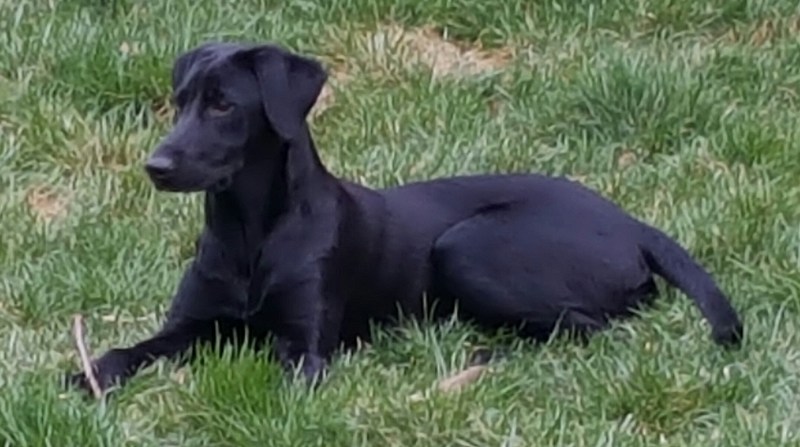
Continuing progress

I haven’t asked Lightning to learn anything new the last few days. Instead we’re continuing to practice and strengthen skills we’ve already been working on:

  • The highlight of most days is practice with gunner-thrown marks using thawed ducks and gunfire. Each session begins with a bumper retrieve, while  a duck lies elsewhere on the field upwind. Each day, the duck is closer to the gunner than before. Once Lightning retrieves the bumper, the gunner runs to pick up the duck to throw as reinforcement for the bumper retrieve, and from then on, all marks that session are with the duck. Eventually, Lightning will be able to retrieve a thrown bumper even with a duck at the gunner’s feet and with duck scent in the vicinity of where we’re working. That’s what we’re working toward.
  • The first few days Lightning retrieved a duck, he tended to drag it by a wing. Yesterday, the duck wasn’t quite thawed, though the outside feathers were soft. Training with the wings still frozen to the body turned out to be an advantage, because Lightning carried the bird by holding its whole body in his mouth as I would like him to. I thought it might be more of a problem to solve, but Lightning seens to have worked it out himself with the help of partially frozen birds.
  • Yesterday’s training had more distraction than I would have preferred, two girls practicing soccer on an adjacent field despite the sub-freezing temps. Lightning frequently looked at them, both when waiting for a throw at the line and when he arrived at the bird after running out to it, but he stuck to his work, so we didn’t have to move to a different location.
  • Lightning’s retrieves themselves were good. He ran straight to each mark, even when I had the bird thrown into a shallow depression so that he couldn’t see it till he got close.
  • Perhaps the most significant element of Lightning’s performance for me is that for some time now, Lightning has been running directly back to the handler on his returns, with no attempts at keep-away. I attribute this to the check cord, which makes any attempt at keep-away futile, to the fact that the handler doesn’t force Lightning to give up the bird but let’s him drop it whenever he’s ready to, and perhaps to natural breed or individual tendencies that have nothing to do with our training. Whatever the reasons, that facet of the retrieve was a major challenge with Lumi and Laddie literally for years, so having found an approach that lets us avoid those pitfalls, at least so far, is for me a major revelation.
  • I don’t know how many retrieves other puppies at Lightning’s stage run per session, but I’ve been keeping our sessions short. Yesterday, for example, Lightning retrieved the bumper at 40y once and the duck, working out to 80y, about eight times. I then called the session off while his performance was at a peak. We’ve had good results with short sessions.
  • On a personal note, I was having some back and leg pain yesterday. Fearng a relapse of my spinal injury, I brought along two assistants and guided them via radio while I watched from the vehicle. It makes me a bit sad to have other people running Lightning, but I think they do a good job when we take this approach, and as I’ve mentioned before, I think it may help Lightning to develop a clearer concept of the retrieve pattern than if he always had the same handler.
  • In other facets of Lightning’s development, I rarely use a lead any more, though he continues wearing a check cord for retrieving. In the house and in the yard, he and Laddie both stay close to me without the need for leashes, a benefit I think of having kept them close to me on tether in their early weeks, so that staying close became natural for them.
  • Although I still watch Laddie closely, he and Lightning are now able to rough house together. Lightning also gets play sessions in the kitchen with Ryley most days. Ryley is two months older and about twice as big as Lightning now, but they both engage excitedly in the sessions.
  • Lightning seems to have a fairly clear understanding of what I mean when I guide him in relatively subtle ways, such as with a sweep of my hand thru a gate or a soft call of “c’mon” as I head upstairs. Thus our communication had gradually strengthened with nearly continuous training throughout the day.
  • I’m also using sweeping hand gestures to practice Lightning coming to heel on both sides each day. He’s learned to turn in place and not go around behind me, since I would not want him going behind me at the line. So far we’ve only practiced coming to heel in the house. He’s developed an automatic sit as he comes into position and to respond to a verbal Heel cue with a hand gesture to indicate which side, so he’s made good progress. I don’t feel much urgency for him learning the Heel cue at this stage. Eventually his Heel will be combined with other skills to become Lightning’s delivery, but I think that’s a couple of months away, when he’s done teething and ready to learn Out, Hold, and Fetxh. By then, he’ll have been practicing Heel for months.
  • On other matters, I no longer need to cut up his raw food into bite-sized pieces. He eats chicken drumsticks straight from the freezer, but I thaw chunks of ground meat for him at room temperature for an hour or two. In theory he gets three meals a day, but it often works out to more like six meals, since he often stops eating after he’s eaten about half his food. I then open his crate, where he eats his meals, and he comes out and then goes back in to finish the meal sometime later. He’s extremely lean and I worry when he won’t eat, but I guess that’s natural for him. Laddie was the same way in his early years. Other retrievers we’ve had were much more food motivated and always eager for food.
  • In all the time I’ve had Lightning, he’s never pooped in the house, and he rarely pees inside, either, though it still sometimes happens when he gets excited.
  • Since I know that people are sometimes concerned about puppy biting, I thought I’d mention that I followed my friend Jody’s advice not to worry about it, and in fact to offer my hands and fingers to Lightning for biting in those early days, along with countless dog toys. Yes, the biting was a bit painful, but he quit doing it on his own within a few weeks. No training to deal with it was needed. He still chews on toys, shoes, etc. and play bites when wrestling with other dogs, but he stopped chewing on people early on.
  • Finally, I thought I’d mention that I do not take Lightning for walks in our neighborhood, and never let Laddie or him cross our property boundaries when they are outside. So even though we do not have a fenced yard, Lightning has never attempted to wander off. That would be unlikely anyway since he tends to stay close to Laddie and me, but I want him to have a sense of the property boundaries as an additional precaution. He gets plenty of time off the property since we go out to train most days along with other adventures, but we always go in a vehicle.

I’ve been wanting to cover some of those topics to make this journal more complete, but now they’re out of the way. I probably won’t mention some of them again.

Lightning at four months

Lightning turned 4mo four days ago. I thought it might be worth while to take stock of where we are in his training program.

As I’ve mentioned, I call the program I’m developing Positive Retriever Training (PRT), modeled on Total Retriever Training (TRT), the program created by renowned trainer Mike Lardy using traditional methods he’s helped to refine. While PRT follows the same steps to accomplish the same training goals in the same sequence, PRT does so without the use of physical aversives such as the ecollar and Force Fetch.

I began my efforts to develop PRT with Lumi and Laddie, and am now continuing with Lightning.

One of my goals in maintaining this journal is to tell others who might be training retrievers about my experience with this experimental approach. Even those using TRT or some other traditional program might find some of the information interesting. But especially if you are planning to train without using physical aversives, you may find this journal to be a unique resource to help you with your goal.

In terms of where we are in the program, Lightning has been training for about four weeks. I actually picked him up from the breeder about ten weeks ago, but because of a back injury that became badly aggravated that day, I was unable even to sit up, much less stand or do any training, for the first six weeks. So in comparison to a puppy with similar breeding in a daily training program, Lightning is presumably about six weeks behind in his training.

That does not mean that another trainer using PRT, or a traditional program for that matter, would be at the same place in his training after four weeks. The dog might have started training at six weeks younger and a different maturity level as I had planned for Lightning, or at an older age, and in that case would have had life experiences that might or might not be helpful to your training goals. In addition, the dog might have different breed or individual characteristics. And of course, the trainer might have different skills, be using different methods, have different grounds or weather conditions for his or her training, and so forth. The important point for me  is that skills be taught in a sequence that maximizes the dog’s future performance, however long those steps take.

As an aside, retriever trainers don’t universally agree on performance goals, training sequence, or both. For example, a dog being trained for hunting might have more of a focus on steadiness training in the early stages and less of a focus on the retrieve pattern and building motivation for the retrieve.

However, I’ve made no effort to postulate an alternate training sequence. Rather, I trust that Mike’s performance goals for his dogs are about the same as my goals for my dogs, and I trust his vast knowledge, born of generations of field trial retrievers and their trainers, and unprecedented success in his own career as a trainer and competitor, of what sequence to train skills in to reach toward those goals.

In terms of the TRT and therefore also the PRT programs, Lightning and I are now in the first stage, which Mike calls “Socialization and Introduction to Field,” shown in the box at the top of Mike’s TRT Flow Chart and not covered in his TRT video.

As I’ve been describing in this journal, of the 18 objectives outlined in that box, Lightning’s training has met to varying extents all but three so far:

  • He’s had no introduction to water retrieves, because the weather, though unseasonably warm in our region this year, has still been too cold for introducing a puppy to water, at least in my opinion.
  • He’s had no introduction to upland hunting because I’m not a hunter.
  • And he’s had no multiple marks.

Of those three objectives, I expect to introduce Lightning to multiple marks soon, but introduction to water will have to wait for warmer weather, and its possible he’ll never have an opportunity to go hunting, upland or otherwise.

Yet even if we had begun running some multiples, and even if Lightning had done some water retrieves and some upland hunting, it would not be time in my opinion to go on to the next stage of the TRT and PRT programs, which Mike calls “Basics”. The reason is that I’m under the impression that Basics is suitable for a dog who has finished teething, which I estimate will be in about two months for Lightning.

For an older dog who has accomplished all the introductory goals and is past teething, it’s possible the dog would benefit from proceeding to Basics after only four weeks of training. But even after ten weeks, which Lightning would have had if I had not been injured, something else might still be missing, something not expressly shown on the flow chart. By that, I mean a greater depth of experience with those introductory objectives. In the next two months, Lightning will have an opportunity to get even better with his recall, Sit and remote Sit, heeling, and the retrieve pattern, not only achieving better understanding, but also discovering ever more deeply his love for the activities that make up the career of a competition retriever.

As in any other learning process, such as playing a musical instrument, it’s not always best to push on to the next stage of learning (for example, a more difficult piece of music) once an earlier stage has been covered. Instead, it’s often best to continue to practice the skills already learned, as they become ever more accomplished, ever easier, ever more enjoyable, and ever closer to second nature. The result is to strengthen the foundation that what follows will be built upon. That’s the approach I plan for Lightning over the next two months.

Retrieving a thawed duck

When my assistant Peter and I took Lightning out the last three afternoons to work on running marks with a thawed duck rather than bumpers, Lightning went thru one of several possible sequences for developing this skill.

In the first session, although some retrievers won’t pick up a duck at first, Lightning was at the opposite extreme. He was crazy about the duck, and his emotions put any thought of performing a retrieve out of the question. Instead, he needed time to figure out how to pick the bird up, and he also needed to discover that he would not be permitted to eat the bird. The 15′ check cord Lightning always wears at this stage when we train in the field was critical equipment for being able to prevent him from going into a game of keep-away, but aside from that, in that first session, he was just getting to know what a duck is.

In the second session, we began to shape a retrieve, using the check cord to gently draw him back to the start line once he’d picked the bird up. At first he remained overwhelmed by his excitement, but by the end, he performed an actual mark, picking up a thrown bird and bringing it back to the handler.

In the third session, after several marks continuing to work with the gunner calling hey-hey-hey, we introduced gunshots. We also found that for some reason, Lightning had better returns on longer marks, up to 80y, than at shorter distances.

By the way, in the course of the sessions, Peter and I alternated our roles, one of us handling and the other throwing for a few marks, then switching positions. Although my physical condition dictated that to some extent, I believe working with a variety of handlers and gunners also helps the dog to generalize the retrieve pattern as distinct from particular elements of context such as who the handler is.

That generalizing was in addition to other proofing we were performing, for a variety of training locations and placements of the start line, changes in orientation such as N-S for one session and E-W for another, randomly alternating between RTL and LTR throws, and distances of the marks. However, all the marks were thrown in the open, making hunting unnecessary and encouraging a habit of running directly to the fall.

One last point. From the first day we brought out a thawed duck, Lightning was unwilling to pick up a bumper, much less retrieve it, or even play tug with it. So this morning, I took him outside and threw a 2″ white bumper for him without a duck or duck scent present. He repeatedly retrieved the bumper with his usual enthusiasm. Over the next few days, we’ll gradually introduce duck scent, first at a long distance and gradually closer and closer to the gunner, until Lightning can retrieve a thrown bumper even when a duck is lying at the gunner’s feet, and even when the bumper is lying where ducks had previously been thrown.

I’ve seen at training days that some dogs have never been trained to pick up a bumper (typically for blinds) if ducks are being used (typically for marks) in the same session. I don’t want Lightning to be one of those dogs.

Running marks with gunfire

Today Lightning ran three series of approximately six retrieves each, separated by breaks between the series. All marks were 50y, with Peter handling and Liza throwing, but aside from that, we went thru a progression as follows:

  • Each of the three series was run from a different start line, with Liza pacing off 50y from there.
  • Instead of Liza moving from one side to the other to change the direction of the throws, she stayed in the same place and alternated throws to her left and right. Having Lightning handle that was not my primary concern for today’s work, and we would have switched to repeatedly throwing to the same spot as in previous sessions if necessary. But it was good to see Lightning handle this new picture. Despite the dispersed throws, he ran straight to the fall on every mark, picked the bumper up immediately, spun around, and ran straight back to Peter.
  • Our primary goal for today’s session was for Lightning to run marks thrown with the gunner firing a blank pistol before throwing. To introduce gunfire, we proceeded as follows: Liza threw the first four marks with hey-hey-hey, as in Lightning’s last mark from yesterday’s session. After that, I asked Liza to fire the pistol, then check to see if Lightning looked at her to see the throw. If yes, Liza was to go ahead and throw. If not, she would call hey-hey-hey to attract his attention, then throw. Lightning needed the hey-hey-hey the last two marks of the first series because he was confused by the echo from the gunshot and looked in the direction of the echo in nearby trees, and the same thing happened for the first couple of marks of the second series. But by the third mark of the second series, he had figured out that gunfire predicts a throw, and he immediately locked in on Liza as soon as she fired, so she would then throw immediately.
  • Despite a 15 minute break between the second and third series, Lightning picked right up where he had left off as he began the third series. Watching from the van, I decided to have Peter and Liza stop after four marks in the three series. Lightning was doing good work and showing good motivation, but I didn’t want to risk pushing him into a drop in motivation or performance.

Lightning has not yet turned 4 months old, so I’m not sure how much more distance is prudent, though I’m certain he has the motivation for longer marks. But rather than adding much more distance, I think the next step is to see if he’s ready to pick up a duck, which was too heavy for him a couple of weeks ago. I’ll take one out of the freezer to thaw overnight.

Gunner-thrown marks with gunner visible

Today Lightning ran two sessions of seven retrieves each, with a short break in between. I acted as handler and Liza, my assistant, was the thrower, or “gunner”, though we didn’t use gunfire.

We worked on the outfield of a baseball field where we’ve never worked before. Lightning ran each mark in the same direction, with only the distance, and the side where the throws were coming from, changing.

For the first session, Liza threw to gradually increasing distances up to 40y, occasionally moving over to the other side to throw in the opposite direction. For the second session, Liza threw all the marks to the same spot at 40y, sometimes from the right, sometimes from the left. She was clearly visible the entire time.

Lightning did a good job on every retrieve. He never showed any confusion about whether to return to me or to Liza as he has in the past, and he ran directly back to me most of the time, rather than trying to run around me.

I think it’s likely that Lightning could have run longer marks, run the marks well with Liza firing a pistol, or both, but I didn’t want to risk problems after such a breakthrough performance. Those will be objectives for sessions later this week.

Outdoor remote Sit and Here

Putting together some of the ideas from previous posts, today I began using the sit/here game for continued outdoor proofing of Lightning’s remote Sit and Here cues. Although we have practiced Lightning’s outdoor recall for weeks, today’s work was the first step of outdoor proofing for the sit/here game, the first outdoor step being the yard near the house. Some details:

  • As in the indoor game, I would cue Sit wherever Lightning happened to be standing, then immediately cue Here. I carried an open jar of PB and gave him a taste from my finger as reinforcement.
  • I left Laddie inside while I worked with Lightning outside. I’ve let Laddie participate in this game indoors, but we need to proof it so that it works without him as well.
  • Sometimes Lightning would run to me to sit when I cued Sit from some distance. By walking him back to his point of origin, then walking away and cueing Sit again, running to me before sitting became less likely.
  • Since I couldn’t reinforce the remote Sit from distance, for the game I immediately cued Here as soon as he sat down. Thus Here is functioning not only as a cue on its own, but also as a secondary reinforcer for a different cue, in this case Sit.
  • I have to be careful not to inadvertently train Sit/Here as an invariable behavior chain, since eventually Sit will often be followed by some other behavior, such as watching marks being thrown, or taking casts during handling. So sometimes after a remote Sit, I walked over to Lightning to reinforce rather than calling him to me.
  • Once again, I found that Lightning seems to especially enjoy a search element for recall, with me being out of sight when I finally call Here. That has the added training advantage of proofing Sit so that he can stay sitting even when I go out of sight.

Later today, we’ll do some retrieving. As we’ve done over the last few days, and will continue to do for months into the future, Lightning will often get some kind of non-retrieve training, and some retrieve training, in separate sessions on the same day. Filled with mental stimulation as well as physical activity, I guess it’s an exciting life for a dog.

Balancing direction of throws


In yesterday’s post, I described a session of Lightning learning to run gunner-thrown marks with the gunner throwing LTR.

Today we returned to the same location, but this time Liza set up at 2 o’clock, so that she was throwing RTL. I think that training in the same location made it easier for Lightning to learn the concept of returning to the start line. But Liza’s new position had no trees or shrubs for her to hide behind or blend into.

Nonetheless, it worked. At first, Liza sat on a chair, kept her hood up, and turned her face away except when she was throwing. I waited in the vehicle again but communicated with Liza and Peter via radio. For the later retrieves, I asked Liza not to turn her face away, and finally to put her hood down, making her fully visible.

Once again using the strategy of Peter and Liza alternating throws, but this time with me sometimes using the radio to call for Liza to throw several times in a row, Lightning seemed to become more and more confident in executing the retrieve pattern. Yes, he would focus intently on Liza when she called hey-hey-hey and swung the bumper, but once she threw it, he was off like a rocket to the fall. I watched his eyes and he completely ignored her once he started his retrieve. He just raced to the bumper, grabbed it, spun around, and brought it back to Peter at the start line.

By the way, although Peter was prepared to capture Lightning using the check cord when he ran past as he has done in previous sessions, today that was not necessary. Instead, Lightning was bringing the bumper back to Peter. In most cases, he also didn’t take long to drop it. I have asked both Liza and Peter to make their throws the instant Lightning dropped the bumper since we began retrieve trading a couple of weeks ago, and I believe that has helped him realize that avoiding the handler on his return, or hanging onto the bumper, delayed his opportunity to chase the next mark, which is much more fun to him than standing around.

Like yesterday, Lightning’s work today was flawless in terms of returning to the handler rather than the gunner on every retrieve. Next session, we’ll start to add distance and see whether Lightning can still return correctly as the picture stretches out.

Gunner-thrown marks

Since Lightning has only been learning to retrieve for about a week and a half, of course he doesn’t completely understand the retrieve pattern. When I tried to run him on setups with gunner-thrown marks too often in a couple of earlier sessions, he became confused about his returns and began bringing the bumper to the thrower instead of back to the handler at the start line.

Realizing that I had not broken the return concept down enough, today we used a plan where Lightning was able to practice retrieving gunner-thrown marks without that confusion. I had brought two assistants, Liza and Peter, so I actually stayed in the van to avoid straining my back and legs, still recovering from my spinal injury, while they did all the training. Here’s the plan I provided:

  • Lightning, as usual when we work on outdoor retrieves, wore a 15′ check cord.
  • Peter stood at the start line, using the check cord to restrain Lightning till the bumper was thrown. For simplicity, and to maximize motivation, we’re not working on any sort of steadiness yet, just relying on the check cord for restraint. Lightning is released as soon as the bumper is in flight.
  • The target spot for all throws, from both Peter and Liza, was planned to be 20y from the start line. Let’s call the direction of that target 12 o’clock from the start line.
  • Liza was 30y from the start line, in the direction of 10 o’clock. That means she was throwing LTR to the target. Peter, Liza, and the target spot formed a triangle, approximately equilateral.
  • The key to this stage of the training was that Liza was almost invisible to Laddie. I had planned to use a location with a shrub or tree for her to hide behind, which this location turned out not to have without Liza having to step into swampy terrain. But she happened to be wearing a long coat the same color as the trees, and when she turned her back so that her face was not visible, she was entirely camouflaged.
  • Another key was that I did not assume, once Lightning had picked up one of Liza’s throws and then returned to Peter at the start line, that all confusion was gone and from then on all the marks could be thrown by Liza.
  • Instead, I requested that Peter make the first couple of throws, which I believed Lightning would retrieve correctly, and he did. Then Liza and Peter would alternate, so that Lightning would get to practice a gunner-thrown mark, but then immediately receive a refresher on his earlier experience with a handler-thrown mark. Occasionally Liza might throw two marks in a row, but no more than that without a throw from Peter.
  • Altogether, they threw about a dozen marks. Lightning’s performance was just what we hoped for, never once even considering a return toward Liza but instead every time grabbing the bumper and heading straight back toward Peter.
  • Peter would then use the check cord to capture Lightning near the start line, wait for him to drop the bumper, and then, as quickly as possible, the next thrower would call hey-hey-hey and throw.

By the way, it turned out that because Peter was actually throwing about 30y, the target spot was beyond the flat area where we had planned the bumper to land, and instead in a shallow ditch, making the bumper invisible once it had landed. Liza saw where Peter was throwing to and made her throws to the same spot. The first time Peter made that throw, Lightning ran in the correct direction but hunted a couple of yards short, unable to find it. After a few seconds, Peter went out to pick up Lightning’s check cord, then took another couple of steps to pick up the bumper as Lightning watched. Ah, so that’s where it was! Lightning never had a problem with the disappearing marks again. He ran the correct line but no longer hunted short. Instead he continued full speed into the depression, grabbed the bumper, and immediately turned back toward Peter, no matter who had thrown the mark.

Though not part of the original plan, I think this was a good step in strengthening Lightning’s confidence in running marks, discovering repeatedly that if he ran in the direction of where he had seen the mark fall, it would be there waiting for him when he got there. Naturally I prefer Lightning taking a straight line to the mark to a strategy of running to the general area of the fall and hunting, or running toward the gunner and then veering over to the mark.

I might mention that in these sessions, Laddie is also getting some work, for example a double plus a keyhole blind, or a double momma-poppa, that is, both gunners throwing two marks, one to the left and one to the right. The work is interesting and hopefully helpful to Laddie’s continued development, but I won’t always take the time to describe it in these posts to Lightning’s journal.

We plan to train again tomorrow, New Year’s Eve. Lightning’s work, at least in the first set of marks, will be the same as today’s, but with Liza throwing RTL this time so that Lightning doesn’t become out of balance in the direction the throws are coming from.

If he is again successful, we may do a second set where Liza begins to make herself visible during part of the work, until eventually, Lightning will always return to the handler at the start line even when gunners, and eventually other distractions, are visible.

For this training, the key will be not to rush into adding complexity to the work, avoiding a situation where Lightning again becomes confused about where to return to. Today was a good step in that direction.

Proofing Sit and Here together

Behaviors the dog learns in the training room will require extensive proofing before they can be used in competition. A typical series of proofing locations might be:

  • Other rooms of the house
  • The yard immediately outside the house
  • An enclosed area away from the house, such as a tennis court
  • An open field
  • A field in the vicinity of a training day, but away from the other dogs and people
  • A training day with other dogs and people, simulating competition as much as possible
  • Competition

Here is a way to work on proofing both Sit and Here for such a progression of locations:

  • Cue Sit (see earlier post on how to train this cue). The dog may need to be retrained this cue in new locations, so patience is essential.
  • Back away one step, then quickly return to the dog.
  • If the dog moved toward you, speak gently to give assurance that it’s OK, but don’t reinforce with a treat. Then try again. You can maneuver the dog with hand gestures back to the original position but it’s not necessary. Instead, you can just start again from the dog’s new position.
  • When the dog stays in the sit as you step backwards, quickly step forward again and reinforce with treat and encouragement.
  • Continue in this way until you can step backwards several steps.
  • Also, without stepping backwards, turn around in place, so that for an instant your back is to the dog.
  • As the next step in your training, after you have backed away, instead of coming back to the dog, cue Here. I like to do this with enthusiasm, so that the cue itself shows your pleasure in the dog’s good Sit and acts as an immediate reinforcer. Then, of course, when the dog arrives in front of you, reinforce with a treat and perhaps more words of encouragement.
  • As you extend the distance for this game, you can also introduce a bit of hide-and-seek by gradually creating the situation where you move out of the dog’s sight, and the dog hears you call Here from out of sight. I’ve found dogs seem to love this version of the game.
  • Splashing thru puddles, and swimming across channels once the dog has learned to swim (to be discussed in a later post), are further important location-proofing facets.

So this provides a game you can play in a series of increasingly challenging locations to proof both the Sit and the Here cues.

Besides location proofing, another kind of proofing is also essential: distraction proofing. So as you proceed with location proofing, you also need to introduce distractions of increasing difficulty, such as food bowls, rolling or flying tennis balls or bumpers, duck crates, and other people and well-behaved dogs, both still and moving.

The skills of Sit and Here are so difficult in the context of a competition retrieve that it’s possible no amount of proofing will complete the training needed for that work, and you even occasionally see well-trained and experienced field retrievers fail either of those cues in competition or a training day. But a thorough proofing with this game will lay a foundation for both cues that you can build on as they are merged into retrieve training.

[Note: This post is not specifically about Lightning and will eventually be moved, perhaps with edits, to the PRT website still under construction. But I might mention that this is one bit of dog training that seems to work fine if I let Laddie train alongside Lightning. It’s way too easy for Laddie, it uses twice as many treats, and it’s conceivable I’ll find that Lightning is not learning the skills as well as if he were training alone. But it tugs at my heart to lock Laddie away, especially while he can hear me training Lightning, so at least in the early training I’ve let him join us in the game.]

Tug

The game of tug, short for tug of war, is widely taught and used by positive trainers for dogs who participate in many activities. You can work with the dog to the point where tug becomes a powerful primary reinforcer, so after a successful trial in a wide variety of trained skills, you can offer a game of tug to reinforce the performance and make that version more probable in the future.

But before I continue, a disclaimer: I have found that some traditional trainers do not think you should teach a dog to play tug, much less actually play the game with them. I’m not sure why. An obvious possibility is that they believe it increases the risk that the dog will develop a habit of sticking (reluctant release) or even freezing (refusal to release) on delivery to hand. Sticking and especially freezing are serious flaws, and I’ve heard that they can be so difficult to repair that they can end a dog’s career.

If that’s the concern, then it may be true for some dogs, so please stay alert if you decide to train the game anyway. But my experience with the small number of dogs I’ve trained is the opposite. Over time, the dog and I achieve a long history of playing tug, with an evolving understanding that when I stop playing, that round is over and they release, with a high probability that I will then immediately initiate another game of tug, or provide some other high value reward, to reinforce the release.

On the question of whether you should always, or never, let the dog win, my experience is that it doesn’t much matter. I believe that tug simulates two dogs working cooperatively to tear apart a large piece of meat, so I believe it is the game itself that acts as a reinforcer, not how it ends. That said, it may be useful to let the dog win in the early training to help her engage in the game until she discovers within herself the pleasure of tugging itself.

Training tug:

  • Select an article the dog has a natural, previously displayed inclination to hold onto when you reach for it in her mouth. It is an uphill and possibly losing battle to try to train tug with an article you think would be good for the game but which the dog has little inclination to play tug with.
  • For each trial, entice the dog with the article, for example by swinging it a few inches over the floor or snaking it in front of the dog.
  • When the dog grabs it, lightly resist giving it up, then let go. Over time, you’ll be able to increase how hard you pull against the dog to virtually full strength and engage for several seconds per trial.
  • An advanced version of the game is to swing the dog around on a circle fast enough that the dog’s rear legs lift off the ground. I never got that far with either of my Goldens, perhaps because Goldens have much softer bites than the Schutzhundt dogs that trick is sometimes taught to. I’ll have to see whether Lightning will be able to do it when he’s older.
  • Another advanced version of the game consists of holding the article behind your back and then putting it in one hand and suddenly pivoting your body to left ot right to reveal the article. The dog must now grab it in the blink of an eye or you pivot back and she loses the opportunity. This trains her to seize the opportunity without delay, which I suppose is vital for police dogs, with whom this game is played. I’m not sure I see such a reflexive response as important for a field retriever as a skill per se, but it does seem to increase motivation, which is always a good thing.
  • In Lightning’s first session, I experimented with a number of articles that didn’t work. At last I found that he would engage with the rope of a 2″ bumper. We played for about 20 trials. His motivation gradually increased as he figured out the game, but he never became highly motivated. Perhaps he needed more practice, or other conditions, such as play room distractions or being a bit tired from earlier play, were in effect. By the second session, he was just as happy to grab the bumper itself, rather than the rope, and his motivation was significantly higher.
  • Eventually you will want to train a release. That’s actually part of the Trained Retrieve, and that component is cued by various trainers as “out” or “give”. I’ve even heard the cue “leave it” for this purpose. In any case, it doesn’t need to be trained at this time. You can just let the dog win.
  • Alternately, if you stop tugging but just refuse to let go, the dog eventually becomes bored and lets go. It could take minutes the first few times. But if you instantly reinforce the release with a high value reward, possibly another game of tug, the dog will release sooner and sooner without the need for a verbal cue, until the dog simply reads your body language and releases almost as though reading your mind. That skill can extend to field work. Both of my Goldens generally released the bird on delivery to hand without a verbal cue, though I did train “Out” when we worked on the Trained Retrieve. We’ll discuss that in a later post, since it will be after teething.