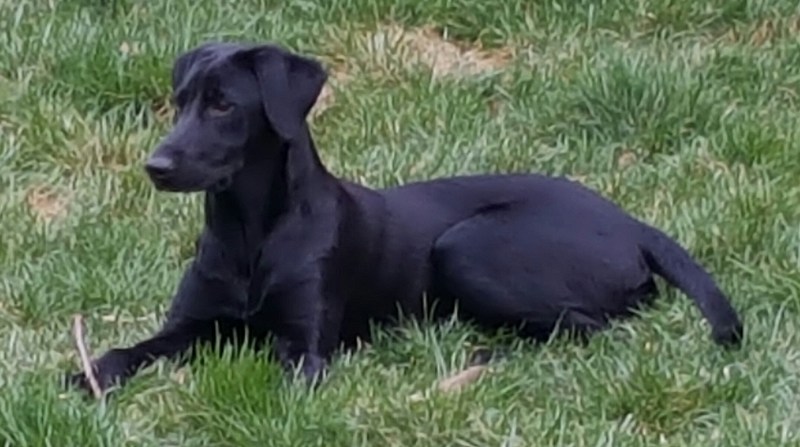
Sit on cue, plus remote sit

My grandson Gavin is visiting for Christmas. The combination of a 5yo (his birthday was yesterday) and two puppies is explosive, but they’d had a day to get used to each other. So when Gavin asked if we could train Lightning, I thought this might be an opportunity to get help with some indoor clicker training.

Next up on my training queue was Sit, so we’d train it first with a visual cue, then with a verbal cue. I didn’t know it, but we’d also end up training something special I hadn’t planned for the first session.

I experimented with letting Gavin do the clicking, his preferred task, but he couldn’t get the timing right. After a number of late clicks, I gave him the new job of feeding treats. Eventually I also had him try giving the verbal cue, with some success.

I you perform an online search, you’ll probably see a number of approaches for clicker training a sit. We used this one:

  • Gavin tore up some sliced ham into small pieces, about inch-square, which we would use as our high value treats.
  • I recharged the clicker: click-treat three times to kick off the session.
  • With my empty hand in a cupped shape, I moved around until Lightning was on his feet, then moved my hand over his head, palm up. He followed it with his eyes, which caused him to sit down. Click treat.
  • I repeated that a couple of times, and then tried the gesture without actually moving my hand over his head. He sat down. Click treat. Now we had a visual cue for Sit.
  • I said “Sit” and waited a second, then used the visual cue. He sat. Click treat. I repeated that a few times, and soon he began to sit as soon as I said Sit without waiting for the visual cue. Now we had a verbal cue.
  • Dog minds are different from ours in many ways, and one of those is that when they learn something, they learn the entire context, not just what we consider salient. As a result, Sit, like any other cue, would need to be proofed for both location and distractions. It might even need to be retaught in several locations before the dog generalized it.
  • So Gavin and I refreshed our supply of treats, providing a valuable break in the session.Then we moved around the play room, practicing verbal Sit in one location after another. I usually gave the cue and clicked at the moment Lightning sat down. Gavin dispensed the treats.
  • I soon noticed that having Gavin giving the treats meant that Lightning did not need to be responding to the Sit cue while physically close to me, nor in a “front” position. He could be in any part of the room, facing in any direction, when I cued Sit and clicked, and would not be motivated to come to me for his treat because Gavin would be right there. So now, though I had not planned it, we had a remote Sit. That may or may not have much value for a pet dog or in some dog sports, but it’s hugely valuable for a field retriever because it’s a key component of handling skills. In time, Lightning will be cued to sit hundreds of yards away from where I’m standing. We had now laid the groundwork for that skill. In fact, no reteaching had even been needed. Lightning had come to understand Sit as a remote cue in his first session.

Of course we’re not done with proofing Sit by a long shot. Lightning will be practicing that cue for the rest of his life, and if he’s like other dogs I’ve known, he’ll even forget what it means occasionally, despite my best efforts to reinforce it consistently and my attempts to make it reflexive. After all, dogs are always basically guessing at what we mean by our attempts to communicate. Sometimes they draw a blank or guess wrong, and of course sometimes the context they are in produces a different outcome than we intend.

Nonetheless, Gavin and I had given Lightning a good foundation for Sit in our training session on Christmas eve. I think it was fun for all of us.


Longer marks (with video)

For today’s training session, we had limited time and only one assistant, Peter. I decided to use those resources as follows:

  • We would drive to a nearby ball field, large, isolated enough that we could use the blank pistol, and likely to be deserted or nearly so. A woman was playing with her daughter on a swing set far from where we’d be working, but no one else was there, so we had a good location.
  • I asked Peter to throw a double for Laddie, moving from one gun station to the other, while I handled Laddie from a chair. The terrain was flat, but the marks had good distance and some trees to negotiate, and of course the memory bird was retired since Peter stayed over at the go-bird station. Laddie took a slightly outside arc on the go-bird, a straight line on the memory bird, but ran directly to both marks. Hopefully this is helping him restore his endurance and have a little fun.
  • Peter then put Laddie in his crate and brought out Lightning. For Lightning, I had three goals:
    1. Start training with white bumpers rather than the various other articles we’ve been using. We’re sticking with 2″ bumpers for now.
    2. Stop depending on the check cord to guide Lightning’s return. The cord is there to help catch him if necessary, but at some point he needs to return without being guided.
    3. Begin to stretch the length of his retrieves.
  • The training plan was simply to address those goals one by one, each building on the one before. Peter did all of the work and did a fine job. For example, even on his long throws, he kept them low so that Laddie wouldn’t lose sight of them in flight.
  • In all, Lightning ran about 20 retrieves. He looked like he’d gladly run a thousand more, but we’ve been having success with short sessions and stayed with that approach today.
  • I managed to get a video of a couple of Lightning retrieves once we reached the point where Peter was throwing the bumper good distance. Unfortunately, my voice sounds terrible, but I think it’s fun to watch Lightning’s work. So here’s Lightning retrieving at 3mo:

Hand touch

Some time ago I worked with Lightning to charge the clicker, a series of click-treat pairs until Lightning realized, visible in his reaction to the click, that a click predicts a treat.

Today I used that work as the basis for a simple, fundamental skill: training Lightning to touch his nose to my hand when I present an open palm. No verbal cue is used, just the visual cue.

Training this skill is simple. I started by tearing up some pieces of sliced ham, since I wanted to use a high-value reinforcer. [I think training with anything less than a high-value reinforcer is a waste of time.]

Next, I sat on the couch in our TV room, where Lightning spends most of his days. Both of our family’s Goldens were nearby. Ryley was in his crate in an adjoining room, and Laddie was lying on the floor a couple of feet from Lightning and me. Both are clicker-trained and both like sliced ham, so I wasn’t sure we’d be able to work in that location, but they ignored us so it was fine.

The room is also littered with dog toys, but again, all of Lightning’s attention was on me. If he had been distracted, we would have moved so that we could work without distractions.

As soon as I sat down, Lightning came to a sit in front of me. He often gets treats in that location. He couldn’t see the ham, which was in a bowl on a table next to the couch, though he could probably smell it. In any case, he was fully engaged.

I started with a quick recharge of the clicker, three click-treats. He alerted to all the clicks, so we were ready to go.

Then I put my open hand a few inches from his face. It’s natural for a dog to touch your palm with his nose when you do that, and when Lightning did so, click-treat. I repeated that about twenty times, till I ran out of ham.

Of course I didn’t leave my hand in the same place each time. I gradually increased the distance, until he eventually had to stand up and walk over to me to touch my hand. I also used my other hand a few times.

I may not write more about this in the future, so I’ll mention a few points before I finish:

  • We’ll practice this skill for the rest of Lightning’s life in various forms, greater distances being one goal, and also proofing for distractions of all sorts and for many different locations, inside and out.
  • A time will soon come when I’ll reinforce Lightning for moving to my hand without actually touching his nose to it. At that point, my hand can be used to lead him into any desired position, such as bringing him around from front to heel, without physical contact.
  • Similarly, he’ll soon learn to follow the direction of an open hand gesture with momentum right past my open hand. In that way, I’ll be able to use a sweeping gesture to cue him into his crate or thru a door in front of me, again without physical contact.
  • With respect to field work, the visual cue, even for an advanced field dog, when you are calling the dog in either straight or on an angle, is one or both palms open toward the dog as your arm or arms reach down toward the ground. So Lightning is already learning a retriever’s handling cue, too!  :0)

The hand touch is a nice starting skill for a new clicker-trained dog. I’ll discuss others in future posts.

Duck wing retrieves and gunner thrown marks

Although Lightning’s third training session, described in “First Duck Interaction”, showed progress and promise, I later realized that in one respect, I had attempted a much larger increment from previous training than I had intended. A Mallard weighs as much as 3-1/2 pounds, several times more than any object Lightning had ever carried before. That, combined with unfamiliar scent, taste, and texture was, apparently, a bit too much for a pup who, after all, himself only weighs 21 pounds.

Yet I wanted to take the next step from retrieving bumpers, though of course we’ll work plenty with bumpers, too, in the future. The solution to taking that next step: let Lightning retrieve a duck wing rather than a whole duck.

So that was the third goal of today’s session: to see whether Lightning could retrieve a duck wing as well as he had a slipper, and then an orange bumper, in previous sessions.

The training plan was the same, and Lightning turned out to be crazy about his duck wing. The only difference was that he took much longer to drop it than previous articles, but I urged Peter to be patient and not take it away. As I’ve mentioned previously, I don’t want Lightning learning that returning to the handler means something undesirable will happen, in this case, having his prize taken away from him. We’ll get to deliver-to-hand after teething, in a few months.

By the way, from 20y away, I was ecstatic with Lightning’s work, but Peter later told me that Lightning was chewing the wing. That will need to get fixed when we train Hold, but that won’t be for months. I don’t want to be digging a training hole in the meantime, so for now I don’t plan to train with duck wings or ducks at all again for some time. We’ll use bumpers to continue introducing Lightning to the PRT pre-teething skill set.

Yet I’m not quite finished telling you about today’s session. Yes, we had met all three of our training goals, but as we began packing up, I noticed two unusual facts: for once we were not rushed for time, and for once we had a second assistant, Evan. Lightning was certainly not used up, not as long as that duck wing was in the picture.

So this was a fine opportunity to try Lightning out on gunner-thrown marks, something he had not seen before. Evan acted as the thrower, and Peter continued his sterling work as handler. Since Peter had Lightning’s check cord to guide Lightning’s returns, it went smoothly. Peter would call for the throw, Evan would attract Lightning’s attention and toss the duck wing to the same location Peter had been tossing it, Lightning would be on the wing in the blink of an eye, and Peter would gently guide Lightning back to the start line. Then, Peter and Evan would patiently wait till Lightning dropped the wing for an instant, giving them an opportunity to grab it off the ground and set up the next trial.

I almost think Lightning could have played this game all afternoon, but I called it off after three trials, while Lightning’s motivation was still assuredly at its peak. This time we really did pack up, and the session was finally complete.

Gunfire conditioning

I had three goals for today’s training session, two of which were to occur together, and the third afterwards. I’ll describe them in two posts. This is the first one, where we worked on the first two goals.

One of the goals was for Laddie, my Golden, and that was just to give him a chance to do some retrieving. My injury has made that difficult, and he’s gotten little work the last two months. So today we brought along Peter, who has become my primary assistant, and one of his friends, Evan, who has worked with us before and did a nice job today as well. That enabled Laddie to run some singles, with Peter handling and Evan throwing. We worked in a field with uneven terrain and varied cover, hardly the most challenging Laddie has run but at least of some interest. Besides, it would probably be best to phase him back into more demanding work after the long layoff anyway.

In theory we could have run doubles. I can’t throw, or at least I don’t think it would be safe for my spine, but I could probably handle from a chair. However, I had another job to do, which was for our order goal: conditioning Lightning to gunfire.

So I sat in my chair with Lightning accompanying me on a short lead, no particular activity available. Peter handled Laddie form a start line 30y away, and Evan threw bumpers from various positions further away from Lightning and me. For the first throw, Evan was 120y away from us. All three of us had radios to coordinate our work.

My “equipment” was a warm hot dog from a convenience store, broken into a dozen or so large chunks.

Each trial went as follows:

  • Peter would call Laddie to heel, lock him in on Evan, and call for the throw.
  • Evan would fire the pistol, loaded with 209 primers, and throw a white bumper.
  • In the next instant, as Lightning looked around to find the source of the sound, I offered first one, and then a second, chunk of hot dog, which he ate in his puppy nibbling way, a new flavor for him and one much to his liking.
  • Meanwhile, Laddie completed the retrieve and Peter threw a few happy bumpers for him to add even more fun and exercise to his experience.
  • I then used the radio to reposition Evan for the next throw, closer to us each time, while Peter continued to use the same start line, repeating until Evan was only 50y from us. I then moved Peter and his start line to a new location 10y from us, and Evan to throw another 20y from there. He did his best to provide Laddie with a relatively interesting retrieve, considering the short distance.
  • Finally, I had Peter and Evan reverse positions. Now Laddie would be running toward us rather than away on his send out, and the gunfire was only 10y away. I used my last two chunks of hot dog. By now, gunfire was old hat to Lightning. He heard the gunshot and enjoyed his hot dog chunks.

Lightning now knew, or rather had been conditioned to the fact, that gunfire predicts good things, and Laddie had gotten some work in. Both our first two goals had been accomplished.

In my next post, I’ll describe our work on the third goal we had set for the session.

First duck interaction

Despite subfreezing temps, a stiff wind, and a wind chill of 25 degrees, Peter and I had a thawed duck to work with this afternoon and were determined to give Lightning a chance to try retrieving it. This would be Lightning’s first interaction with a duck. Here’s how it went:

  • We tried a new location but something in the environment kept drawing Lightning’s attention. We only stayed for three trials, then headed back to the location where we had last had good results.
  • We tried the red bumper from out previous session and Laddie ran a nice retrieve and return. I was satisfied he was ready to see the duck.
  • Peter then executed our planned trial about six times. It went exactly the same every time: Peter would show Lightning the duck, he would throw it a few feet, Lightning would swoop down onto it, he would jump back a foot and begin to circle it with an occasional sniff, and after about three circles he would get distracted. I’d then say to Peter, Throw it again. After six trials, I saw no progress and the trial ended with me asking Peter to give me the duck.
  • From my chair, I then held the duck up at Lightning’s eye level. He immediately ran over, grabbed it with his teeth, and pulled it out of my hand, then dropped it. So he was willing to attempt to carry the bird. That was progress. Was it repeatable?
  • Yes, it was. I held the duck up again, and Lightning did exactly the same thing.
  • We could have stopped there on a high note, but I just wanted to see if Lightning’s attitude about the duck had now evolved a bit. So instead of holding it up, I picked it up but then set it down on the ground. Lightning ran to it, grabbed it, and dragged it a few inches.

Yay! We can build on that. Meanwhile, the duck is back in the freezer till next time.

Bumper retrieves

Today, on a short, damp, gloomy, and chilly day, my assistant Peter joined Lightning and me for our second training session together.

Since my working window is limited by gathering pain when I’m not lying down, Peter did virtually everything today, following my instructions cheerfully and suggesting his own valuable innovations as we worked. I stayed inside lying down as he prepared our work site, then bundled up and watched as he carried out the training. Afterwards, I retired to the couch indoors to recover while he put everything up. Kudos to Peter for a job well done!

Here’s how the session went:

  • Although our yard is a bit slick from the rain, I still wanted to use it if possible rather than the driveway. Peter’s first job was to select a suitable area and clear as many leaves, branches, and other possible distractions as possible. In the end, we used that area for a few retrieves but something in the distance kept distracting Lightning, so mid-session Peter selected a different location that worked better, where we finished the session.
  • Both areas were on a hillside, but we eliminated the risk that Lightning would tend to swerve off-track because of gravity by working on the hill’s axis, with the trainers at the bottom and the article tosses straight up the hill. Diagonal hill retrieves will come later.
  • We brought about six kinds of bumpers and also one of my slippers to try as articles.
  • As before, Peter’s instructions were to draw Lightning to us if he picked up the article and then went in some other direction than carrying it back to us. That never happened a single time.
  • Also, Peter again followed the principle of tossing the article again immediately as soon as Lightning dropped it. We ran about a dozen trials and that was again effective, Lightning each time seeming increasingly engaged and comprehending of the retrieval pattern.
  • Peter did get one use of the check cord. A couple of times, Lightning dropped the bumper early. I suggested to Peter that he gently draw Lightning toward us without the bumper. As I hoped, that engaged Lightning’s anxiety that he would lose the bumper and he grabbed it before he has been pulled too far.
  • For the first trial of two, Peter made his re-throws in random directions within our area. I asked him to stop doing that. Instead, return to our start line and re-throw up the hill from there. That eliminated the variable of multiple views, helping Lightning grasp the pattern more readily.
  • We only used the slipper once. We also had a little luck with a white bumper. But Peter noticed that Lightning seemed interested in an orange bumper we’d brought, and he was right. We used that the rest of the session with great results.
  • And so we had a session of bumper retrieves: Peter would toss the bumper; Lightning would chase it, pounce on it, pick it up, and bring it back in his dancing, puppyish way; finally he’d drop it and Peter would pick it up and run the next trial.
  • After about a dozen trials, while Lightning’s enthusiasm was still at maximum, we wrapped it up. Lightning never had a chance to begin to lose interest.

What’s next?

We could simply repeat today’s session several times over the next few days, strengthening Lightning’s understanding of the retrieve pattern.

But I think we’ll try adding one more element. I asked Peter to take one of my ducks out of the freezer to thaw overnight. If it thaws enough, perhaps tomorrow Lightning will retrieve his first duck.

Sleepover

Another item in my PRT program, as in TRT and any good puppy program, is socialization. That means giving the dog an opportunity to meet many kinds of people of different ages, genders, and as many other variations as possible during the dog’s socialization window. Not just other people, but also other dogs, other kinds of pets, strange outfits like hiking gear, new locations, and so forth.

Of course Lightning knows our other two dogs, has met neighborhood dogs, and has met a few other people. But with my injury, I have been concerned that I have not done enough socialization in this limited time window.

What great fortune, then, when a childhood friend named Bette, who has stayed in touch and is probably the person who bequeathed me her love of dogs so many years ago via a big dog she owned named Steve, got in touch a few days ago offering to take Lightning for a visit. An extraordinary act of friendship at a perfect time in Lightning’s development.

So Renée fixed up a package with all the frozen meals, and Bette picked Lightning up a little while ago for a sleepover about 50 miles from here. She’ll bring him back tomorrow evening. Till then, I’ll still have Laddie as my dog to sleep and cuddle with as I deal with my injury.

Lightning was all over Bette, so I think he’ll have a great time. Let’s face it, I already miss him badly. But I’m glad to get this important facet of Lightning’s training further addressed.

House training

Unless you’ve trained a puppy recently, you may not remember much about how you taught her to eliminate outdoors. Some puppies come house-trained or nearly so when you get them. And the training period is rarely very long.

But if you do happen to have a puppy or older dog who is still making mistakes indoors, this article, together with others available online, may help.

I think you need to apply two principles, both of which can be applied in a myriad of ways:

  1. The dog needs to be taken outside often enough.
  2. When the dog is inside, she must spend every second in locations where she has a natural instinct to maintain control till next trip outdoors.

You could follow a cookie-cutter approach or invent your own, as long as it meets those two criteria.

Though I had had him for several weeks, my puppy Lightning was a challenge at 12 weeks because he did not seem to have come with much understanding of where was OK to go in the first place, and because for our first month together I was almost immobile from a spine injury. At nearly 3 months of age, he was still peeing almost indiscriminately in the house.

So my wife and I worked out a schedule specific to Lightning’s needs, and we’ve now pretty much resolved the issue, with no mistakes in several days. Your situation is no doubt different, but perhaps our example will help you apply the principles to your own solution.

  • Lightning is walked three times per meal: once immediately before, once immediately afterwards, and once about 20 minutes afterwards. The operative word here is “immediately”. For Lightning, he eats in his crate and then he finds a treat-filled Kong or other treats in his crate after the second and third walks. Thus going out is a satisfying adventure (he gets to relieve himself), and coming back in is also fun and reinforcing. I should mention that this is a big daily job, since Lightning is on a raw diet where he eats four times per day. That’s twelve walks per day right there.
  • In addition to those walls, he gets a walk first thing in the morning and last thing at night, plus every couple of hours during waking hours, if those aren’t covered by the mealtime walks.
  • Lightning, like any puppy, needs thorough hydration, but in the early days of house-training, he gets all his water added to his meals. He will have free access to fresh water when he has better control.
  • He loves to play with my wife’s Golden, who is two months older. For those play sessions indoors, I have to interrupt him every few minutes to take him outside for a break. I’m not sure why, but that’s one time when Lightning has especially poor control. I guess it’s the excitement.
  • So much for frequency. It’s a lot, but it could be worse, and I’m sure some dogs would need even more frequency in the early stages.
  • As for safe indoor locations, Lightning has two: his crate, provided he really, definitely has empty tanks when he is in there; and tethered to me on a short leash attached to his flat collar. By short, I mean 30″ or so. That works for us because as it happens, Lightning has never tried to eliminate when he was that close to me. That, by the way, is how we sleep at night. Lightning actually spends little time confined to his crate, since his company means a lot to me while I’m injured.

Obviously all the constraints I’ve described will gradually be broadened, and equally obviously, they are unlikely to apply perfectly to your requirements. But hopefully they provide a sense of the stringent discipline you need to apply to your own behavior as a trainer if you have a particularly difficult case.

Slipper retrieve

[This post contains ideas previously discussed elsewhere as well as other editing annoyances. My apologies; I’ll fix it when I can. But meanwhile,what a day! I would love to tell you about it.]

Circumstances

The PRT program I am developing includes about a score of pre-teething goals, with sequence sometimes crucial and sometimes irrelevant. One of those goals is “Intro to retrieving”. I can’t remember whether it has prerequisites in TRT, but I think any trainer might want to see at least enough to gauge what he’s starting with.

In my case with Lightning, unfortunate events prevented me from trying a single outdoor retrieve with him for more than a month after I picked him up, by which time he was a few days past three months old.

Then, out of the blue, Peter, one of my long-time training assistants, now a full-time college student, contacted me and mentioned that, with winter break, he was available if I were interested. With a few more text exchanges, we had made arrangements and he was here first thing this morning. First he helped me with some business duties, and then he stayed for another few minutes so we could try Lightning out on a small experiment.image

Lightning outfitted for training the next day

Discovery training

I call the method we would be using “discovery training”. It shares some principles with a well-known training method called “shaping”, which you can study via an online search if you wish.

As for discovery training, the trainer accomplishes it by creating opportunities for the dog to discover within herself self-reinforcing behaviors which happen to coincide with the trainer’s objectives. Thus the reinforcement comes not from extrinsic rewards, such as food (+R) or electric shocks (-R), nor from the dog’s relationship with the “pack” or “pack leader”, but rather from the dog’s own primary feelings about the actual activities being performed.

By example, a dog who was naturally more comfortable with a symmetrical sit than with an asymmetrical one could learn an improved obedience “front” by being given enough opportunities to practice that she eventually began sitting straighter because it felt better to her. No treats, no relationships.

The method obviously has limited applications, though perhaps is more useful than might first seen apparent. As an example, discovery training is a fine approach to house-training, since the act of eliminating actually provides all the reinforcement the dog really needs, and is just as effective as treats and cheer-leading if used in combination with giving the dog well-timed opportunities to experience elimination in the trainer’s desired target areas.

I can’t say whether discovery training would have much application in other dog sports. I suspect that the answer is yes at least for those sports and activities the dog was actually bred for, such as herding and sled-pulling.

It seems to have broad application in training competition retrievers to dogs bred for the sport, in any case, and we’ll see an example of it in today’s work.

Important note: Years after I wrote this post, I decided that discovery training is not such a good idea after all, and may have contributed to Lightning’s addiction to keep-away games, which plagued several years of his early training. I added a post to this journal at that time to discuss the issue: The demise of discovery training

Expectations

Here, then, were the modest goals I set for my session with Lightning and Peter today, and how I thought we might address particular contingencies.

[Now, by the way, may be as good a time as any to mention that I am not always good at predicting dog training contingencies. For me, a valuable skill is coming up with ways to address particular responses on the fly, when they actually occur, even if I had had no idea in advance the session would happen that way. I think hat means that for my experiences to be useful to others, you may find you need to exercise spontaneity, flexibility, and even creativity at times as you conduct your training, sometimes even varying your program from one dog to another that same day.]

My training plan was more or less as follows:

  • I was confined to a chair, so I would demo how to run each trial, provide verbal guidance, and Peter would then execute as many times as necessary. Peter did a great job with that approach.
  • Working in our front yard, Lightning was too distracted by the leaves that kept blowing by. At Peter’s suggestion, we moved into a wind-sheltered area of the driveway, which helped a lot.
  • Laddie needed to be in the house. He was barking and it made me sad, but you can’t train two dogs at once in most cases.
  • Each trial would start with a short toss of a retrieval article, Lightning unrestrained. The universe of possible responses from Lightning would dictate our next step. Peter and I discussed the possibilities at some length. At one extreme, Lightning would ignore the throw. At the other, he would execute a perfect retrieve.
  • We would not require a delivery. Lightning could do whatever he wanted to with the article once he was near the handler. I believe strongly in this concept for pre-teething dogs.
  • Lightning wore a 15′ check cord. I also strongly believe in pre-teething pup’s practicing retrieves while wearing a check cord.
  • I won’t attempt to go over all the hypotheticals. Let’s see what actually happened.

Payoff

We ran about six trials. Here’s what happened:

  1. I tossed a 2″ white bumper. Almost perfect retrieve. OMG!
  2. Identical toss. Lightning did not even run to it. Hmm, 180 degrees from first trial.
  3. I thought he might be finding the bumper unsatisfying, so I took off one of my slippers, and we used that remainder of session. I tossed it, Lightning chased it, picked it up, and started to go crazy shaking it and running around with it. Awesome response. Per instructions, Peter picked up Lightning’s check cord and gently drew him towards us. After a few feet Lightning dropped the slipper.
  4. Per instructions, Peter scooped up the slipper and tossed it again, so that it lay inactive for less than a second. Lightning chased it, picked it up, went crazy again, and just held onto it a bit longer when drawn back towards us via the check cord.
  5. An almost mathematical progression. This time Lightning carried the slipper almost all the way to us. He was also visibly more directed about that being the natural direction for him to go after his pick-up.
  6. Once again, Peter tossed the slipper, and once again, Lightning raced to it and picked it up. But this time, he made an arcing return run right to my hand, which was hanging beside the chair, without dropping the slipper at all. Thrilled, I scooped him into my arms and let Peter know that we had completed our session on a triumphant note.

This session really illustrated the discovery mechanism at work. No treats, no praise, no cheer-leading. Lightning was simply given the opportunity to discover for himself what great fun it is, if you happen to be a retriever, to bring the article back so it will be tossed again a split second later.

Yet he was never given a chance to get bored. We quit while he was hungry for more. I think that’s the right way to do it.

So there you have it. I honestly feel we have the natural foundation for a retrieve. Now all Lightning needs is a few years to refine the details.